In the summer of 1954, a series of bombings struck American and British targets across Egypt—libraries torched, post offices damaged, cinemas set ablaze. Egyptian authorities quickly arrested the perpetrators, but the truth behind the attacks proved far more complicated than local terrorism. The captured operatives were Israeli agents, part of a covert cell activated to sabotage Western relations with Cairo. What began as an intelligence operation spiraled into a decade-long political crisis that would nearly destroy Israel’s government from within.
Key Takeaways
- Operation Susannah was a 1954 false-flag campaign targeting Western sites in Egypt to disrupt British withdrawal from Suez.
- Egyptian authorities arrested the network after a premature bomb detonation exposed Israeli operatives, resulting in executions and imprisonments.
- Defense Minister Pinhas Lavon denied authorization while intelligence officials claimed he approved, triggering political investigations and his eventual resignation.
- Institutional failures included poor operational security, forged documents, and perjured testimony that deepened Israel’s governmental crisis and credibility damage.
- The scandal caused prolonged diplomatic isolation for Israel and led to major intelligence reforms including restored Mossad oversight.
The 1954 False Flag Operation: Israeli Agents Bomb Western Targets in Egypt

In the summer of 1954, Israeli intelligence operatives launched Operation Susannah, a covert campaign designed to sabotage British withdrawal from the Suez Canal Zone through carefully orchestrated acts of terrorism against Western targets in Egypt. The false flag motives centered on destabilizing Nasser’s government by creating public insecurity that would erode Western confidence in Egyptian leadership. Western target selection proved methodical: U.S. Information Agency libraries in Alexandria and Cairo, British-owned theaters, American educational centers, and cinemas. On July 2, agents detonated a bomb at Alexandria’s post office. Twelve days later, operatives planted homemade devices—acid bags suspended over nitroglycerine concealed inside books—at multiple locations. The crude mechanisms activated hours after placement, though explosions caused minimal damage. Israeli planners intended suspicion would fall upon the Muslim Brotherhood, Communists, or Egyptian nationalists. The operation ultimately relied on Egyptian Jews recruited as sayanim who had been cultivated by Avraham Dar years earlier under his cover identity as British businessman John Darling.
How Israeli Intelligence Recruited and Trained the Egyptian Cell
In early 1950s Cairo, Avraham Dar arrived under the alias John Darling, tasked with identifying Egyptian Jews whose loyalties could be redirected toward Israel rather than their native country. He moved through Jewish social circles, seeking individuals who lacked Egyptian citizenship and demonstrated enthusiasm for the Zionist cause, eventually recruiting Marcelle Ninio after she displayed both confidence and existing Israeli connections. Dar’s training regimen covered bomb-making techniques for delayed-action devices, conspiratorial tradecraft, and the selection of Western civilian targets—cinemas, libraries, American cultural centers—to be struck after hours in operations designed to appear as indigenous Egyptian extremism. The recruits had received secret military training in Tel Aviv before being deployed to carry out the false-flag attacks against American-linked sites in Cairo and Alexandria.
Colonel Dar’s Recruitment Methods
During the early 1950s, Lieutenant Colonel Mordechai Ben-Tsur of Israeli military intelligence identified Major Avraham Dar as the ideal operative to establish a covert network deep inside Egypt. Dar arrived in Cairo posing as John Darling, a British businessman from Gibraltar. His recruitment tactics targeted Egyptian Jews who attended Jewish schools and participated in illegal emigration networks—individuals already operating outside Egyptian law. Within weeks, Dar enlisted nine young Egyptian Jews into Unit 131’s sleeper networks.
Dar’s recruitment strategy exploited existing vulnerabilities:
- Infiltrated social circles of Jews facilitating illegal emigration to Israel
- Presented himself as a confident Israeli operative embodying national liberation
- Selected recruits like Marcelle Ninio who didn’t identify primarily as Egyptians
- Built networks across Cairo and Alexandria for future sabotage operations
The cell’s operational structure relied on compartmentalized communication, with Marcelle receiving payments totaling EGP 1000 for her critical role as liaison between the Egypt-based operatives and the high command stationed in Paris.
Training Under False Identity
Avraham Dar’s transformation into John Darling required more than a fabricated passport and rehearsed backstory—it demanded the construction of an entirely plausible existence that could withstand Egyptian counterintelligence scrutiny. Operating as a British citizen from Gibraltar, Dar established networks throughout Cairo while maintaining operational deception so thorough that even his recruits initially believed his cover identities. His training curriculum taught Egyptian Jewish operatives—selected specifically because they had already risked imprisonment helping refugees flee to Israel—how to construct delayed-action explosive devices using acid-triggered nitroglycerin mechanisms. Letter bombs, photography techniques, and compartmentalized intelligence tradecraft filled covert sessions designed to produce saboteurs capable of planting devices in public spaces during operating hours. The recruits traveled to Israel in early 1952 for advanced instruction, then returned to Egypt as sleeper agents embedded within the very society they were trained to destabilize. When Avri Elad replaced Dar as operational commander, he brought with him a troubling history of prior criminal behavior that should have disqualified him from such sensitive intelligence work.
The July 1954 Bombings: From Alexandria Libraries to Premature Exposure
After months of dormancy, the Egyptian Jewish network known as Operation Susannah received activation orders from Aman in spring 1954. The first strike came on July 2nd—a bomb planted at Alexandria’s post office. Twelve days later, coordinated attacks targeted U.S. Information Agency libraries in Alexandria and Cairo, along with a British-owned theater. The operatives employed homemade devices: nitroglycerine explosives paired with acid timers designed to detonate hours after closing, minimizing casualties while maximizing political impact.
Key operational details:
- Cinema sabotage and library bombings used acid-based delay mechanisms on book shelves
- Zero civilian casualties despite multiple coordinated strikes
- Egyptian State Security arrested 11 suspects after persistent interrogation
- Cell leader Elad and Colonel Dar evaded capture
The false-flag operation intended to frame Egyptian extremists, derailing British withdrawal negotiations from Suez. When the captured agents faced trial in Cairo, two were executed in January 1955 while others received lengthy prison sentences.
The Cairo Trial: Executions, Prison Terms, and Acquittals
The Egyptian trial opened on December 11, 1954, bringing the captured Israeli operatives before a military tribunal in proceedings that would stretch across seven weeks of testimony, interrogation, and international outcry. By January 27, 1955, the court handed down its verdicts: death sentences for Moshe Marzouk and Shmuel Azar, acquittals for two defendants, and prison terms ranging from seven years to life for the remaining accused. The executions of Marzouk and Azar at Cairo’s Tura Prison proceeded despite interventions from President Eisenhower, Prime Minister Nehru, and Pope Pius XII, with Egyptian authorities justifying the hangings by invoking America’s recent execution of the Rosenbergs as precedent for handling espionage cases. The trial had begun weeks after eleven persons were arrested following the premature detonation of Philippe Nathanson’s incendiary device.
Defendants and Charges Filed
Following the arrests of the cell members in July 1954, Egyptian authorities assembled their case against thirteen Jews accused of operating a sabotage network on behalf of Israel. The defendants faced espionage and sabotage charges for bombing Cairo Railways, Rivoli Theater, Metro, and Rio cinemas. Among those charged were Moshe Marzouk, the cell leader, alongside Shmuel Azar, Marcelle Ninio, Robert Dassa, and Victor Levy. Philip Nathanson’s arrest proved catastrophic—scattered black powder at a police station exposed covert recruitment methods and cell operations. Seized evidence included bomb-making materials: potassium chlorate, zinc, walkie-talkie codes, and instructional videotapes.
Key charges included:
- Espionage against Egypt through coordinated bombing campaigns
- Sabotage of public infrastructure and cultural sites
- Possession of explosives and communications equipment
- Zionist activities initially disguised as anti-British operations
The trial concluded with two defendants receiving death sentences (carried out) and eight others sentenced to long prison terms. Three Israeli commanders managed to flee Egypt before capture, though one subsequently committed suicide.
Verdicts and Death Sentences
On 11 December 1954, six weeks of courtroom proceedings began at Cairo’s High Court House, where Egyptian prosecutors presented evidence of the sabotage campaign against thirteen accused Jewish operatives. By 27 January 1955, the verdict exposed deep fractures in judicial integrity. Two defendants walked free on insufficient evidence. Five received sentences between seven years and life imprisonment—Marcelle Ninio and Robert Dassa got fifteen years, while Victor Levy and Philip Nathanson faced life. Dr. Moshe Marzouk and Shmuel Azar received death by hanging. International backlash erupted immediately—President Eisenhower, Nehru, and the Pope demanded clemency. Egypt dismissed these appeals, citing America’s execution of the Rosenbergs as precedent. Both men were hanged in early 1955. Israel consecrated them as martyrs. Max Binet committed suicide during his imprisonment rather than face continued captivity.
Imprisonment Terms for Survivors
Behind the courtroom doors where two men learned they would hang, four others received sentences that would stretch across fourteen years of imprisonment. Marcelle Ninio drew fifteen years in Kanather women’s prison—a record-breaking term for any female political prisoner in Egypt, nearly double the previous eight-year maximum. Robert Dassa received fifteen years, while Victor Levy and Philip Nathanson faced life sentences, the severest non-capital punishments available.
Prison conditions and inmate solidarity shaped their survival:
- Ninio endured isolation at Kanather while the men maintained inmate solidarity at Tura prison
- Prison conditions at Tura allowed the male agents to support each other throughout incarceration
- Life sentences reflected Cairo’s compromise between execution demands and international pressure
- Mossad chief Meir Amit secured early release through back-channel contacts in the late 1960s
Who Authorized the Lavon Affair? The Command Dispute That Shook Israel
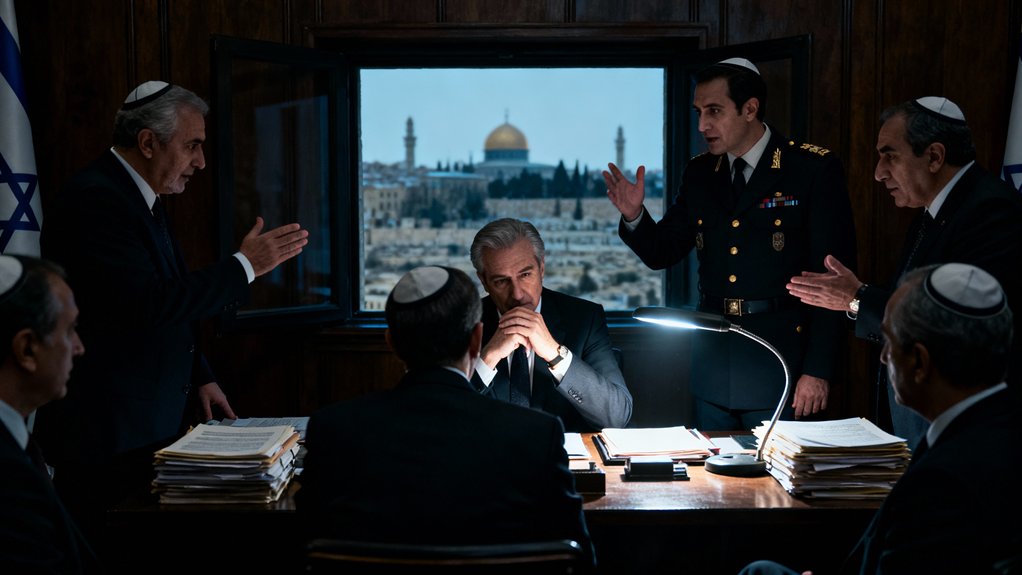
The most explosive question to emerge from Operation Susannah’s catastrophic failure was not how the spy ring was compromised, but who ordered the operation in the first place. Defense Minister Pinhas Lavon vehemently denied issuing authorization, while Intelligence Directorate chief Colonel Benjamin Gibli claimed verbal instruction from Lavon himself. This command responsibility dispute fractured Israel’s defense establishment.
| Position | Figure | Claim |
|---|---|---|
| Defense Minister | Pinhas Lavon | Denied all knowledge |
| Intelligence Chief | Benjamin Gibli | Received verbal orders from Lavon |
| Chief of Staff | Moshe Dayan | Blamed Defense Minister |
| Prime Minister | Moshe Sharett | Kept uninformed entirely |
The Olshan-Dori inquiry found no conclusive evidence either way. Later investigations revealed perjury and cleared Lavon, but David Ben-Gurion rejected these findings. This political cover-up ultimately destroyed careers and triggered governmental collapse. Following the unresolved controversy, Lavon resigned as Defense Minister in February 1955, marking the beginning of a leadership purge that would reshape Israeli military and political hierarchies.
How the Scandal Forced Mass Resignations in Israel’s Defense Ministry
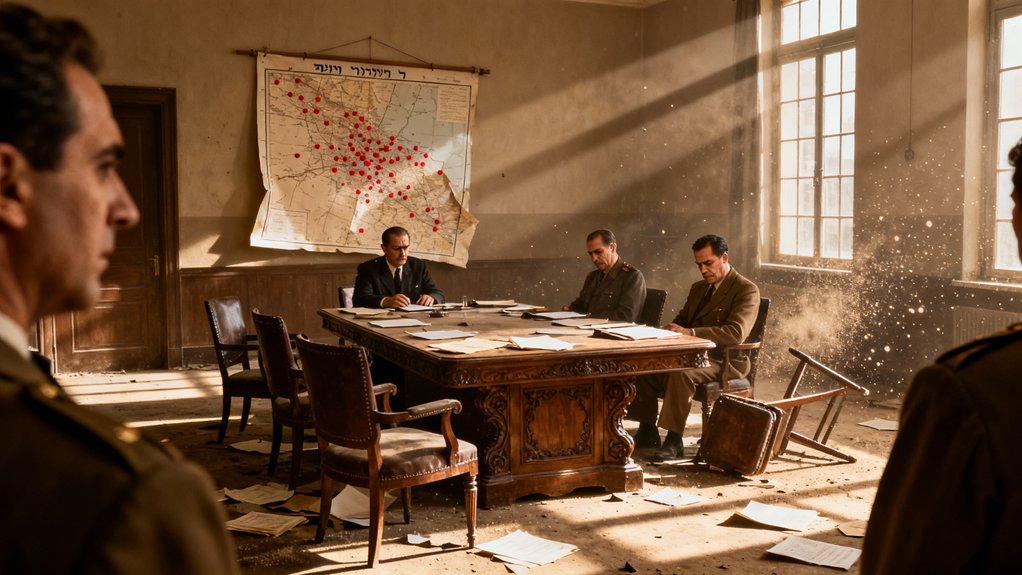
Inability to assign responsibility for Operation Susannah set off a cascading political crisis that consumed Israel’s defense establishment. The political fallout began when Defense Minister Pinhas Lavon resigned on February 17, 1955, after the Olshan-Dori board failed to prove he authorized the operation. Prime Minister Moshe Sharett, who had publicly denied Israel’s involvement, resigned November 3, 1955. David Ben-Gurion emerged from retirement to replace both men, consolidating power despite accusations of internal sabotage by subordinates who falsified testimony. The operation itself targeted Western installations in Egypt through a spy network of Egyptian Jews working to discredit the government.
Three defense leaders fell in succession as falsified testimony and finger-pointing over the botched Egyptian operation fractured Israel’s ruling coalition.
Key resignations that reshaped Israel’s government:
- Lavon forced out despite three inquiries clearing him of ordering the Egyptian bombings
- Ben-Gurion resigned January 31, 1961, rejecting Cabinet’s exoneration of Lavon
- Sharett removed after siding with officers who testified against Lavon
- Scandal triggered early Knesset elections, fracturing the ruling Mapai party
The 1960 Reinvestigation: Evidence of Perjury and Document Forgery
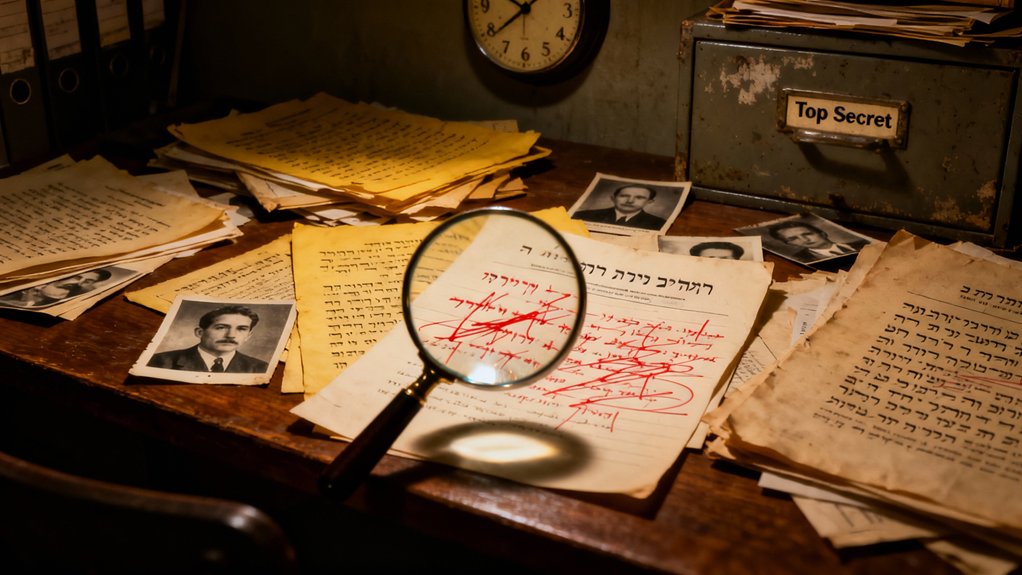
In April 1960, routine review of the 1954 inquiry minutes exposed cracks in testimony that had shaped Israel’s defense establishment for six years. Forensic analysis revealed fraudulent documentation embedded within Gibli’s original statements, while two senior officers were identified as delivering false testimony against Lavon. Avraham Elad, the agent who ran Operation Susannah, admitted perjury during the initial inquiry. Prime Minister Ben-Gurion, refusing to let the matter fade, ordered Supreme Court Justice Haim Cohn to investigate these revelations in September 1960. The Cohn Committee’s findings, published October 23, confirmed systematic deception and cleared Lavon entirely. Without witness immunity protections, the investigation exposed how institutional cover-ups had protected military intelligence leadership while destroying Lavon’s career.
The cover-up involved not just perjury, but the physical alteration of documents, including mimicking authentic signatures and backdating military correspondence to create a false chain of command that implicated lower-ranking officers while shielding the Defense Minister
How the Lavon Affair Damaged Israel’s Relations With Britain and America
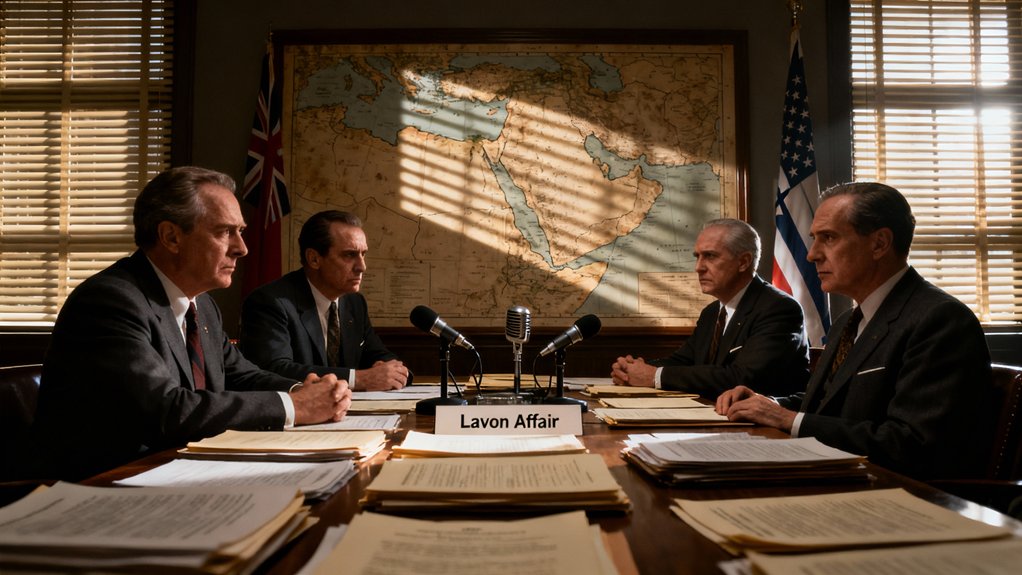
Discovery of Operation Susannah in July 1954 fractured Israel’s relationships with its two most critical Western allies at a moment when regional diplomacy hung in precarious balance. The revelation that Israeli agents had bombed American and British facilities in Egypt to fabricate terrorist incidents shattered years of carefully cultivated trust.
Immediate Consequences:
- Eisenhower administration’s outrage derailed indirect peace negotiations with Egypt
- British withdrawal from Suez Canal accelerated, eliminating Israel’s strategic buffer
- Covert targeting of allied installations demonstrated willingness to manipulate partners
- Years of denial followed by perjury deepened strategic mistrust across Western capitals
The affair triggered diplomatic isolation lasting two decades. Israel’s credibility collapsed as forged documents and contradictory testimonies emerged. Only in 2005 did official recognition of the agents end the charade.
From Intelligence Failure to Strategic Independence: The Affair’s Lasting Impact
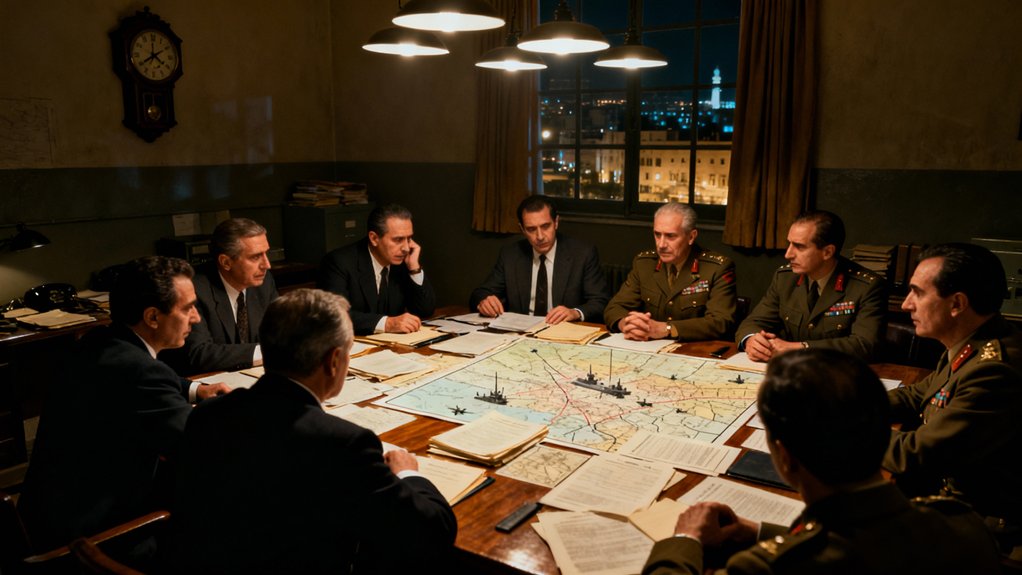
Catastrophic tradecraft failures transformed Operation Susannah from a covert action into a textbook case of intelligence incompetence. Philip Natanson’s premature bomb detonation at Alexandria’s Rio Theatre triggered arrests exposing the entire network. Operatives knew each other’s identities, enabling Egyptian police to dismantle the cell from Natanson’s apartment. Double agent Avraham Seidenwerg fed intelligence to Cairo while committing perjury during inquiries.
| Failure Point | Immediate Consequence | Institutional Reform |
|---|---|---|
| No capture protocols | Full confessions under interrogation | Mandatory handler training programs |
| Lavon bypassed Mossad | Aman operated without oversight | Restored Mossad jurisdiction over enemy operations |
| Ad-hoc Unit 131 deployment | Radio malfunctions exposed network | Professional operational security standards |
| Missing civilian controls | Military intelligence excesses | Ben-Gurion reinforced governmental authority |
This strategic reorganization ended reckless independence, establishing operational oversight preventing future disasters.
Frequently Asked Questions
What Happened to the Egyptian Jewish Community After the Lavon Affair?
The Egyptian Jewish community faced severe community backlash following the Lavon Affair, branded as “Zionist spies” and subjected to intensified suspicion by authorities. This persecution accelerated cultural erosion as families fled Egypt, particularly after 1967. The trial’s aftermath poisoned intercommunal relations, while remaining Jews endured systemic discrimination. Israeli government silence on their plight—prioritizing covert prisoner exchanges over public advocacy—left the community vulnerable, ultimately hastening an exodus that decimated centuries of Jewish presence in Egypt.
Did Any of the Imprisoned Operatives Eventually Return to Israel?
Yes. Following patient prisoner exchanges and persistent diplomatic negotiations through back-channel contacts, all surviving operatives secured family reunification in Israel by February 1968. Meir Amit’s meticulous Mossad mediation with Cairo freed Marcelle Ninio, Dror Dassa, Victor Levy, and Robert Natanzon after the Six-Day War. Earlier, Meir Meyuhas and Meir Zafran had completed shorter sentences. Despite their sacrifice, authorities denied them public recognition until decades later, forcing freedom-seeking patriots into quiet anonymity.
How Did Egyptian Intelligence Discover the Israeli Spy Ring?
Egyptian intelligence uncovered the network through multiple channels. Following the July bombings, clandestine surveillance tracked suspects’ movements and communications. Interrogators employed relentless pressure—threats and beatings—breaking operatives’ resistance. Azar’s confession proved decisive, exposing the Zionist cell’s structure. Cryptographic analysis of seized materials confirmed Israeli connections. Evidence suggests spymaster Avraham Seidenberg may have betrayed the network to Egyptian handlers, though this remains disputed. The rapid arrests demonstrated Egyptian counterintelligence effectiveness against foreign operations.
What Role Did Avri Elad Play in Exposing the Operation?
Elad’s betrayal remains murky—he recruited the network yet allegedly tipped Egyptian police about target arrivals, maintaining suspicious contact with intelligence chief Osman Nuri afterward. While never convicted as a double agent, intelligence veterans accused him of covert whistleblowing that doomed his operatives. The intelligence leak began in Cairo, where he escaped arrest but lingered conspicuously. His forged documents and perjury during trial suggested deeper complicity, though definitive proof of deliberate exposure eluded investigators, leaving his treachery suspected but unconfirmed.
Did Israel Officially Acknowledge Responsibility for the Bombings?
Israel denied responsibility for decades before gradually acknowledging involvement. Official admission came incrementally—a 1960 inquiry cleared Lavon without confirming state accountability, while March 1975 marked the first formal recognition that operatives received IDF training in Israel. Full state accountability emerged only in 2005, when Israel publicly honored the surviving bombers with military ranks and ceremonies, effectively admitting governmental authorization of the false-flag operation fifty years after Egyptian convictions.
Final Thoughts
In 1960, when investigators pried open Unit 131’s classified files, they discovered forged signatures on operational orders—ink still fresh on documents supposedly drafted six years prior. Like those fraudulent papers, the Lavon Affair itself became a palimpsest of Israel’s early statehood anxieties: beneath official denials lay exposed networks of deception that forced the young nation to choose between convenient deniability and institutional accountability. The scandal’s residue would shadow Israeli intelligence doctrine for generations, a cautionary archive locked in permanent classification.
References
- https://journals.sagepub.com/doi/abs/10.1177/0096340213493259
- https://archives.mod.gov.il/sites/English/Exhibitions/Pages/The-Lavon-affair.aspx
- https://www.scirp.org/journal/paperinformation?paperid=117347
- https://en.wikipedia.org/wiki/Lavon_Affair
- https://www.youtube.com/watch?v=xiE25bsLfg8
- https://cisac.fsi.stanford.edu/publications/the_lavon_affair_how_a_falseflag_operation_led_to_war_and_the_israeli_bomb
- https://study.com/academy/lesson/lavon-affair-overview-history-operation-susannah.html
- https://israeled.org/ben-gurion-resigns-lavon-affair/
- https://questdev.palestine-studies.org/en/overallchronology?&sideid=5822
- https://www.britannica.com/topic/Lavon-Affair