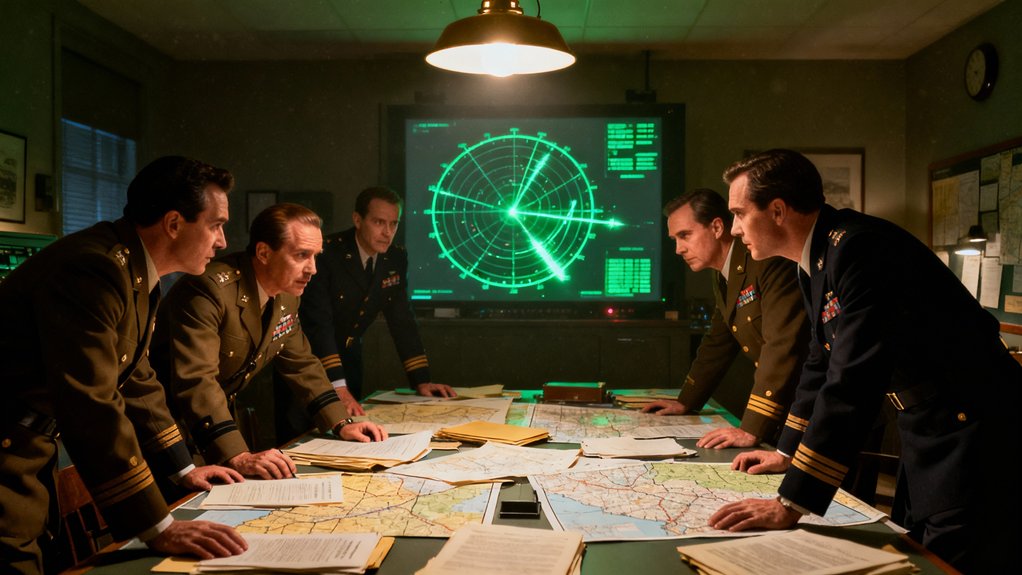
On the night of August 4, 1964, American destroyers in the Gulf of Tonkin reported a furious assault by North Vietnamese torpedo boats. Radar operators tracked incoming vessels. Sonar detected torpedoes in the water. The ships maneuvered violently, firing hundreds of rounds into the darkness. Within hours, President Johnson ordered retaliatory airstrikes against North Vietnam. Three days later, Congress granted him sweeping war powers. But the captain who commanded those destroyers had sent an urgent cable that same night, one Washington chose to ignore.
Key Takeaways
- The August 4, 1964 attack never occurred; NSA analysts falsified intelligence by withholding 90% of data and altering intercept times.
- Johnson administration concealed U.S.-backed South Vietnamese commando raids that preceded the August 2 engagement, falsely claiming unprovoked aggression.
- The Gulf of Tonkin Resolution passed in forty minutes, granting unlimited executive war authority based on fabricated reports and deliberate deception.
- NSA released documents in 2005 proving no North Vietnamese boats were present on August 4; sonar errors created false attack narrative.
- The resolution enabled Vietnam War escalation without formal declaration, providing legal basis for bombing campaigns and ground operations through 1971.
August 2, 1964: The First Gulf of Tonkin Incident
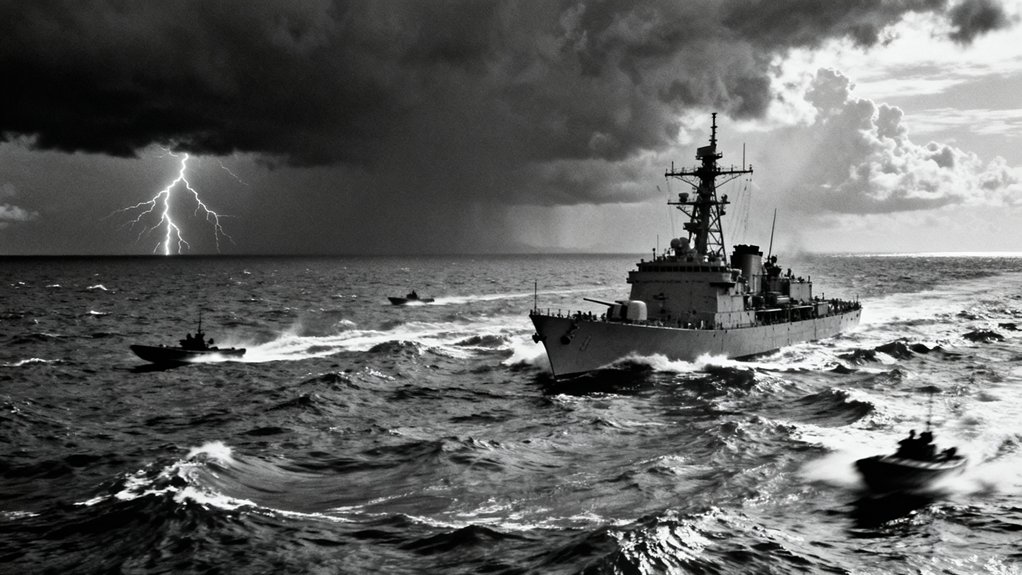
On August 2, 1964, the USS Maddox, a destroyer engaged in signals intelligence operations, prowled the waters of the Gulf of Tonkin mere miles from North Vietnam’s coastline. Three North Vietnamese torpedo boats approached the American vessel. The Maddox fired warning shots, escalating the naval provocation. The torpedo boats responded with torpedoes and machine gun fire. Aircraft from the USS Ticonderoga joined the firefight, damaging three enemy boats and killing four sailors. The Maddox withdrew with only a single bullet hole and no casualties.
Washington received word by August 3. Publicly, officials condemned the attack as unprovoked aggression. Privately, they acknowledged intelligence ambiguity surrounding US operations that may have triggered the confrontation. North Vietnam believed the Maddox had participated in prior raids on Hon Me and Hon Ngu islands conducted by South Vietnamese commandos just days earlier. Immediate retaliation was withheld, setting the stage for far more consequential claims two days later.
Why the Maddox Attack Wasn’t Actually Unprovoked?
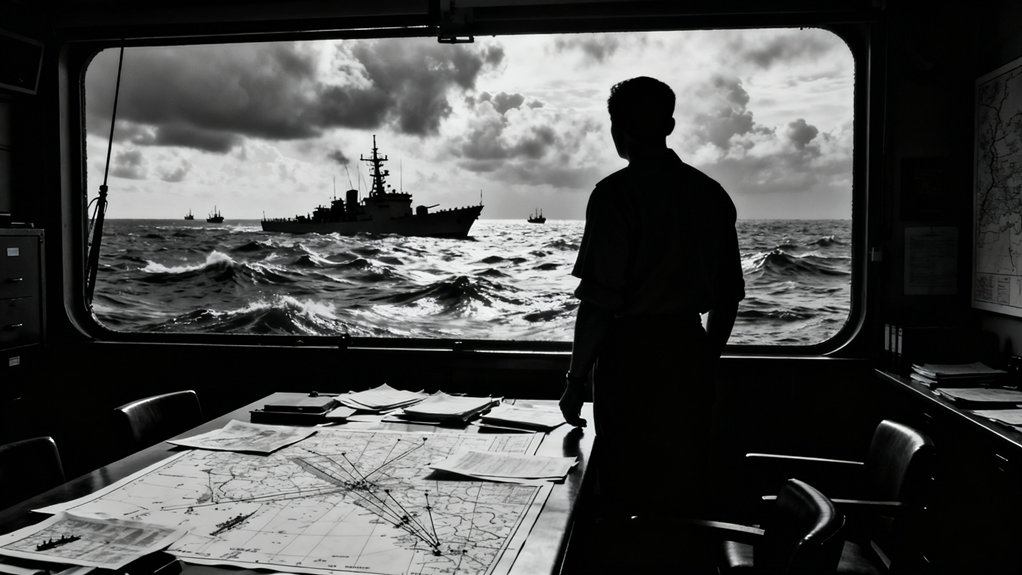
The Johnson administration publicly characterized the August 2 attack as unprovoked aggression, yet privately conceded that U.S.-backed South Vietnamese commando raids on Hon Me and Hon Ngu islands days earlier likely triggered North Vietnam’s response. The Maddox, equipped with intelligence-gathering specialists and positioned to support covert operations, appeared to North Vietnamese forces as part of the assault rather than an innocent bystander in international waters. Critical details about OPLAN 34A operations and the destroyer’s SIGINT mission remained concealed from Congress and the American public during the administration’s push for military authorization. Despite these troubling circumstances, the resolution passed with minimal debate and only two senators voting against it.
Warning Shots Fired First
What actually constitutes an unprovoked attack when a U.S. destroyer fires warning shots before hostile vessels open fire? The August 2, 1964 naval engagement reveals a key sequence: USS Maddox discharged three warning shots as North Vietnamese P-4 torpedo boats approached, then escalated to full weapons capability. The torpedo boats returned fire only after these initial discharges. This documented timeline contradicts the “unprovoked attack” narrative that justified military escalation. The Maddox had been conducting intelligence operations near Hon Mê island—shelled by South Vietnamese commandos just two nights earlier. Four North Vietnamese sailors died while the destroyer sustained merely a single bullet hole. The Americans fired first, transforming defensive posturing into offensive action that precipitated the very response later characterized as aggression. General Phùng Thế Tài later revealed that North Vietnamese forces had tracked the Maddox continuously since July 31, suggesting the destroyer’s movements were under surveillance well before the confrontation.
Covert Operations Provoked Response
Warning shots tell only part of the story—beneath surface-level engagement timelines lay covert operations that fundamentally altered what “unprovoked” meant. South Vietnamese commandos attacked Hon Me and Hon Ngu islands on July 30-31, just before the Maddox encounter. The destroyer wasn’t merely conducting routine patrols—it carried seventeen SIGINT specialists in an electronic eavesdropping mission supporting these raids. North Vietnamese forces viewed the Maddox as direct participant in coordinated American-South Vietnamese military action, not neutral observer. Intercepted communications revealed their planned response to perceived American involvement in the commando strikes. Torpedo boats dispatched after the raids encountered what appeared to be the intelligence platform enabling covert aggression. CIA Director John McCone assessed the attack as a defensive reaction to U.S.-backed OPLAN 34A raids. Strategic deception erased operational context from public understanding, transforming North Vietnam’s defensive response into unprovoked attack—the exact narrative manipulation needed for escalation.
Withheld Information From Public
Public statements about “routine patrol” concealed operational reality—the Maddox carried seventeen SIGINT specialists and communications intercept equipment specifically to monitor North Vietnamese military responses during South Vietnamese commando raids against coastal installations. This public deception transformed coordinated intelligence operations into innocent navigation exercises. Administration officials deliberately omitted the destroyer’s proximity to 34A raids when characterizing North Vietnamese torpedo boat approaches as unprovoked aggression. The hidden agendas extended beyond operational details: Secretary McNamara never informed President Johnson of Captain Herrick’s explicit doubts about the August 4 engagement, despite cables stating contacts were “doubtful” due to “freak weather effects.” NSA analysts later confirmed no attack occurred that night, yet congressional briefings portrayed certainty about two unprovoked assaults, securing authorization for military escalation through systematically withheld contradictory evidence. The Gulf of Tonkin Resolution passed with strong bipartisan support, granting the president broad authority to use military force without a formal declaration of war.
August 4, 1964: The Phantom Attack That Never Happened
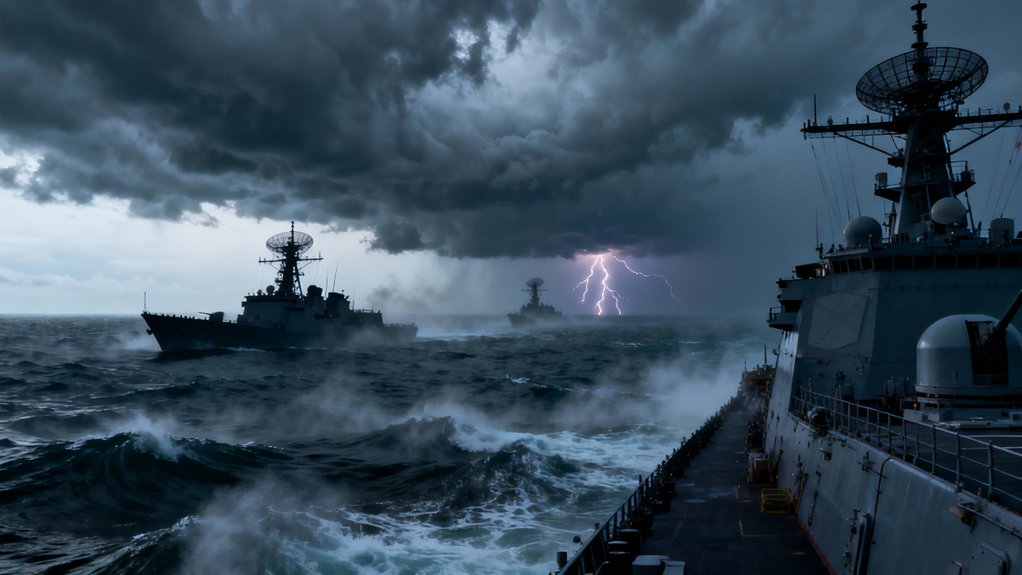
On the night of August 4, 1964, the destroyers Maddox and Turner Joy reported they were under attack from North Vietnamese torpedo boats—yet no such attack ever occurred. Captain John Herrick himself cabled his doubts about the incident’s validity within hours, warning his superiors that freak weather effects and overeager sonarmen likely explained the phantom contacts. Declassified documents would later expose a systematic campaign of deception: NSA analysts cherry-picked intercepts, altered receipt times, and withheld 90 percent of relevant intelligence to manufacture evidence of an attack that never happened. The Johnson administration publicly denied any U.S. provocation while privately acknowledging that covert South Vietnamese raids may have triggered the earlier August 2 incident.
Misinterpreted Intelligence Reports
How could seasoned naval crews and intelligence analysts mistake weather conditions and equipment malfunctions for a coordinated enemy assault? The answer lies in a perfect storm of weather anomalies and radar distortions that transformed routine signals into phantom threats.
| Source | Actual Content | Reported As |
|---|---|---|
| SIGINT intercepts | Salvage operations for August 2 damaged boats | Planned attack confirmation |
| Radar contacts | Six-foot waves and weather interference | Enemy vessel positions |
| Sonar readings | Equipment malfunction in stormy conditions | Incoming torpedo launches |
The NSA withheld ninety percent of relevant intelligence while inserting specious data into summaries. Intercepts received falsified timestamps. Cherry-picked evidence obscured reality. By 2002, the NSA definitively concluded: no attack occurred on August 4, 1964.
Captain Herrick’s Doubts Ignored
While Washington received distorted intelligence summaries, the commander on scene began questioning the very existence of an engagement. Captain John Herrick, commanding Destroyer Division 192 from USS Maddox, sent increasingly urgent messages disputing the August 4 attack. By early afternoon Washington time, he attributed reported contacts to “freak weather effects” on radar and signal errors from overeager sonarmen. His 0127 flash message was unambiguous: “Review of action makes many reported contacts and torpedoes fired appear doubtful.” No visual sightings confirmed enemy vessels. The command confusion deepened when Herrick proposed halting further action pending complete evaluation. His caution proved prophetic—1981 log reviews and the 2005 NSA study validated his skepticism. Yet Washington ignored these doubts, preferring manufactured certainty over battlefield truth. Herrick, who had served as commanding officer of a landing ship during the Korean War, understood naval combat conditions firsthand.
Declassified Evidence Reveals Truth
What really happened in the Gulf of Tonkin on August 4, 1964? Decades of secrecy ended when the NSA declassified over 140 top-secret documents between 2005 and 2007, exposing systematic SIGINT manipulation. Historian Robert Hanyok’s analysis proved devastating: nearly 90 percent of available intelligence was deliberately withheld, intercepts were altered to show false receipt times, and specious data was inserted into summary reports. The official NSA history confirmed the August 2 attack occurred but flatly stated the August 4 incident never happened. No second attack took place—only freak weather, misread radar, and overeager sonarmen chasing phantoms. This wholesale abandonment of intelligence integrity enabled Johnson and McNamara to deceive Congress, securing the Gulf of Tonkin Resolution through fabricated evidence and launching America’s longest war. Johnson used the incident to justify retaliatory air strikes against North Vietnamese targets and obtain Congressional authorization for military action.
Captain Herrick’s Doubts and Washington’s Certainty
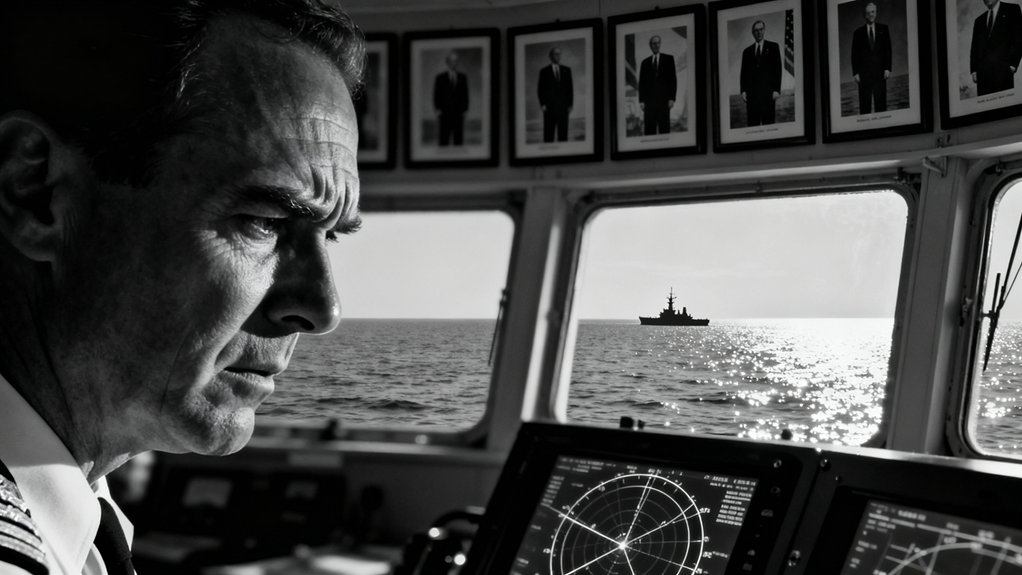
Within hours of reporting a sustained torpedo attack on his destroyers, Captain John Herrick began dismantling his own account. His 0127 flash message on August 5th declared most contacts and torpedoes “doubtful,” attributing reports to sonar anomalies and radar distortions caused by freak weather. Overeager operators had mistaken the Maddox’s own propeller echoes for enemy vessels.
Captain Herrick’s doubts arrived hours too late—Washington had already committed to retaliation based on phantom contacts and sonar ghosts.
Technical failures that manufactured a war:
- Sonar operators heard their ship’s screw reflecting off rudders during evasive turns
- Main gun directors couldn’t lock targets—radar was tracking wave tops
- Turner Joy detected zero torpedoes despite Maddox’s reports
- A noise spike at 6,000 yards was misidentified as incoming ordnance
Washington received Herrick’s doubts at 1327 on August 4th—after the Pentagon had already released attack details and promised retaliation. His concerns evaporated. Yet Herrick’s final message affirmed the original ambush was bonafide, acknowledging that despite the confusing technical details, the initial engagement with North Vietnamese forces had been genuine.
How Johnson and McNamara Sold Congress on Retaliation
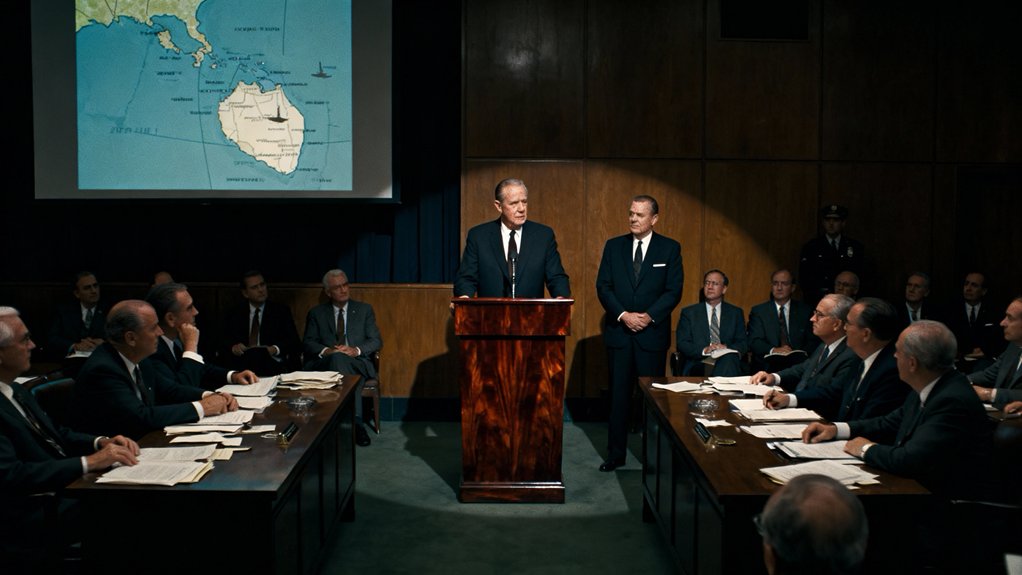
Even as Captain Herrick’s doubts circulated through classified channels, President Johnson appeared on national television at 11:36 PM on August 4 to announce retaliation for what he called “repeated acts of violence” on the high seas. McNamara testified before congressional committees two days later, characterizing both incidents as unprovoked aggression while concealing the covert OPLAN-34A operations that preceded them. Congress approved the Gulf of Tonkin Resolution on August 7 with near unanimity—no dissenting votes in the House and only two in the Senate—granting sweeping war powers based on an attack that may never have occurred. The resolution authorized the President to take all necessary measures to repel armed attack against U.S. forces and prevent further aggression, language that would later justify full-scale military involvement in Vietnam.
“Unequivocal Evidence” Claims Disputed
Deception formed the cornerstone of the Johnson administration’s case for military retaliation in August 1964. McNamara testified before Congress that signals intelligence supporting the August 4 attack was “unimpeachable,” employing strategic ambiguity to mask profound uncertainty. Behind closed doors, the Joint Chiefs scrambled to manufacture “clear and convincing” evidence that no attack had occurred. This political manipulation reached its apex when McNamara deliberately withheld critical doubts from President Johnson before authorizing retaliatory strikes.
The administration’s fabricated certainty included:
- Concealing reconnaissance missions that provoked North Vietnamese responses
- Inserting specious intelligence into NSA reports after the fact
- Suppressing cable traffic questioning whether destroyers faced genuine attack
- Misrepresenting routine patrols as innocent vessels subjected to unprovoked aggression
Congressional authorization followed swiftly, built entirely on manufactured threats.
Resolution Passed Within Days
Armed with fabricated certainty about an attack that likely never happened, the Johnson administration moved with startling speed to secure congressional authorization for war. Johnson submitted the Tonkin Gulf Resolution on August 5, 1964—a document drafted months earlier in June. The House approved it unanimously after just forty minutes of debate on August 7. That same day, the Senate voted 88-2 following three hours of discussion. Chairman Fulbright orchestrated this rapid legislative process, urging “prompt overwhelming endorsement” despite his staff’s incredulity at the haste. Bipartisan consensus prevailed amid election-year fears of appearing soft on communism. Only Senators Wayne Morse and Ernest Gruening dissented. Morse prophetically warned future generations would view Congress’s action as a historic mistake.
The Gulf of Tonkin Resolution Passes With Two Dissents
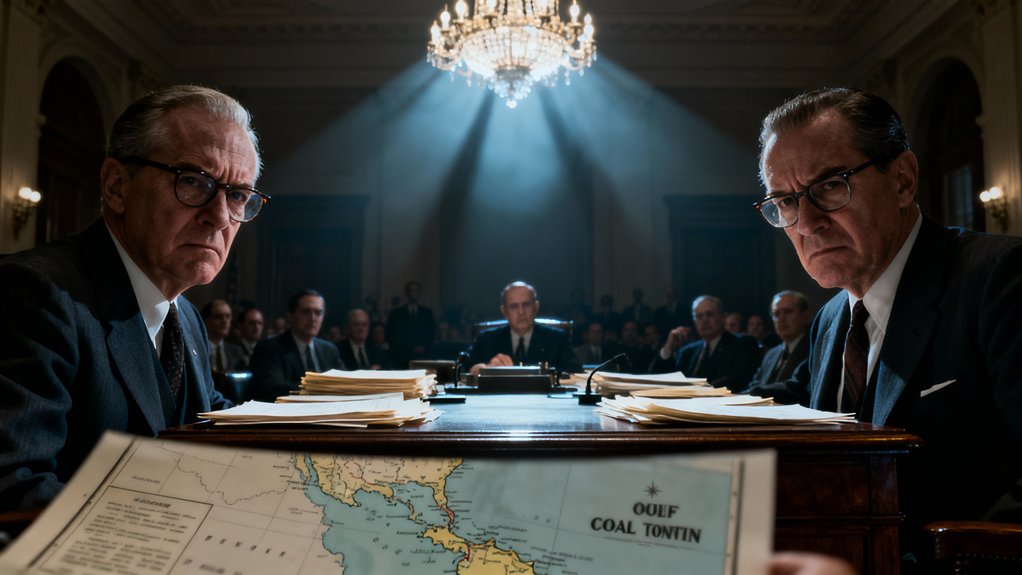
On August 7, 1964, the Senate voted 88-2 to approve the Gulf of Tonkin Resolution, granting President Johnson sweeping authority to use military force in Southeast Asia without a formal declaration of war. Only Wayne Morse of Oregon and Ernest Gruening of Alaska demonstrated political courage through Senate dissent, prophetically warning the vote would haunt future generations. The House capitulated unanimously.
Key Elements of the Rushed Vote:
- J. William Fulbright shepherded the resolution through minimal debate—a stark contrast to prior 13-day deliberations on Middle East resolutions
- Politicians feared appearing “soft on communism” before the November Johnson-Goldwater election
- McNamara reported favorable congressional mood after providing misleading testimony about the alleged attacks
- Congress later rescinded the resolution in June 1970, acknowledging the deception that enabled catastrophic escalation
Johnson’s Blank Check: What the Resolution Actually Authorized
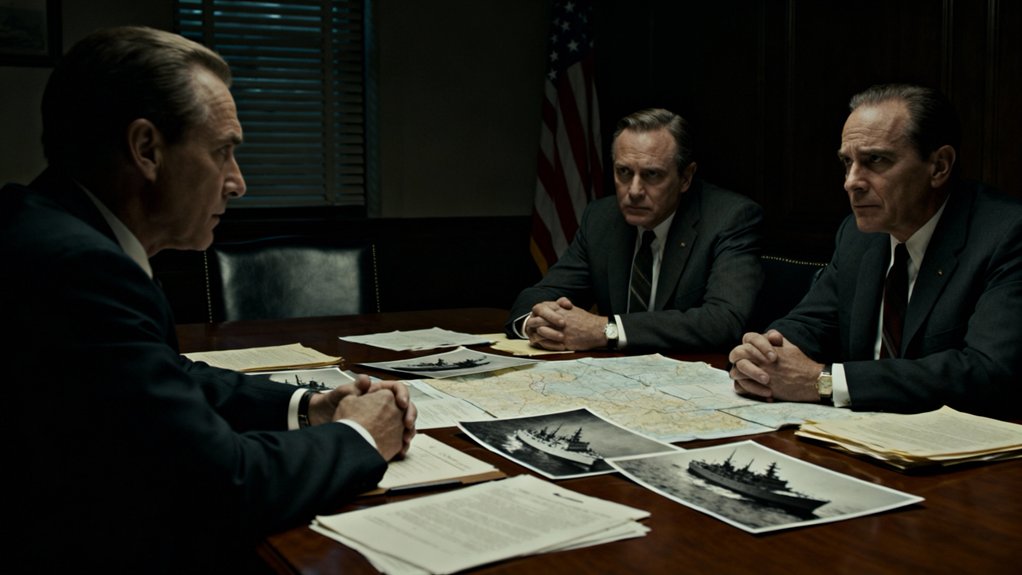
The resolution Johnson signed on August 10, 1964, granted him authority so sweeping that he later boasted it covered “everything, just like grandma’s nightshirt.” Its deceptively brief text—fewer than 300 words—authorized the President “to take all necessary measures to repel any armed attack against the forces of the United States and to prevent further aggression” in Southeast Asia. This constitutional overreach contained no time limits, geographic boundaries, or requirements for further congressional approval. The President alone would determine when “peace and security” had been achieved. Johnson transformed this blank check into a carte blanche charter for escalation, deploying conventional military forces without formal war declaration. The resolution concentrated unprecedented executive authority in the White House, enabling both Johnson and later Nixon to wage an undeclared war.
How the Gulf of Tonkin Resolution Justified the Vietnam War
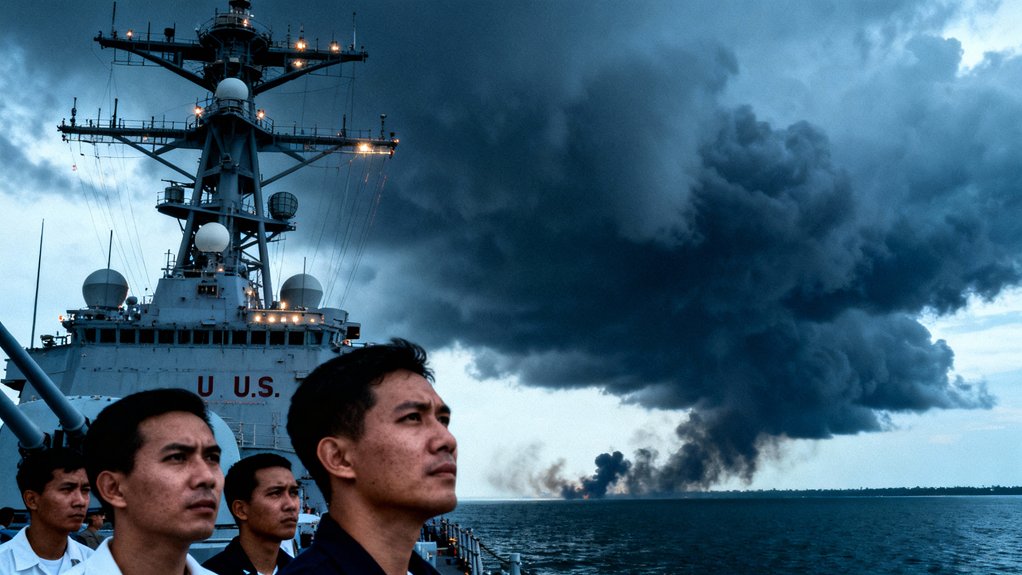
Within hours of receiving reports about the alleged second attack in the Gulf of Tonkin, Johnson appeared before Congress with a request that would fundamentally alter American foreign policy for the next decade. The resolution granted sweeping executive authority that bypassed constitutional war-making requirements entirely.
Johnson’s Gulf of Tonkin resolution bypassed constitutional war-making requirements, granting sweeping executive authority that would reshape American foreign policy for years.
This constitutional overreach manifested through:
- Unlimited military deployment – enabling troop escalations from hundreds to over 500,000 without congressional approval
- Operation Rolling Thunder authorization – launching sustained bombing campaigns across North Vietnam beginning April 1965
- Search-and-destroy mission approval – justifying offensive ground operations far beyond defensive posturing
- Decade-long war conduct – providing legal cover for two administrations’ military policies through 1971
Johnson himself acknowledged the resolution’s breadth, comparing it to “Grandma’s nightshirt”—covering everything. No formal war declaration was ever required.
1971: The Pentagon Papers Expose the Deception
Daniel Ellsberg’s unauthorized release of 7,000 pages of classified documents in 1971 tore away the veil concealing a quarter-century of systematic government deception about Vietnam. The Pentagon Papers documented how successive administrations deliberately misled Congress and the American public, presenting optimistic narratives while internal assessments painted grim realities. McNamara’s own commissioned study revealed planners had decided on escalation before seeking congressional authorization—hidden agendas masked by democratic theater. Most damning were the Gulf of Tonkin revelations: officials publicly denied knowledge of South Vietnamese naval raids they themselves commanded. The systemic deception extended to intelligence manipulation, with 90 percent of conflicting NSA intercepts suppressed, altered, or fabricated. Some signals were falsified entirely to justify retaliatory strikes, transforming questionable incidents into manufactured pretexts for war.
NSA Records Confirm No Second Attack Ever Occurred
Four decades after the alleged incident, the National Security Agency shattered its own mythology. On December 6, 2005, the NSA released long-secret documents proving intelligence officers deliberately skewed evidence to fabricate a North Vietnamese attack on August 4, 1964. Historian Robert J. Hanyok’s findings exposed systematic historical revisionism that violated basic intelligence ethics.
NSA documents proved intelligence officers deliberately fabricated the August 4, 1964 attack through systematic evidence manipulation and historical revisionism.
Key revelations included:
- No North Vietnamese boats were present during the reported attack
- Fifteen specious SIGINT reports were inserted to sustain the false narrative
- Only information supporting the attack claim reached Johnson administration officials
- Rough weather caused radar and sonar misinterpretations that officers knew contradicted reality
The 2002 NSA report confirmed what commanders suspected immediately: freak weather and overeager sonarmen created phantom enemies, while analysts suppressed contradictory evidence.
What the Gulf of Tonkin Lie Reveals About War Powers
The Gulf of Tonkin deception exposed fundamental vulnerabilities in America’s constitutional architecture for controlling war-making power. McNamara’s intentional distortion of intelligence prevented Congress from exercising civilian control over military deployment—a cornerstone of democratic governance. The resulting resolution granted Johnson discretionary authority to “take all necessary measures,” language so broad Johnson compared it to “Grandma’s nightshirt” covering “everything.” This constitutional erosion allowed both Johnson and Nixon to wage sustained warfare without separate congressional declarations, establishing precedent for executive overreach that would persist for decades. Congress approved the measure believing it authorized retaliation for unprovoked aggression, not comprehending they were surrendering their war-making responsibility. The deception revealed how easily fabricated threats could bypass constitutional checks and balances entirely.
Frequently Asked Questions
Who Were the Two Senators That Voted Against the Gulf of Tonkin Resolution?
Wayne Morse of Oregon and Ernest Gruening of Alaska cast the lone Senate dissent against the Gulf of Tonkin Resolution on August 7, 1964, defying an 88-2 vote that granted sweeping war powers to President Johnson. Their political courage proved prophetic as the resolution’s deceptive premise—fabricated attacks on U.S. vessels—unraveled. Both senators recognized the constitutional surrender masked within the resolution’s language, warning against an unchecked presidential blank check for war.
What Specific Covert Operations Provoked North Vietnam Before August 2?
Playing with fire along North Vietnam’s coast, covert raids under OPLAN 34A directly preceded the August 2 incident. U.S.-backed South Vietnamese commandos executed naval provocations including the July 30-31 shelling of Hon Me Island and August 2 village bombings. These CIA-trained forces targeted radar installations, bridges, and military positions using Norwegian patrol boats. The operations, transferred to MACV-SOG control, deliberately antagonized North Vietnamese defenses while USS Maddox gathered intelligence nearby—a calculated escalation U.S. officials later privately acknowledged as provocative.
Did Robert Mcnamara Ever Admit He Misled Congress About the Attacks?
McNamara partially acknowledged deceiving Congress, admitting in interviews he answered “yes and no” when asked if legislators were misled about the Tonkin Gulf Resolution. However, this equivocation demonstrates limited moral accountability. While conceding in 1968 that the Maddox operated near covert raids—contradicting his 1964 testimony claiming no connection—he simultaneously insisted essential facts remained unchanged, exemplifying historical revisionism that obscured his deliberate manipulation of intelligence to justify war expansion.
How Many American Troops Were Deployed to Vietnam Following the Resolution?
Following the resolution, troop escalation transformed America’s military commitment from 23,000 advisors into a massive ground war. By 1965, deployment surged to 184,300 troops. The numbers climbed relentlessly: 385,300 in 1966, 485,600 in 1967, peaking at 536,100 in 1968. By April 1969, 543,000 American personnel occupied Vietnam—a staggering twentyfold increase built upon Congressional authorization secured through deception, binding millions to a conflict whose foundational justification remained fundamentally compromised.
Were Any Officials Prosecuted for Deceiving Congress About the Second Attack?
No officials faced prosecution for deceiving Congress about the phantom second attack. Despite declassified NSA documents confirming McNamara’s falsified intelligence and withheld doubts from Captain Herrick, legal accountability never materialized. The 1968 Senate hearings exposed deliberate misrepresentations that violated congressional trust, yet recommended no charges. Even Hanyok’s 2001 report documenting systematic distortions produced zero indictments. The architects of this deception escaped consequences while sending thousands to die based on fabricated provocations.
Final Thoughts
The phantom blips that never were. The intercepts selectively edited. The commander’s frantic cables urging restraint, buried beneath manufactured certainty. In Gulf of Tonkin’s dark waters, truth drowned while Congress surrendered its constitutional authority, handing one man unchecked power to wage undeclared war. Fifty-eight thousand American names carved into black granite. Millions of Vietnamese dead. All launched on intelligence officials knew was false. The question lingers: how many wars since have begun the same way?
References
- https://www.usni.org/magazines/naval-history-magazine/2008/february/truth-about-tonkin
- https://www.ebsco.com/research-starters/history/analysis-gulf-tonkin-incident
- https://www.britannica.com/event/Gulf-of-Tonkin-incident
- https://en.wikipedia.org/wiki/Gulf_of_Tonkin_incident
- https://www.zinnedproject.org/news/tdih/gulf-of-tonkin/
- https://millercenter.org/the-presidency/educational-resources/tonkin-gulf
- https://www.nsa.gov/portals/75/documents/news-features/declassified-documents/gulf-of-tonkin/articles/release-1/rel1_skunks_bogies.pdf
- https://www.archives.gov/milestone-documents/tonkin-gulf-resolution
- https://www.history.navy.mil/research/library/online-reading-room/title-list-alphabetically/t/tonkin-gulf-crisis/gulf-tonkin-1964-incidents.html
- https://www.ebsco.com/research-starters/military-history-and-science/gulf-tonkin-incident