On April 16, 1985, Aldrich Ames fed a single envelope through a Washington mail slot, handing the KGB the CIA’s entire Soviet roster. Directorate K swiftly cross-referenced his names, executing assets like Adolf Tolkachev within weeks. The KGB then fabricated reports for 18 months, forcing Langley to chase ghosts. Ames’s betrayal didn’t just shatter spy networks—it dismantled trust itself. The full scope of this purge reveals even darker turns.
Key Takeaways
- Ames delivered names of all CIA assets in the USSR in June 1985, triggering immediate executions.
- He provided real names and locations, enabling KGB ambushes on top assets like Tolkachev and Polyakov.
- KGB analysts decrypted unredacted CIA briefings, revealing entire European station operational blueprints.
- The KGB ran a global deception campaign, “Operation Maskirovka,” to hide Ames as the source.
- Ames’s betrayal caused a decapitation loss of the CIA’s most embedded Soviet assets by 1986.
April 16, 1985: A Manilla Envelope Breaches 1125 16th Street NW
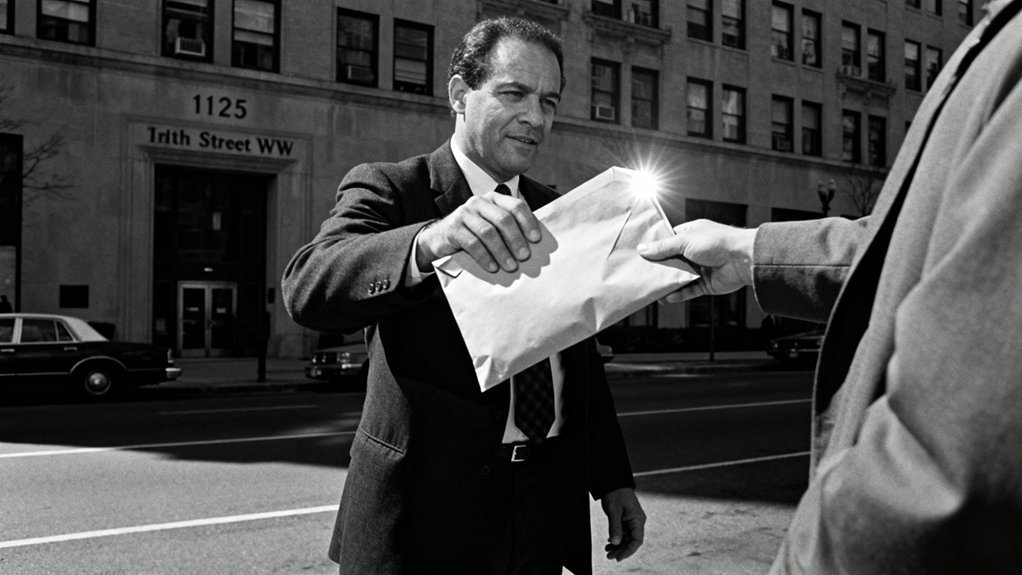
Although the KGB had long cultivated assets within Western intelligence, it wasn’t until April 16, 1985, that a single manila envelope, slipped through the mail slot at 1125 16th Street NW in Washington, D.C., handed them the keys to the kingdom.
Inside, Aldrich Ames detailed the CIA’s most sensitive Soviet sources—names, operational locations, and recruitment methods. This wasn’t a casual betrayal; it was a systematic offering.
The KGB’s Directorate K immediately recognized the windfall. They decided KGB operational mechanics must pivot, shifting from passive counterintelligence to active exploitation.
For an audience yearning to understand how a single traitor collapsed an empire’s secrets, here’s the grim truth: Ames gave them the map, and they burned every bridge.
The aldrich ames kgb espionage campaign began not with a whisper, but with a typed list—and the liberation of those networks became a nightmare of exposure.
Viktor Cherkashin and the Directorate K Assessment of a Golden Walk-In
Directorate K didn’t accept Ames’s intelligence on faith alone; they rigorously verified his access and claims through their own counterintelligence channels.
They cross-referenced his operational details against compartmented knowledge, confirming he possessed authentic secrets before authorizing the fifty-thousand-dollar down payment.
Viktor Cherkashin then received the green light to formally recruit this golden walk-in, setting the stage for a devastating breach of U.S. networks.
Directorate K’s Initial Verification Protocols for the Washington Source
When Viktor Cherkashin first received word from Aldrich Ames in 1985, Directorate K didn’t just accept the golden walk-in at face value. They deployed rigorous verification protocols, cross-referencing Ames’s initial disclosures against known compromised CIA Soviet assets.
The declassified KGB operational mechanics reveal a meticulous process: they demanded specific operational details, not just names. Cherkashin’s team scrutinized every file, ensuring Ames’s intelligence matched their own surveillance data.
They sought confirmation of betrayals from within their own ranks, a liberation from doubt. Only after this painstaking vetting did Directorate K begin to trust the windfall, knowing a single misstep could unravel their entire purge.
Authorizing the Fifty-Thousand Dollar Down Payment
Once Viktor Cherkashin verified the KGB had a genuine traitor inside the CIA, he didn’t hesitate.
The Directorate K counterintelligence chief understood that securing Ames required immediate, tangible commitment. Authorizing fifty thousand dollars as a down payment wasn’t a gamble; it was a calculated investment. Cherkashin bypassed bureaucratic delays, wiring the cash through dead drops. He knew from the Aldrich Ames declassified files that such a sum would bind the source tighter than any oath. This wasn’t a bribe; it was a lifeline from a patron who demanded loyalty.
For those seeking liberation from oppressive secrecy, the payment marks the moment the KGB’s exploitation truly began—a golden walk-in bought with cold, deliberate currency.
The June 13 Chadwick’s Handover: Liquidating the CIA’s Moscow Roster
Because the KGB demanded immediate results from Ames’s intelligence, the June 13, 1985 handover—known within the CIA as “Chadwick’s”—became the operation’s tipping point. Ames handed over a stack of documents that named every CIA asset inside the Soviet Union. This wasn’t just a leak; it was a liquidation order.
The KGB’s Directorate K immediately initiated soviet network exploitation, cross-referencing Ames’s list with their own surveillance files. They didn’t hesitate. The compromised asset executions began within weeks. Agents vanished. Safe houses sat empty. The CIA’s Moscow roster—painstakingly built over years—collapsed overnight. Each name on that paper represented a human life, a network, a promise broken.
The KGB treated the handover as a surgical strike, not a fishing expedition. They targeted known assets with precision, ensuring no one escaped. Chadwick’s didn’t just betray secrets; it forced the CIA to confront a brutal truth: their own man had handed over the keys to the kingdom.
Yasenevo’s Midnight Triage: Directorate K and Directorate T Digest the Motherlode
That night, the KGB’s analysts faced the grim task of decrypting seven pounds of unredacted Langley briefings.
Directorate T wasted no time, immediately exploiting the compromised United States telecom architecture Ames had exposed.
This motherlode of raw intelligence promised to sever the CIA’s direct lines to its most valuable assets.
Decrypting Seven Pounds of Unredacted Langley Briefings
As the clock neared midnight inside Yasenevo’s secure analysis wing, Directorate K and Directorate T operatives huddled over what KGB archivists would later describe as seven pounds of raw, unredacted Langley briefings—a haul that didn’t just spill names, but handed over the entire operational blueprint of CIA stations across Europe and the Soviet bloc.
They didn’t skim; they decrypted layers of tradecraft, cross-referencing agent codenames against surveillance logs.
Directorate T operations at Moscow KGB headquarters now possessed the precise timelines of CIA technical operations, from dead-drop schedules to encrypted frequency shifts.
Each page revealed a station’s vulnerabilities, allowing them to map CIA’s human and signals intelligence web without guesswork.
This wasn’t mere theft; it was liberation from Langley’s shadow, granting Yasenevo the raw power to dismantle decades of American penetration in a single night’s work.
Directorate T’s Exploitation of Compromised United States Telecom Architecture
While Directorate K focused on the human assets, Directorate T operatives at Yasenevo turned their attention to the compromised United States telecom architecture, a rich storehouse of signal intelligence buried within the seven pounds of briefings. They mapped Langley’s trunk lines, switching hubs, and satellite relays, exploiting every vulnerability to intercept traffic. This wasn’t just theft; it was a systematic hijacking.
The CIA mole tactical fallout cascaded, as agents couldn’t trust their own circuits. The KGB’s technicians listened in real-time, dismantling late-cold war intelligence parity. Every secure call became a gamble; every encrypted message, a trap. The telecom architecture, once a fortress, became a sieve, bleeding secrets directly to Yasenevo’s midnight triage. Liberation for their network remained a distant, bleeding hope.
Operation Maskirovka: Engineering a Global Deception to Insulate the Washington Source

When the KGB first received Aldrich Ames‘ revelations about a gemstone of a US intelligence asset—a Soviet general feeding technical secrets to the CIA—Directorate K didn’t just clamp down locally.
They engineered a global deception, codenamed Operation Maskirovka, to insulate their Washington source.
They knew any sudden, targeted arrests would scream “mole leak.”
So, they orchestrated a widespread kgb counterintelligence purge across Eastern Bloc stations, sweeping up low-level agents and fabricating defector stories.
This smokescreen made the soviet double agent compromises appear routine, part of a broader security crackdown rather than a direct response to Ames’ tips.
By feeding disinformation about unrelated double-agent penetrations, they convinced CIA counterintelligence that Moscow’s moves were systemic, not sourced.
This allowed Ames to keep working undetected, his value shielded by a continent-wide stagecraft that fooled Langley into believing their golden asset was still safe.
Eradicating Langley’s Crown Jewels: The Targeted Seizures of Tolkachev and Polyakov
The KGB’s strike team didn’t hesitate; they ambushed Adolf Tolkachev on a Moscow highway in June 1985, snatching the man the CIA considered its “billion-dollar spy.”
By July 1986, they’d dismantled another crown jewel, seizing Major General Dmitri Polyakov, a source who’d fed Langley Soviet military secrets for decades.
Ames’ precise disclosures transformed both men from protected assets into isolated targets, directly handed over for capture.
June 1985: The Highway Ambush of the Billion-Dollar Spy
Because Directorate K operated strictly on verifiable locations and real names, their blueprint for the June 1985 ambushes was already drawn before Ames ever left a Washington restaurant.
They knew precisely where to find Adolf Tolkachev, the CIA’s billion-dollar source inside the Soviet military-industrial complex. On a Moscow highway, KGB officers swarmed his car, seizing him without a struggle. This strike didn’t just burn one asset; it tore a gaping hole in the entire U.S. intelligence architecture. The First Chief Directorate had finally silenced the man who handed Langley the keys to Soviet air defense and stealth technology. For an audience craving liberation from oppression, the message was stark: the moment a source’s true identity reaches a hostile authority, their freedom—and often their life—evaporates instantly.
July 1986: Dismantling Major General Dmitri Polyakov
As Directorate K’s blueprint extended beyond Tolkachev, their next target was already locked—Major General Dmitri Polyakov, the CIA’s most deeply embedded asset in Soviet military intelligence.
For decades, this man had fed Washington the Kremlin’s toughest secrets, betraying the GRU from within. Ames‘s simple confirmation—his true name, his operational history—unlocked him. Directorate K didn’t hesitate. They meticulously tracked his decades of service, cataloging every transaction.
By July 1986, they’d assembled an airtight case. They didn’t arrest him; they dismantled him slowly. The KGB isolated Polyakov, then closed in.
For the CIA, losing him wasn’t just a loss—it was a decapitation. Langley‘s crown jewels were eradicated, and the parity of intelligence power tipped irrevocably toward Moscow.
The Exfiltration of Oleg Gordievsky: A Singular Failure in the 1985 KGB Dragnet

Despite the KGB’s methodical dragnet of 1985—which had successfully rolled up nearly every compromised CIA asset Aldrich Ames had betrayed—one key target slipped through their fingers. Oleg Gordievsky, the KGB’s own London rezident, was a double agent of extraordinary value.
The Centers suspect finally crystallized, and Moscow recalled him, planning a lethal interrogation. But the British, tipped by a defector, moved first.
The Centre’s suspicion hardened into a death sentence, but London’s defector moved first.
- The sheer terror of a man watching his own service close in.
- The desperate gamble of a midnight exfiltration across the Finnish border.
- The silent prayer of a handler burning all traces of a mission.
- The bitter taste of a KGB triumph forever incomplete.
They didn’t catch him. The Soviets executed a textbook liquidation campaign, but Gordievsky’s escape was their one profound failure.
A single, irreplaceable asset vanished, leaving a hole in their victory that no amount of interrogations could fill.
Lefortovo Prison and the Systematic Liquidation of Compromised Assets
While Gordievsky vanished into the British night, the KGB’s Directorate K turned its full, cold efficiency toward those who remained. Lefortovo Prison became the grim terminus for a generation of compromised assets. Investigators didn’t just interrogate; they systemically liquidated entire networks. They extracted every name, every safe house, every dead drop from men broken in its soundproofed cells.
The KGB didn’t waste time on show trials for these assets. They knew the Americans couldn’t save them. Instead, Directorate K orchestrated a silent purge. A quick bullet to the back of the head in a basement execution room ended Dmitri Polyakov. A staged “car accident” erased another source. Families received no explanations, only black bags.
The prison’s walls absorbed the screams of men who’d trusted the wrong handler. This wasn’t justice; it was methodical extermination. The KGB understood that a compromised asset is a weapon turned backward. They simply unloaded them.
Weaponizing the Dead: Feeding Langley 18 Months of Fabricated Disinformation
The KGB didn’t just kill the network; it resurrected the ghosts. For 18 months, it pumped fabricated reports through dead agents’ channels, maintaining the illusion that CIA’s prized human assets still breathed.
This masterpiece of disinformation exploited the Agency’s bureaucratic inertia and its blind denial that the entire network had already been liquidated.
Maintaining the Illusion of Active Human Intelligence Networks
Once KGB Directorate K and T finished culling Ames’s verifiable network of real names and locations, they faced a glaring tactical problem: the U.S. side would eventually notice those assets had gone silent, dead, or arrested. To sustain the illusion, they weaponized the dead.
They crafted reports from vanished agents, simulating active human intelligence networks for eighteen months. This disinformation campaign did the following:
- It forced Langley to chase ghosts, wasting resources on fabricated leads.
- It deepened the Agency’s denial, masking the purge’s scale.
- It paralyzed counterintelligence, as analysts trusted tainted data.
- It prolonged the betrayal, allowing Ames to remain undetected.
The KGB’s deception liberated them from detection, while the U.S. remained trapped in a fabricated reality of their own making.
Exploiting United States Bureaucratic Inertia and Blind Denial
Because Langley’s bureaucracy operated on confirmation bias and procedural inertia, the KGB didn’t just kill U.S. networks—they resurrected them as puppets.
For eighteen months, Directorate K weaponized dead assets. They fed fabricated reports through compromised channels, exploiting Ames’ access to sustain the illusion of live networks. Agency analysts, blinded by denial, refused to question the sudden flow of disinformation. They’d rather trust a rotting system than admit a mole existed. The KGB exploited this deeply: they polluted CIA assessments with false data, steering operations toward Soviet traps. Langley’s fear of accountability became its leash. Liberation demands understanding this—how bureaucratic cowardice turned a counterintelligence disaster into a tool for the enemy’s deception.
Laundering the Blood Money: Structuring 4.6 Million Dollars Through Covert Dead Drops
Although the KGB’s Directorate K prioritized intelligence extraction, they faced a more mundane yet critical problem: how to securely funnel $4.6 million in cash payments to their star asset without triggering U.S. financial surveillance.
Their solution? A brutal, low-tech network of dead drops—park benches, restroom stalls, and suburban mailboxes—where Ames would collect stacks of hundred-dollar bills wrapped in paper.
The KGB structured each payment to stay beneath the $10,000 bank reporting threshold, deliberately avoiding any electronic trail. This wasn’t just operational security; it was a calculated insult to the system.
- Each envelope represented a U.S. asset’s betrayal, paid in currency that could never be traced back to its source.
- The cash bought Ames’ loyalty, but it also bought the quiet dismantling of entire spy networks.
- Ames’ own CIA salary never topped $70,000; the KGB gave him seventy times that, in secret drops.
- The money didn’t just fund a traitor’s life—it financed the systematic death of American intelligence operations.
The February 1994 Takedown: Yasenevo’s Internal Shock at the Arlington Arrest

The KGB’s Directorate K had perfected the art of the invisible handoff, but no amount of dead-drop discipline could shield them from the shockwave that hit Yasenevo on February 21, 1994. That morning, encrypted cables from Rezidentura Washington flashed a single, horrifying message: FBI agents had cuffed Aldrich Ames outside his Arlington Jaguar.
Inside Yasenevo’s concrete nerve center, officers froze mid-stride. They’d watched Ames launder millions through phantom accounts, never questioning his loyalty. Now, the Bureau’s takedown meant one thing—the entire U.S. network they’d systematically exploited was compromised. Directorate K’s analysts scrambled, burning files and severing contact lines, but the damage was already done. They hadn’t just lost a spy; they’d lost the keys to the kingdom. The shock wasn’t fear of exposure. It was the crushing realization that their invisible war now had a visible grave—dug in Arlington, where the false god of operational security finally crumbled.
Zero Parity: The Irreversible Dismantling of Late-Cold War United States Intelligence
Once the shock of Ames’s arrest settled, Directorate K‘s analysts realized the full, unthinkable scope of the damage—they’d achieved a zero-sum victory. Every compromised asset, every hollowed-out network, every silenced source now formed a single, irreversible equation: parity reduced to zero. The KGB hand’t just stolen secrets; they’d systematically dismantled the very architecture of U.S. intelligence from within, leaving nothing to rebuild.
- You’d trusted your own, yet that trust betrayed a generation of operations to the void.
- You’d guarded names and locations, but those names now lie in unmarked graves, silenced by your own.
- You’d believed in compartmented security, yet the KGB had the master key to every locked room.
- You’d fought for a free world, only to learn the enemy already held the map to its undoing.
This wasn’t a loss of secrets. It was a surgical amputation of America’s intelligence future. Liberation now demands you confront the depth of that dismantling, not for vengeance, but for clarity.
Frequently Asked Questions
What Did the Manilla Envelope Contain Besides Ames’ Classified Documents?
Like a skeleton key for a locked vault, the manila envelope held more than Ames’ classified documents. It contained detailed operational notes—real names, verified locations, and declassified files—handing the KGB a roadmap to dismantle U.S. networks. This wasn’t just intelligence; it was a liberation from uncertainty, a systematic guide to exploit every compromised link, altering the balance of power with surgical precision.
How Did Directorate K Verify Ames’ Claims so Quickly in 1985?
Directorate K verified Ames’ claims in 1985 by cross-referencing his specific operational details—real names, locations, and file numbers—against their own declassified intelligence.
They didn’t need lengthy analysis; his leaks matched active surveillance data, confirming his access instantly.
This rapid confirmation allowed them to swiftly exploit compromised networks, shifting late-Cold War intelligence parity before the CIA even suspected a mole.
Why Did the KGB Choose Liquid Assets Over Diamonds for Payments?
The KGB’s accountants preferred liquid assets because they don’t sparkle under a traitor’s lamp. Diamonds require cumbersome appraisal and traceable markets, while cash flows invisibly through Swiss accounts.
They’d learned from past moles that jewels attract suspicion; a suitcase of untraceable bills buys freedom faster than a crown. It’s a simpler tool for a liberation that comes with betrayal.
Was Gordievsky’s Exfiltration Deliberately Allowed by Yasenevo?
No, Yasenevo didn’t deliberately allow Gordievsky’s exfiltration. The KGB’s Directorate K, blindsided by Ames’ disclosures, moved too slowly.
They surveilled him but lacked the operational stealth to intercept his MI6 extraction before it unfolded. This failure reveals their reactive panic—not a calculated release—proving the spy’s escape was a tactical slip, not a sanctioned door left ajar.
The liberation from their grip came through their own hesitation.
How Did Putin’s KGB Network Later Use Ames’ Disinformation Playbook?
Putin’s KGB network didn’t just borrow Ames’ playbook—they institutionalized it.
They weaponize his disinformation tactics, planting calculated falsehoods within intelligence channels to misdirect and fracture.
By feeding fabricated data through compromised assets, they replicate Ames’ method of corrupting trust.
This isn’t past history; it’s a living operation, silently severing networks from within.
Liberation demands recognizing that their playbook still runs today.
Final Thoughts
Moscow’s playbook won the war, yet Langley’s trust never returned. The KGB traded a traitor’s secrets for a fleeting parity; the CIA traded a decade of silence for a permanent fracture. Cherkashin’s triumph became Yasenevo’s quiet shock—a victory hollowed by its own success. The purge was surgical, but the scar is systemic.