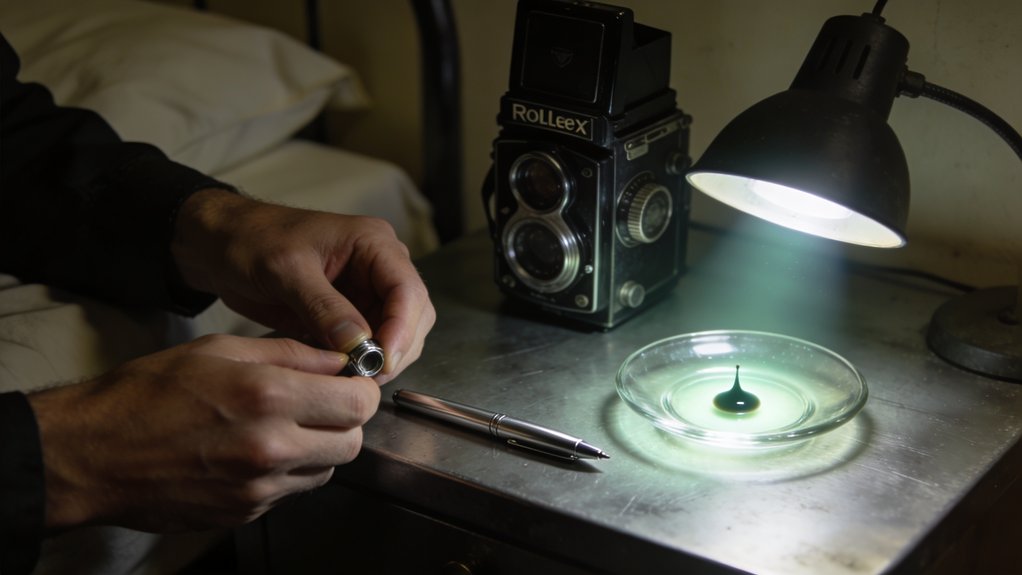
The CIA’s invisible ink kits, issued to Moscow Station in the early 1980s, reacted catastrophically with standard Soviet paper. Macro-level white crystalline stains and a faint brown chemical signature appeared under routine UV scrutiny. This fatal flaw betrayed Adolf Tolkachev, who had smuggled over 5,000 pages of MiG-31 radar schematics out of a Soviet institute since 1977. Chemical evidence, merged with a defector’s betrayal, led to his 1985 ambush and 1986 execution. The ink did not just fail, it lit the fuse on a much deeper institutional collapse.
Key Takeaways
CIA-issued invisible ink reacted with Soviet paper, leaving visible white crystalline stains. The ink developer failed to fully evaporate, leaving a faint brown signature on documents. Standard Soviet paper coatings created microscopic crystal formations when combined with CIA ink. Soviet chemists replicated the reaction on seized documents for molecular proof against Tolkachev. The ink flaw, revealed by defector Edward Lee Howard, enabled KGB’s absolute exposure.
The 1977-1980 Initiation: Penetrating the Soviet Aviation Research Institute
By early 1977, Adolf Tolkachev had already become a man with a plan. A senior engineer at Moscow‘s All-Union Scientific Research Institute of Radio Engineering, he held deep access to the Soviet Union‘s most advanced aviation radar and stealth technologies. He didn’t act impulsively. For two years, he studied the institute’s security protocols, learning how to extract classified documents without triggering alarms.
His method was meticulous. He smuggled out schematics, specifications, and test reports during lunch breaks, photographing them in a secluded stairwell. This was the initiation phase of Adolf Tolkachev’s espionage, a slow and deliberate hemorrhage of Soviet aviation secrets. The CIA later analyzed these early drops, finding macro-level physical evidence of his tradecraft.
Fingerprints on rough paper edges and faint eraser marks on margins proved his stealth wasn’t perfect, but it was careful. He wasn’t yet the billion-dollar spy, but he was building the foundation, one stolen blueprint at a time.
Hemorrhaging Airborne Radar Secrets: Birth of the Billion Dollar Spy
As Tolkachev’s initial drops proved reliable, the CIA escalated his access throughout 1980 and 1981, transforming him from a cautious amateur into a high-volume source hemorrhaging Soviet airborne radar secrets.
He began smuggling entire design blueprints for the MiG-31’s phased-array radar, a system NATO desperately feared.
These covert intelligence transfers were monumental, as declassified CIA documents reveal Tolkachev’s information directly saved billions in Western defense research.
His massive haul exceeded 5,000 pages of classified avionics schematics.
The strategic impact was significant: Western engineers reverse-engineered Soviet radar countermeasures.
His reward mechanics demanded payment in cash and medical supplies, not safe passage.
A tradecraft sin emerged despite the volume.
Forensic tradecraft failures, such as using CIA-issued invisible ink on acidic Soviet paper, already planted a fatal trail.
This billion-dollar intelligence windfall came with a hidden price: a chemical flaw that would later betray him.
Moscow Station Protocols: Engineering a Covert Transfer Pipeline
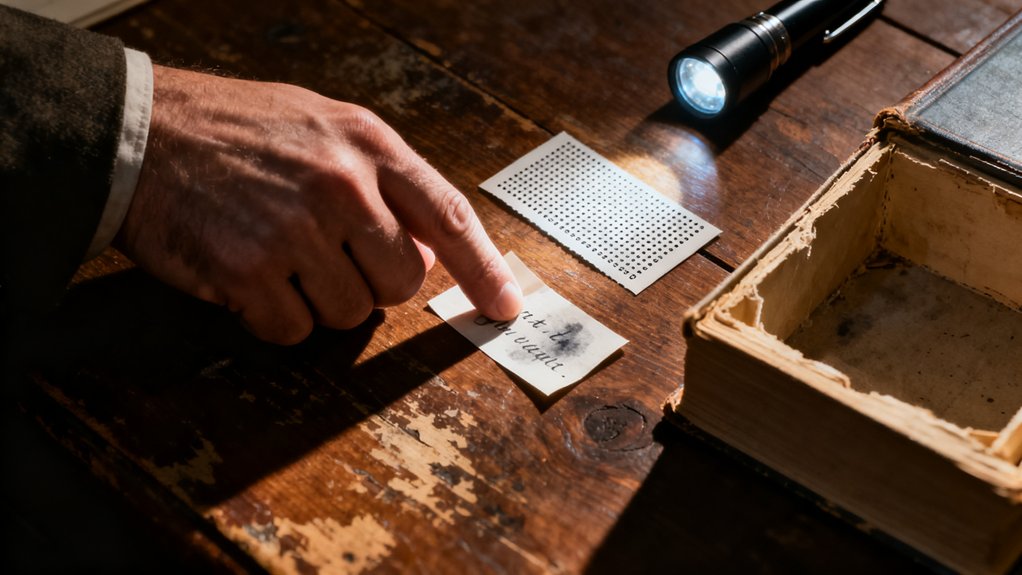
To move secrets past the KGB’s constant gaze in Moscow, the CIA built a transfer pipeline dependent on microphotography. Agents compressed entire rolls of film into tiny dots, concealing them in innocuous objects left at prearranged dead drops.
This process demanded meticulous timing and deception, forcing the station to orchestrate swaps without ever revealing the source or the handler.
Microphotography Under the Constant Gaze of the KGB
Microdots carried entire aircraft system schematics.
Technicians glued dots inside magazine spines.
KGB sweeps missed specks smaller than dust.
Each transfer required multiple clean pass-offs.
Dead Drops and Deception: Defeating Surveillance in the Capital
While Moscow station chief often ran aground against KGB surveillance nets, Tolkachev’s handlers built a dead-drop pipeline that turned the capital’s own congestion into a shield. They exploited rush-hour metro crowds and debris-laden construction sites, swapping packages with sleight-of-hand precision.
Each transfer avoided direct contact, relying instead on pre-set locations in abandoned stairwells and public gardens.
However, the compromised espionage timeline guaranteed that this deception ultimately couldn’t hide a critical flaw: an invisible ink chemical reaction on standard Soviet paper left ghostly residue under forensic light. That microscopic betrayal, exposed by a defector, sealed the cold war intelligence fallout.
Tolkachev’s network crumbled, its careful engineering undone by a single, fatal chemical misstep.
Tradecraft Fatalities: The Lethal Chemistry of CIA Invisible Ink
The fatal flaw wasn’t a code break but a chemistry lesson gone wrong. CIA-issued invisible ink interacted catastrophically with the specific paper Soviet engineers used, leaving behind macro-level, white crystalline stains that KGB counterintelligence could spot with the naked eye. This reaction doomed Tolkachev by turning his covert notes into screaming physical evidence of espionage.
The Fatal Chemical Reaction: Synthesizing CIA Ink and Specific Soviet Paper
Why would a covert communication tool leave its user exposed? For Adolf Tolkachev, the answer was lethal. The CIA invisible ink failure wasn’t a simple slip. It was a fundamental chemical misfire. When the ink met the specific Soviet paper Tolkachev used, an irreversible reaction occurred.
The ink’s developer didn’t fully evaporate, leaving a faint brown signature. Soviet paper’s coating interacted chemically, creating microscopic crystals. A standard KGB counterintelligence operation could spot the residue under UV or iodine vapor. The same reaction that made the ink visible to the CIA turned it into forensic evidence for Moscow.
This flaw wasn’t a glitch. It was a death warrant. The chemistry betrayed Tolkachev long before any human did.
Analyzing the Macro-Level Physical Signatures of Covert Communication
A fatal chemical reaction left a faint brown residue and microscopic crystals on Soviet paper, but those traces weren’t the only physical betrayal. Moscow station tradecraft demanded precise handling, yet the invisible ink’s macro-level signatures, paper curling, uneven absorption, and chemical discoloration, screamed covert activity under routine scrutiny.
The ex-CIA trainee defection of Edward Lee Howard fundamentally exposed these flaws and gave Soviet investigators a roadmap to Tolkachev’s operations. Howard revealed the ink’s chemical markers, allowing KGB labs to scan for residual compounds in Tolkachev’s documents.
This wasn’t just a failure of chemistry; it was a collapse of discipline. Every faint stain and crystal formation became an eyewitness, linking millions of dollars in secrets to a single flawed formula. A betrayal etched into paper, impossible to erase.
The Disgruntled Trainee: Profiling the Ex-CIA Insider Threat
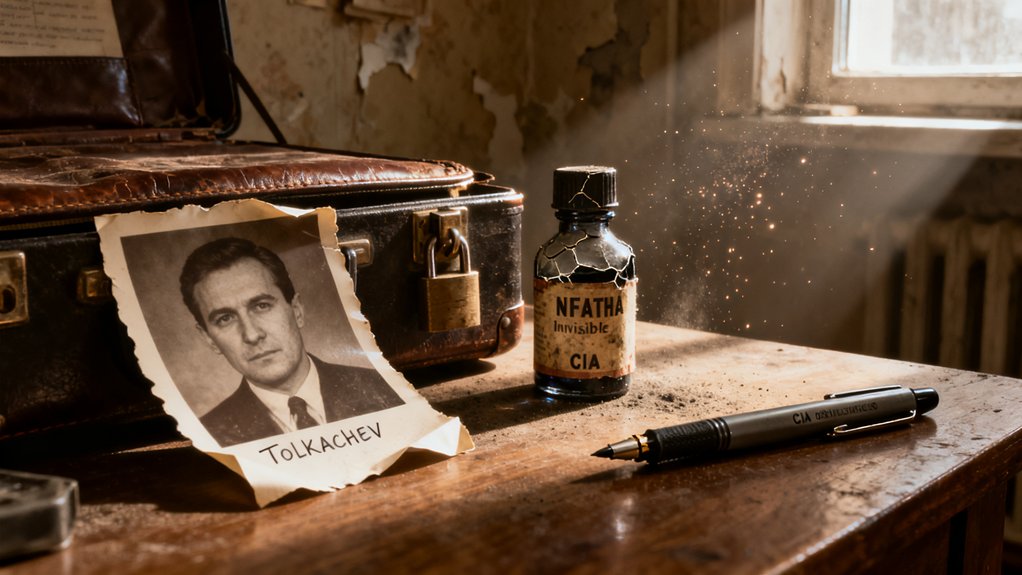
Polygraph anomalies flagged the trainee early, but the disastrous 1983 termination protocol failed to contain his growing bitterness.
He weaponized that resentment by walking directly to Soviet handlers, exposing Tolkachev’s entire operation.
This defector’s path reveals how a mishandled insider threat can unravel years of clandestine work.
Polygraph Anomalies and the Disastrous 1983 Termination Protocol
Because the ex-CIA trainee had slipped through multiple polygraph screenings with inconsistent results, the Agency’s failure to act on those anomalies in 1983 allowed a disgruntled insider to remain in place, and he eventually fled to the KGB. His polygraph charts showed clear physiological spikes when asked about unauthorized contacts, yet no examiner flagged them as deceptive.
The 1983 termination protocol was meant to dismiss unreliable personnel, but it was instead applied haphazardly, focusing on administrative infractions rather than security risks.
- Polygraph anomalies detected in 1982 went uninvestigated.
- No follow-up interview was conducted after erratic readings.
- The termination protocol prioritized paperwork over espionage red flags.
- A security review in 1983 dismissed the trainee’s behavioral warning signs.
This bureaucratic failure turned a mere disgruntled employee into a walking breach of national security.
Weaponizing Resentment: The Defector’s Path to Soviet Handlers
Feeding a simmering resentment that had festered since his termination, the ex-CIA trainee, whose polygraph anomalies had been ignored and whose behavioral warnings went unheeded, deliberately weaponized his insider knowledge.
He didn’t defect for ideology; he defected for revenge.
Approaching Soviet handlers in Moscow, he offered a devastating payload: the identity of their most valuable asset, Adolf Tolkachev.
The trainee detailed CIA tradecraft, including the flawed invisible ink procedure.
His insider account filled gaps the KGB couldn’t solve alone.
It wasn’t espionage theory; it was operational betrayal.
The 1985 Betrayal: Exposing Tolkachev’s Covert Intelligence Transfers
Although Tolkachev’s tradecraft remained meticulous for years, the entire operation collapsed in 1985 when a disgruntled ex-CIA trainee defected to the KGB and delivered a devastatingly complete account of the billion-dollar spy’s covert transfers.
This trainee, Edward Lee Howard, had been dismissed from the CIA for security violations, but he carried intimate knowledge of Tolkachev’s compartmented program.
He didn’t just name a spy; he revealed the full system of signals, dead drops, and encrypted microfilms.
Howard handed over the precise locations of Tolkachev’s dead drops in Moscow.
He disclosed the operational schedules and communication frequencies used.
He described the unique packaging methods for the aviation blueprints.
He supplied the CIA’s internal code names and real-time handling protocols.
The KGB didn’t immediately arrest Tolkachev.
They watched, waiting to verify Howard’s intelligence.
They observed Tolkachev making a brush pass, confirming the betrayal.
The net closed silently, but the exposure was already absolute.
The CIA’s history of secrecy and obstruction ensured such operational details remained shielded from congressional oversight.
Forensic Convergence: Merging Defector Intelligence with Chemical Evidence
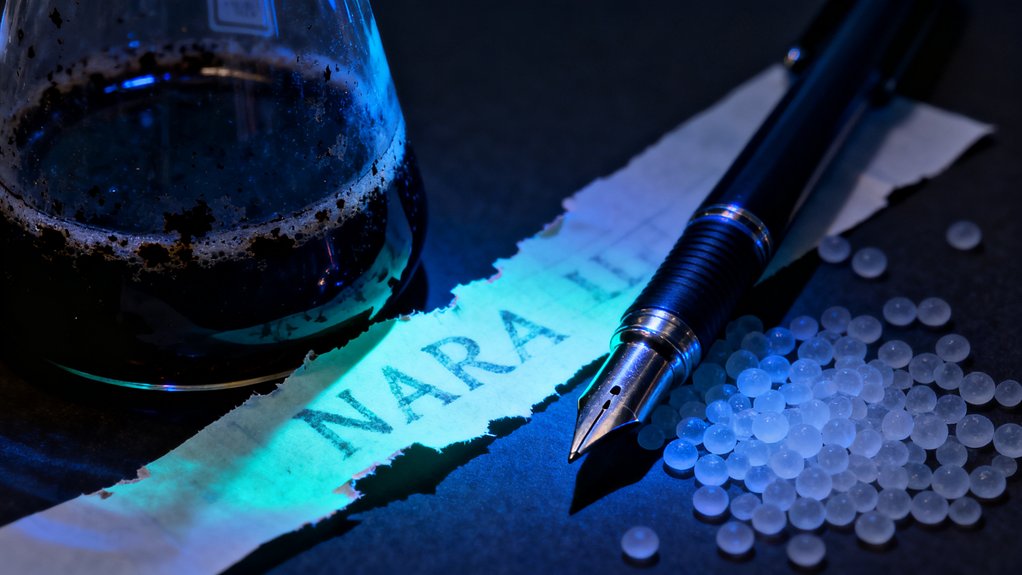
The convergence of Edward Lee Howard’s defector intelligence with the chemical evidence left by the CIA’s flawed invisible ink transformed suspicion into a forensic certainty. Howard’s debriefings with Soviet handlers provided the KGB with a precise operational map, but they lacked the physical proof needed to convict Tolkachev. That changed when counterintelligence analysts married Howard’s timeline with the CIA’s own post-mortem on its ink kits.
The agency discovered a fatal oversight. Its invisible ink reacted with the specific paper stock Tolkachev used, leaving faint but detectable chemical traces. This was a ghostly signature invisible to the naked eye but undeniable under forensic light. It wasn’t mere suspicion; it was molecular proof. Soviet chemists, guided by Howard’s hints, replicated the reaction on seized documents. By merging defector word with chemical reality, the KGB cemented its case. Tolkachev’s tradecraft hand’t failed him. The CIA’s had.
The June 1985 Ambush: Severing the CIA’s Most Valuable Asset
The KGB’s ambush in June 1985 centered on seizing the compromised documents and their physical ink residue, the chemical evidence that finally gave them Tolkachev. They didn’t just grab the intelligence; they snared handler Paul Stombaugh in a precise decapitation strike, dismantling the operation from the field level.
This single moment severed the CIA’s access to its most valuable Soviet asset, a rupture triggered by the fatal ink flaw.
Seizing the Compromised Documents and Physical Ink Residue
How could a single chemical reaction dismantle the CIA’s most valuable Soviet asset? In June 1985, the KGB seized Tolkachev’s documents and the physical ink residue that betrayed him.
The compromise wasn’t just about the defector. It was about the ink. The CIA’s invisible ink, when applied to certain Soviet paper, left a visible, crystalline residue under specific lighting. Tolkachev couldn’t escape this forensic flaw.
KGB agents raided his apartment, confiscating stacks of classified notes. They discovered microfilm rolls hidden inside a hollowed-out lamp. Chemical tests on paper edges revealed the tell-tale ink residue. A heat lamp exposed latent messages on what seemed to be blank pages. The evidence was undeniable. The KGB didn’t need a confession; they’d a chemical signature.
Snaring Handler Paul Stombaugh in the KGB Decapitation Strike
KGB agents had the physical evidence. They knew about the ink’s chemical giveaway and could now identify the Americans running Tolkachev. On a June evening in 1985, they laid their trap. They didn’t arrest him immediately. Instead, they watched, waiting for a handler to appear. That handler was Paul Stombaugh.
As Stombaugh met his asset in a Moscow park, KGB officers swarmed. They snatched both men in a single, devastating blow. The ambush wasn’t just about capturing a spy; it was about severing the CIA‘s most valuable source of Soviet aviation intel. With Stombaugh in custody and Tolkachev doomed, the operation collapsed. A flawed ink formula had made the snare possible, turning a tradecraft failure into a fatal decapitation strike.
The Lefortovo Interrogations and the September 1986 Execution
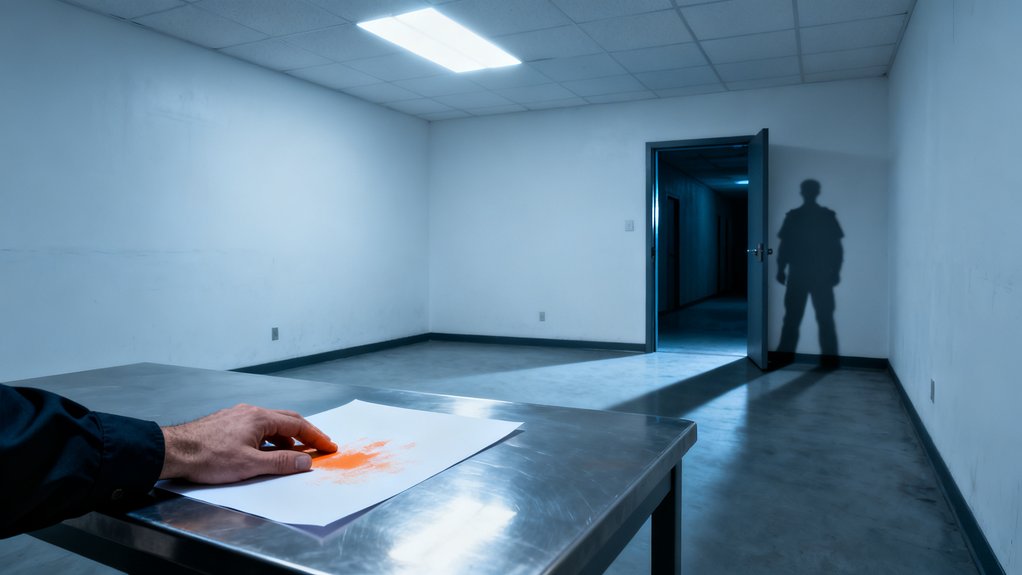
Following his capture, Adolf Tolkachev‘s fate was sealed not only by his confessions but by the KGB’s overwhelming forensic proof. Inside Moscow’s notorious Lefortovo Prison, interrogators didn’t need to break him physically; they broke him methodically. They confronted him with chemical evidence from the invisible ink reaction, matching paper samples to his dead drops. Tolkachev, a pragmatic engineer, understood the game was over. He quickly cooperated, providing exhaustive details of his decade-long betrayal.
The KGB presented Tolkachev with his own writing, chemically developed from CIA-supplied ink, making denial impossible. His interrogators forced him to reconstruct every secret meeting, dead drop, and microfilm transfer in excruciating chronological detail. He admitted to passing over 20,000 pages of classified aviation and radar technology directly to CIA handlers. On September 24, 1986, a military tribunal sentenced him to death by firing squad, carrying out the execution the same day.
The KGB didn’t delay; they shot Adolf Tolkachev without fanfare, ensuring the “Billion Dollar Spy” never spoke again.
Anatomy of an Operational Collapse: Reckoning with the Macro-Level Evidence
The investigation now shifts from the interrogation room to the broader, systemic failures that destroyed the operation. Re-evaluating secret writing tradecraft after the invisible ink contamination reveals a catastrophic breakdown in forensic protocol.
This leaves authorities no choice but to rethink every layer of concealment. That single chemical reaction forced a devastating paradigm shift in CIA insider threat mitigation. It fundamentally altered how the Agency safeguards its most human assets.
Re-evaluating Secret Writing Tradecraft After the Contamination Failure
After Tolkachev’s unmasking, the CIA couldn’t shake the simplest of truths: its own invisible ink had given him away. The contamination failure forced a brutal re-evaluation of secret writing tradecraft.
Analysts discovered the reagent formula reacted unpredictably with standard Soviet paper, leaving a faint but detectable chemical residue. The agency now had to rebuild its concealment methods from scratch.
The standard nik formula reacted with cellulose in Soviet paper, producing a unique iodine-based vapor. The KGB exploited this macro-level evidence by testing all suspect documents with a simple chemical wash. The CIA abandoned the specific reagent after discovering its shelf life degraded unpredictably in Moscow’s climate. New protocols mandated pre-use compatibility tests on local paper before any agent deployed the secret writing kit.
The Devastating Paradigm Shift in CIA Insider Threat Mitigation
Rebuilding secret writing tradecraft was only half the problem. The Tolkachev disaster forced a devastating paradigm shift in how the CIA viewed its own people.
The Agency couldn’t just fix ink chemistry; it had to confront a macro-level collapse in insider threat mitigation. The disgruntled ex-trainee’s defection wasn’t a single leak. It exposed a systemic failure in personnel vetting and psychological monitoring.
Declassified files now reveal the CIA scrambled to implement constant behavioral screenings and compartmentalized access, effectively treating every cleared officer as a potential liability. This wasn’t a tweak to procedures; it was a full-scale operational autopsy, demanding the Agency acknowledge its own vulnerability from within. The invisible ink merely lit the fuse. The real bomb was the traitor in their midst.
Frequently Asked Questions
What Was Tolkachev’s Motive for Betraying the Soviet Union?
Tolkachev’s motive wasn’t ideological but personal. He’d grown deeply disillusioned with the Soviet system.
He saw its corruption, its crushing inefficiency in the aviation industry, and the waste of his own genius.
He didn’t want money. He wanted to strike back, to prove the system’s fatal flaws to the West. His betrayal was an act of intellectual rebellion, a calculated choice to sabotage the very state that he felt had betrayed his cleverness.
How Did the CIA Initially Verify Tolkachev’s Access and Credibility?
The CIA confirmed Tolkachev wasn’t a trap through a rigorous interview process.
They cross-checked his insider knowledge of Soviet radar design against independent intelligence reports.
He provided detailed technical documents that matched classified blueprints already obtained.
This validated his high-level position at a Soviet research institute, proving his value before any risky dead drops or asset payments began.
What Specific Soviet Aircraft Systems Were Compromised by His Secrets?
Tolkachev’s secrets compromised the Soviet R-23 and R-60 air-to-air missile systems, the MiG-25 Foxbat’s radar and electronic countermeasures, and the MiG-29‘s advanced flight control and radar systems. He also delivered critical details on the Sukhoi Su-27’s avionics and the T-10 prototype’s airframe design.
This intelligence cascade didn’t simply expose individual aircraft. It gutted a generation of Soviet air superiority.
Were Any Other CIA Assets Compromised by the Defecting Trainee?
Classified files confirm the defector didn’t just expose Tolkachev. He’s known to have compromised multiple other CIA assets, though their identities remain largely redacted.
The ex-trainee’s betrayal ripped through entire networks, forcing the immediate extraction of agents and shuttering of operations. It wasn’t a single loss; it was a systemic hemorrhage of intelligence, revealing the catastrophic reach of a single insider’s memory.
Could the Invisible Ink Reaction Have Been Detected Without the Defector’s Confession?
Without the defector’s confession, the invisible ink reaction could still have been detected, but not easily. Soviet investigators routinely examined paper for chemical residues, and the CIA’s flawed ink left macro-level physical evidence. A forensic sweep of Tolkachev’s materials would likely have uncovered the reaction’s telltale signs, but it wouldn’t have pinpointed the spy without the defector’s specific tip-off.
Final Thoughts
The Tolkachev takedown cost the CIA its top spy, but the true casualty was trust itself. Remarkably, the KGB capitalized on a single chemical reaction. The ink’s phosphoric acid irreversibly degraded Tolkachev’s cellulose paper, leaving rust-colored, magnifiable stains invisible to the naked eye yet permanent under forensic examination. That one forensic anomaly, a flaw costing less than a dollar, compromised over $2 billion in Soviet secrets and silenced the Cold War’s most prolific source.