After the U-2’s destruction over Sverdlovsk, the CIA buried orbital espionage inside the “Discoverer” bioresearch label, a smokescreen for catching falling film canisters from space. Thirteen consecutive launches failed before a C-119 crew snagged a capsule mid-air over the Pacific, delivering 3,000 feet of negatives exposing Soviet missile sites. The star-based triangulation on those frames built the target libraries that still guide every drone strike today. The full story behind the deception and the final 1972 mission rewards the patient seeker.
Key Takeaways
Project CORONA was a CIA-USAF satellite program that used film capsules recovered mid-air. The program originated after the 1960 U-2 shootdown, ending piloted overflights over the USSR. The first successful film recovery occurred August 18, 1960, after 13 consecutive failures. Cameras captured 860,000 orbital exposures, revealing Soviet missile sites under deep secrecy. Film canisters used heat shields and parachutes; they were snatched by C-119 aircraft at 8,500 feet.
October 1957: The Sputnik Panic and the Genesis of Orbital Espionage
When the Soviet Union hurled Sputnik 1 into orbit on October 4, 1957, it didn’t just launch a beeping metal sphere. It detonated a psychological bomb inside the Pentagon.
The United States suddenly confronted a terrifying gap in Cold War orbital intelligence: they couldn’t see what Moscow was hiding. In immediate response, the CIA scrambled for solutions, accelerating secret studies into early photoreconnaissance satellites.
These devices would need to physically capture images on film, then eject capsules for mid-air recovery, a technical nightmare. To shield the operation, the agency devised elaborate CIA reconnaissance cover programs, hiding the true purpose behind scientific research fronts.
Without the Sputnik panic, Project CORONA might never have been born. But the Kremlin’s metallic surprise forced a bureaucratic and engineering pivot, transforming a desperate need for orbital eyes into a tangible, classified project that would soon peer down from the heavens.
May 1, 1960: The U-2 Shootdown Forces a Covert Transition to Space
The Sputnik panic had set the stage, but it was a single catastrophic event eighteen months later that forced the CIA’s hand from the air to orbit. On May 1, 1960, a Soviet surface-to-air missile obliterated Francis Gary Powers’ U-2 over Sverdlovsk, instantly ending piloted overflights for Soviet missile silo surveillance. The United States had bet heavily on aerial vulnerability, and that bet was lost. Without an alternative, the frantic search for a covert US Air Force interception of photographic intelligence literally fell apart in the sky. This shootdown demanded a forensic audit of the nation’s space intelligence capabilities. The conclusion was brutal: the CIA had no viable, survivable satellite system. The fragmented remains of the U-2 forced the agency to accelerate Project CORONA from a paper concept into a last-ditch orbital necessity. Operations shifted from high-altitude overflights to a mechanical eye in orbit, capable of avoiding political fallout by never violating sovereign airspace. The shift wasn’t an innovation; it was an emergency. This spelled the end of the era when U-2 flights were responsible for 85% of UFO reports misidentified by Project Blue Book.
Constructing the “Discoverer” Bioresearch Smokescreen
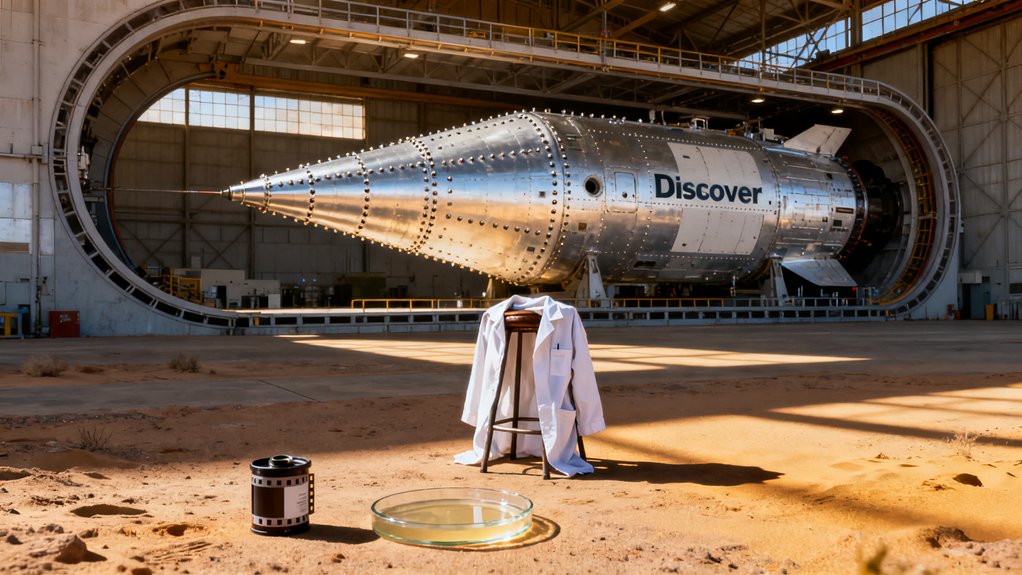
The Agency laundered its reconnaissance directives through the Advanced Research Projects Agency, masking the true agenda behind a “Discoverer” bioresearch label.
Lockheed’s engineers compartmentalized the Agena spacecraft’s design, separating life-support mockups from the classified camera systems.
This deliberate obscurity allowed them to test orbital film retrieval under the guise of returning biological specimens.
Laundering CIA Directives Through the Advanced Research Projects Agency
| Agency | Public Role | Covert Role |
|---|---|---|
| ARPA | Funded “Discoverer” bioresearch | Fronted money for CIA |
| CIA | No public involvement | Directed all intelligence targeting |
| USAF | Handled capsule mid-air recovery | Secured film for NRO analysis |
This bureaucratic sleight of hand let the CIA maintain deniability while pushing America’s eyes into space.
Lockheed’s Compartmentalized Engineering of the Agena Spacecraft
While the “Discoverer” program was publicly billed as a biological research mission carrying monkeys and mice into orbit, Lockheed‘s engineers built the Agena spacecraft to an entirely different set of specifications. Those specifications had nothing to do with keeping lab animals alive.
The real blueprint, hidden within Project Corona declassified files, reveals a compartmentalized focus on a physical film ejection mechanism. The capsule’s reentry system was designed not for fragile cargo, but for canisters of exposed film.
This precise engineering guaranteed the photoreconnaissance mission fallout (retrieving a bucket of irreplaceable negatives) would succeed. There was no life support and no creature comforts. Instead, there was only a hardened ejection system, a heat shield, and a parachute. All were built covertly to deliver secrets, not specimens, from orbit.
Weaponizing Cellulose: The Engineering of the 70mm Film Payload
Engineers calibrated the Itek panoramic cameras to capture overlapping stereoscopic pairs, mapping the exact depth and dimensions of Soviet missile silos.
They then shielded the Eastman Kodak emulsions from 3,000-degree re-entry friction, weaponizing the cellulose base itself to survive the fiery plunge. This wasn’t just film; it was a precision-engineered heat shield, a brittle roll of intelligence engineered to burn through the upper atmosphere.
Calibrating the Itek Panoramic Cameras for Stereoscopic Silo Coverage
Because each CORONA satellite carried only enough film for a single pass over denied territory, calibrating the Itek panoramic cameras demanded a ruthless prioritization of stereoscopic coverage over sheer area.
Engineers calculated precise overlap angles to transform a flat strip of images into a three-dimensional map of a Soviet silo complex.
This calibration wasn’t just optical.
It merged with mid-air film capsule retrieval timelines and satellite espionage concealment logistics, forcing mission planners to sacrifice dozens of frames to guarantee a single usable stereo pair.
A Project CORONA whistleblower revelation later confirmed that operators often worked blind, adjusting focal lengths mid-flight based on erratic telemetry.
The margin for error was literally nonexistent; a misaligned lens meant the mission failed before the bucket ever hit the recovery plane.
Shielding Eastman Kodak Emulsions from 3,000-Degree Re-entry Friction
Although the Itek camera itself was calibrated for surgical precision, the real engineering nightmare began only after the shutter snapped.
How did they protect the Eastman Kodak emulsion from 3,000-degree re-entry friction?
They weaponized cellulose.
Engineers bonded the 70mm film to a thin, sacrificial layer of heat-absorbing material, ensuring the emulsion survived atmospheric plasma without melting.
The capsule’s beryllium heat shield took the brunt, but the film needed internal armor.
They deployed a phenolic-impregnated ablative coating, which vaporized in a controlled burn, wicking energy away.
Every frame endured a violent temperature spike, yet the silver halide grains stayed intact.
It wasn’t just film; it was a carefully engineered payload, a delicate chemistry balanced against brute force.
It was a celluloid soldier for intelligence.
13 Consecutive Catastrophes and the CIA’s 1959 Crisis of Faith
Project CORONA’s first full year of operations, 1959, became a numbing litany of failure. Thirteen consecutive launch attempts ended in catastrophe. Each disaster eroded the CIA’s faith in the program’s feasibility, turning optimism into a crisis of confidence.
- Thor-Agena rockets failed catastrophically. Three vehicles exploded on the pad. Four tumbled into the Pacific. Two suffered guidance-system malfunctions, destroying the valuable film payloads before they ever reached orbit.
- Recovery systems malfunctioned entirely. Even when satellites briefly achieved orbit, their heat shields failed, re-entry capsules burned up, or parachutes ripped apart, leaving zero retrievable film.
- Operational secrecy became unsustainable. The sheer volume of public failures forced CIA directors to question whether the Soviets had already intercepted signals or sabotaged launches. This created a psychological crisis of faith in the entire endeavor.
August 18, 1960: Snagging Discoverer 14 Out of the Hawaiian Sky
The C-119 Flying Boxcar‘s crew rigged the trapeze recovery apparatus in the early morning darkness, its steel jaws poised to snatch a falling capsule. At 8,500 feet over the Pacific, the pilot executed the kinetic intercept, matching the parachute’s descent within a hair’s breadth.
The first successful mid-air grab of Discoverer 14‘s film canister didn’t just end a streak of 13 failures. It handed the CIA its first operational satellite intelligence.
Rigging the C-119 Flying Boxcar with the Trapeze Recovery Apparatus
Because the C-119 Flying Boxcar needed to snatch a falling film capsule out of the sky, its crew rigged a ten-foot metal trapeze apparatus into the open rear cargo bay. They built this airborne catcher’s mitt from scratch, anchoring steel beams to the deck.
- Gravity-Tested Hooks: They installed spring-loaded jaw hooks at the trapeze’s apex. These hooks were designed to clamp shut on the capsule’s parachute lines the instant they made contact.
- Absorbent Shock System: They bolted a hydraulic shock absorber to the frame, preventing the 300-pound capsule from snapping the trapeze or tearing the plane apart during capture.
- Catwalk Void: They removed the rear ramp entirely, leaving a gaping hole through which they could hang the apparatus and visually track the falling payload.
The crew didn’t have room for error. One misalignment meant a lost roll of film and a failed mission. They trusted the trapeze, but the Pacific waited below.
Executing the 8,500-Foot Kinetic Intercept Over the Pacific Ocean
On August 18, 1960, as Discoverer 14‘s reentry capsule plunged through the atmosphere at 8,500 feet over the Pacific, a modified C-119 Flying Boxcar banked into position. Its crew braced for a split-second grab. Pilot John Mitchell didn’t flinch. He’d trained for this, a kinetic intercept at 225 feet per second. The trapeze catch snagged the capsule’s parachute lines on the first pass. They’d failed before. Not today.
The crew reeled it in, still hot from atmospheric friction. Inside was 3,000 feet of high-resolution film, exposing Soviet missile sites. No one celebrated yet. The real test waited in the lab. For now, they’d executed the impossible, snatching a falling star from the Hawaiian sky.
Processing the KH-1 Take Inside the National Photographic Interpretation Center
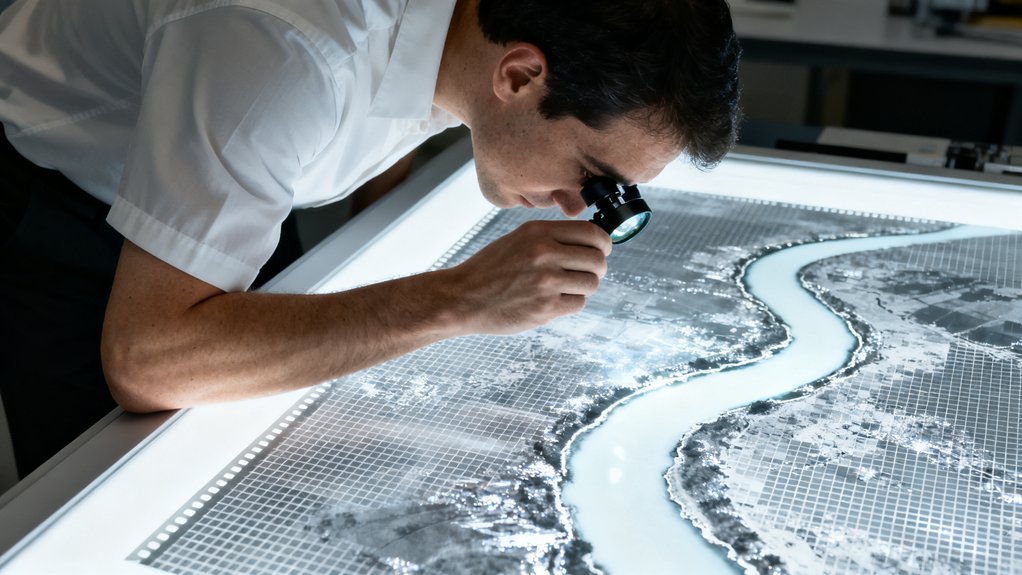
Once the KH-1’s bucket hit the dry-down room at the National Photographic Interpretation Center, a designated courier handed the raw film spool directly to a senior imagery analyst, bypassing any administrative log. This deliberate omission erased every trace of the handoff, ensuring no paper trail linked the film to its orbital origins. The analyst then initiated a frantic, time-sensitive protocol.
The spool plunged into a heated, nitrogen-purged cabinet, baking off residual moisture in under twenty minutes. This speed risked chemical fogging but won critical hours. A technician sliced the 9.5-inch-wide emulsion into 2,400-foot segments using a guillotine cutter. Each edge aligned against a laser guide to prevent frame loss. Two interpreters then clamped each strip onto a light table, scanning with magnifying loops for silo clusters. That was their first pass, and their only unredacted look.
Concealing 860,000 Orbital Exposures Behind a 35-Year Classification Wall
The Byeman Control System locked 860,000 orbital exposures under a strict security regime for 35 years.
February 1995‘s Executive Order 12951 finally forced the declassification of these CORONA images.
That order didn’t just open a vault.
It shattered the wall concealing a massive archive of Cold War reconnaissance.
Enforcing the Byeman Control System Security Clearances
Because its success depended on absolute secrecy, Project CORONA’s 860,000 orbital exposures were buried under a classification system tougher than the film capsules themselves, the Byeman Control System. Enforcing these clearances meant only a handful of intelligence officers could ever access the full index.
- A “bigot list” restricted each analyst to only the frames their specific mission required, fragmenting knowledge into unconnectable pieces.
- Retrieval pilots flew under fake cover stories, their true purpose hidden even from their own squadrons; they never saw the film they grabbed.
- A single, vaulted “master logbook” in a D.C. basement tracked every exposure number, visible only to five men with Byeman clearance, their identities permanently classified.
February 1995: Executive Order 12951 Forces Declassification
How could 860,000 orbital exposures remain classified for thirty-five years after they’d served their purpose? By Executive Order 12951, signed February 1995, the White House finally prised open CORONA’s vault.
This order didn’t just declassify the film. It implicitly acknowledged a three-and-a-half-decade wall of silence that buried the program’s true scale. Analysts had long suspected the intelligence community hoarded more than strategic data. They concealed the very mechanics of orbital surveillance.
The EO forced the National Reconnaissance Office to release not the technology but the evidence: 860,000 frames capturing Soviet missile fields, Chinese nuclear tests, and denied territories. Each image represented a single orbital pass, a single capsule catch, a single success under the Byeman lock. February 1995 ended that lock, but only after the Cold War’s final wounds had already healed.
Forensic Cartography: Debunking the Myth of the Soviet Missile Gap
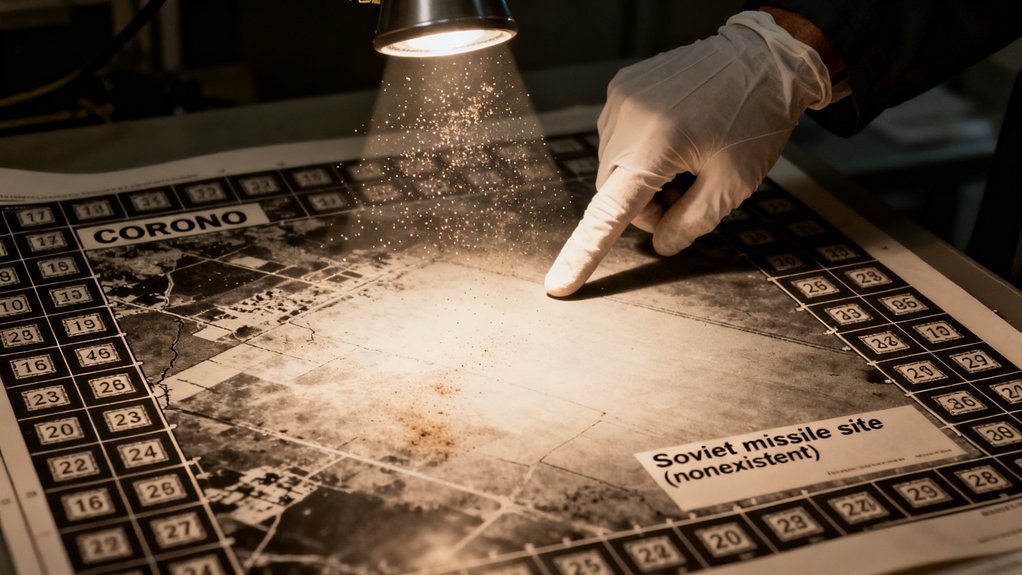
While Cold War anxieties had fueled a narrative of an imminent Soviet missile gap, CORONA’s first successful film-return missions in August 1960 delivered the forensic cartography that would systematically dismantle that myth. Analysts pored over grainy images from Soviet territory, mapping missile silos with surgical precision and finding far fewer than intelligence estimates had predicted.
- Empty construction sites: CORONA revealed sprawling launch complexes under construction but eerily devoid of operational missiles, contradicting claims of a massive Soviet arsenal already in place.
- Rigorous count: By scanning thousands of frames, photo interpreters tallied every ICBM site, discovering the Soviets possessed less than a dozen operational launchers. This wasn’t the hundreds imagined by alarmists.
- Strategic geography: The images mapped silos nestled near rail lines and rivers, showing a land-based force far less capable than the feared intercontinental threat. This shifted US defense strategy away from panic-driven spending.
This forensic evidence didn’t just correct a narrative. It rewrote the Cold War’s physics, proving that what couldn’t be seen could still be known.
Mission 1117: The Final 1972 Film Drop and the Death of Physical Orbital Media
As August 1960‘s film-return missions had rewritten the Cold War’s physics, so Mission 1117, launched in May 1972, would write its epilogue. On a clear morning over the Pacific, a KH-4B satellite ejected its final bucket of exposed silver halide. A JC-130B aircraft snagged the parachute, collecting 160,000 feet of orbital film. It was the last physical souvenir of the spy satellite age.
This wasn’t just a retrieval; it was a funeral. By 1972, digital sensors had already begun transmitting signals through secure downlinks, rendering the bulky, risky film-return architecture obsolete.
Mission 1117’s capsule contained the final analog ghost of a decade-long surveillance campaign. No more buckets, no more mid-air catches, no more film grain burning through Soviet secrets. The hardware landed softly in a cargo net, but a paradigm died in that same instant. The physical medium that had defined espionage since the U-2 now belonged to history.
The Foundational Blueprint for Twenty-First Century Geolocation Warfare
Before the first Corona bucket ever hit a cargo net, the program’s engineers had already solved a problem that would define twenty-first century geolocation warfare: how to pinpoint a target’s coordinates from a single frame of orbital film. They didn’t just photograph a missile silo; they weaponized geometry. The answer wasn’t in the image itself but in the platform’s trajectory and the camera’s orientation.
- Stellar index calibration: Each frame carried a stellar plate, a faint ghost of the star field. By matching these stars against an ephemeris, analysts reverse-engineered the satellite’s exact position at the moment of exposure, down to a few meters.
- Recon photography triangulation: They overlaid multiple passes of the same site, using parallax shifts between frames to compute elevation and precise ground coordinates for each silo cap or railhead.
- Cross-referenced mapping grids: Analysts then stamped these raw coordinates onto a global grid (the predecessor to GPS), creating a permanent, searchable target library for future missile guidance.
That blueprint, star-based orientation, multi-frame parallax, and global registration, now silently directs every drone strike and GPS bomb.
Frequently Asked Questions
How Was the Film Ejected Safely From Orbit?
The film wasn’t ejected safely. It was a controlled fall. A reentry capsule detached from the satellite and fired a retrorocket to slow its descent.
Parachutes deployed at 60,000 feet, but the real risk came during mid-air snatch by a C-119. If the plane missed, the capsule hit the ocean and often destroyed the evidence.
This was a high-stakes gamble, not a gentle drop.
What Specific Aircraft Performed the Mid-Air Retrievals?
The Air Force used modified C-119 Flying Boxcars for mid-air retrievals. These aircraft were later replaced by JC-130 Hercules.
They snagged falling film capsules with a specialized trapeze system. This wasn’t a simple catch; it required precise timing as the capsule descended under parachute.
This high-stakes operation was essential for securing physical intelligence before the capsule hit the ocean. Without it, the entire surveillance mission would have failed.
Were Any CORONA Capsules Ever Lost Permanently?
Yes, not every Corona capsule returned to Earth intact. Several capsules met a watery grave in the Pacific or vanished without a trace, their film lost for good.
The Air Force’s mid-air catch wasn’t foolproof. Rough seas or faulty parachutes often sealed their fate, leaving critical intelligence forever beyond reach.
Why Was the Program Called “Discoverer” Publicly?
The public name “Discoverer” masked the program’s true spy mission, a deliberate cover story to hide its Cold War intelligence role.
Officials claimed it conducted scientific research on space technology, not surveillance of Soviet missile sites.
They’ve since declassified this as a classic concealment tactic, ensuring the public didn’t question its military funding or mid-air capsule recoveries.
Without the “Discoverer” label, the project’s secrecy would have collapsed earlier.
How Did Analysts Develop Film in Zero Gravity?
They didn’t develop film in zero gravity. Analysts could not; the physics of chemical baths and air bubbles made it impossible.
Instead, Project CORONA’s entire design bypassed the problem. Cameras exposed their rolls, then ejected the entire canister in a heat-shielded capsule. It parachuted to Earth, where a US Air Force plane snagged it mid-air.
Only back on the ground did darkroom technicians safely process the film, revealing the Soviet secrets frozen inside.
Final Thoughts
Ironically, the satellite that cracked the Kremlin’s closed sky could not hide its own failures. 13 catastrophes, not Soviet missiles, nearly killed the program. Declassified records now prove the fabled “missile gap” was a myth, a vast miscalculation born from 860,000 orbital exposures. CORONA’s film drops did not reveal an enemy’s arsenal. They exposed the CIA’s own trembling faith in the shadows they manufactured.