Between 1921 and 1927, the Soviet Cheka did not simply repel enemies. It built a phantom insurgency to attract them. Feliks Dzerzhinsky’s blueprint weaponized hope, forging the Monarchist Union of Central Russia as credible bait. Western intelligence unknowingly fed the deception, swallowing fabricated telegrams and staged border skirmishes. Boris Savinkov and Sidney Reilly were lured across fake transit corridors straight into Lubyanka’s kill box. The true trap was not a bomb. It was a lie so complete that victims walked into it willingly. The dismantling of an entire anti-Bolshevik leadership was arithmetic, not explosives, and its clinical architecture metastasized into the KGB’s Cold War playbook. The operation’s full mechanics reveal a far darker precision.
Key Takeaways
The CHEKA created the fake Monarchist Union of Central Russia to lure anti-Bolshevik exiles. The operation used forged documents and staged border crossings to trap White émigrés. Boris Savinkov was lured across a fabricated safe corridor in 1924 and executed. Sidney Reilly was captured in 1925 after crossing the same lethal transit route. Western intelligence unwittingly funded the deception, feeding disinformation to their agencies.
Architecting the 1921 Honeypot: Feliks Dzerzhinsky’s Blueprint for Counter-Subversion
Although the Red Terror had ostensibly crushed domestic opposition by 1921, the Cheka‘s founder, Feliks Dzerzhinsky, understood that the real threat still breathed beyond Soviet borders (exiled monarchists and Western spies plotting a return).
He didn’t need brute force; he needed a trap.
The felix dzerzhinsky honeypot emerged as a calculated instrument of soviet cheka counter-intelligence, a mechanism designed not to repel, but to attract.
Dzerzhinsky ordered his operatives to penetrate White Army circles abroad, feeding false intelligence about a brewing internal resistance.
This required meticulous control of covert russian border crossings, where agents and false documents greased the path for unwitting exiles to re-enter the killing fields of the motherland.
Dzerzhinsky’s blueprint rejected passive defense; instead, it weaponized the enemy’s own hope.
Every fake message, every staged meeting, served a single forensic purpose: to identify the living threat, lure it back, and methodically eliminate it before it could strike.
Fabricating the Monarchist Union: Engineering a Phantom Insurgency in Soviet Russia
To assemble a ghost army, the Cheka first needed a credible banner. A counterfeit monarchist league so convincing that exiles would bet their lives on it. They engineered the Monarchist Union of Central Russia.
This was a phantom insurgency theoretically poised to topple the Kremlin. It wasn’t a mere rumor. It was a highly organized anti-Bolshevik resistance deception.
This was no rumor; it was a highly organized phantom insurgency, poised to topple the Kremlin.
The operation included forged documents, dead drops, and ostensible operatives reporting real intelligence. Cheka controllers carefully bled that intelligence to them.
Exiled Russian monarchists across Europe received overtures from this Union. They believed it was a thriving, armed movement waiting for their return.
They didn’t realize the Union’s sole purpose was to identify the most dangerous dissidents, then lure them back across the border for capture and execution.
The Cheka didn’t merely invent an enemy. They handed their targets a fantasy, then weaponized their hope.
Weaponizing Declassified Parchment: A Macro-Visual Autopsy of State-Sanctioned Forgeries

A macro-lens fixates on a 1923 directive from the Supreme Monarchist Council. Its paper grain and ink distribution betray a single, precise truth: the CHEKA forged it.
The counterfeit directive’s mechanical architecture, a perfect simulacrum of Tsarist-era prose and seal, anchors a state-sanctioned lie.
Each falsified border transit visa in its wake functions as a trapdoor, luring its intended victim deeper into the operation’s fatal geography.
Micro-Analyzing the Counterfeit 1923 Supreme Monarchist Council Directives
Before any directive could lure its target, the CHEKA first had to make the forgery indistinguishable from the genuine article. The counterfeit 1923 Supreme Monarchist Council directives reveal meticulous forgery: aged ink, frayed edges, and precisely replicated signatures.
The operation trust timeline shows the CHEKA accelerating production after Boris Savinkov execution, ensuring fresh bait reached GPU intelligence operatives abroad. Each document’s watermark, micro-bleeding, and paper grain matched real monarchist stationery. The deception’s power lay in the details. A single mismatched cipher code would have shattered the illusion. Instead, these directives lured exiles back to Russia, sealing their fate.
Macro-visual analysis confirms every fracture, fiber, and fade was weaponized to appear authentic. It was a forgery engineered not to deceive skeptics, but to confirm believers’ hopes.
The Mechanical Architecture of Falsified Border Transit Visas
How could a single visa, stamped on aged parchment, rewrite the fate of an exile? It didn’t just grant passage, it weaponized trust.
The CHEKA‘s forgers didn’t merely copy, they engineered mechanical authenticity. Examining declassified Soviet archives reveals their blueprint.
They sourced pre-1917 border control stamps, matched specific ink oxidation levels, and replicated paper grain from a defunct Warsaw consulate. Each visa functioned as a trust counter-espionage mechanism, a sealed invitation that felt bureaucratically real.
The exile saw a friend’s signature, not a trap. This wasn’t amateur counterfeiting, it was the pinnacle of state-sponsored deception tactics.
The visa’s architecture, its lamination and its watermarks, was designed to survive scrutiny at a Finnish checkpoint. Once stamped, the exile’s fate was sealed. They didn’t cross a border, they crossed into a CHEKA reception.
Blindfolding MI6 and the Deuxième Bureau: The Systematic Feeding of Tier-One Disinformation
While MI6 and France’s Deuxième Bureau prided themselves on penetrating Soviet secrecy, Operation Trust turned their intelligence networks into unwitting conduits for fabricated reports.
The CHEKA fed tier-one disinformation with surgical precision, crafting documents that described a robust fake insurgency operation. These reports detailed supposed bolshevik regime dissidents, including phantom meetings and supply caches, all designed to validate the existence of the “Monarchist Union of Central Russia.”
British and French analysts, desperate for actionable intel, devoured this poison. They didn’t realize they were chasing ghosts engineered to legitimize the very deception that led to the Sidney Reilly capture. Each decoded message, each agent’s account, strengthened the lie that a viable resistance awaited Western support.
The CHEKA didn’t need to spy on their enemies; they simply needed them to swallow the bait. MI6 and the Deuxième Bureau became vaults for Soviet fables, unknowingly funding their own intelligence failure.
The August 1924 and September 1925 Border Lures: Snaring Boris Savinkov and Sidney Reilly
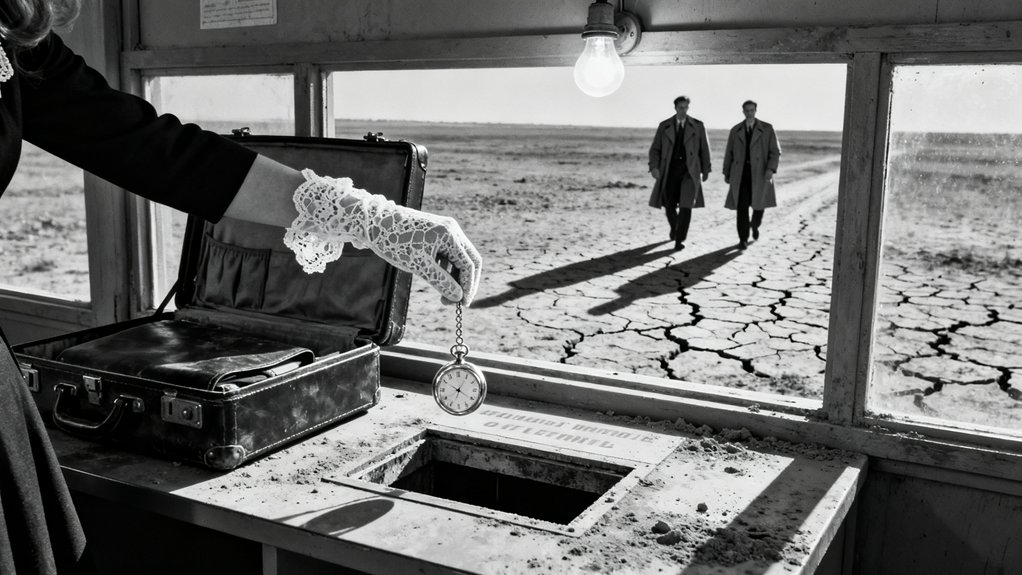
Operation Trust’s architects exploited the “Window 4” covert transit corridor, a lethal trap disguised as a safe passage into Soviet territory. They snared Boris Savinkov in August 1924, then trained their sights on Sidney Reilly, luring him across the same border a year later.
Dissecting Reilly’s Terminal Cell 73 interrogation logs now reveals the psychological precision of the CHEKA’s final snare.
Exploiting the “Window 4” Covert Transit Corridor
To exploit the Window 4 covert transit corridor, CHEKA weaponized border crossing protocols it secretly controlled, staging two distinct lures across the Soviet frontier. They didn’t simply open a door; they meticulously engineered a fatal trap. The August 1924 lure hooked Boris Savinkov, while September 1925’s snared Sidney Reilly. Each believed they were infiltrating a legitimate resistance.
CHEKA fabricated a seamless border crossing point, promising safe passage into Russia. Savinkov entered first, was instantly captured, and later executed, proving the corridor’s lethal reliability. Reilly followed, walking into a prearranged ambush that terminated his espionage career. Both agents trusted the fake network’s handlers, who were actually OGPU officers controlling every move.
Dissecting Sidney Reilly’s Terminal Cell 73 Interrogation Logs
The OGPU‘s mastery of Window 4 guaranteed that Sidney Reilly’s final mission ended not in a safe house, but in Cell 73 of the Lubyanka.
Reilly’s interrogation logs, declassified decades later, reveal a methodical psychological dismantling. He entered the cell in September 1925, already compromised by the Trust’s August 1924 lure that snared Boris Savinkov.
Savinkov’s own interrogation provided the blueprint; his confession, extracted under duress, exposed the Trust’s mechanics. Reilly, however, resisted. The logs show him parsing each question, probing for flaws. Yet the OGPU held every card. They played Savinkov’s records like a recording, trapping Reilly in contradictions.
His final entries, almost illegible, capture a man realizing his legend was just another bait.
Sustaining the 60-Month Mirage: Orchestrating Fake Skirmishes to Validate the Resistance
Maintaining credibility for five years demanded more than just forged documents and dead drops. The CHEKA had to manufacture kinetic proof that the Monarchist Union of Central Russia was a fighting force worth dying for. They orchestrated fake skirmishes along the Soviet border, staging raids on supply depots and ambushing Red Army patrols with actors dressed as monarchist fighters. Casualty reports were fabricated, and bullet-riddled uniforms were planted at scenes for border guards to find. These staged events generated propaganda that reached émigré circles in Paris and Helsinki. The CHEKA also used covert and illegal tactics such as forged correspondence and disinformation to incite internal discord among the monarchist groups. Staged ambushes involved CHEKA agents firing live rounds into empty forests; they then planted spent cartridges and blood-soaked bandages as evidence. They fabricated casualty lists by printing fake death notices in underground bulletins, naming real people who never fought. Radio operators broadcasted coded victory messages from a field headquarters that was actually a Lubyanka basement. To plant heroes, they captured real criminals, dressed them in monarchist uniforms, and executed them publicly to suggest fierce battles.
Every bloody charade cost lives, but it sold the lie well enough to keep the trap baited.
The Lubyanka Execution Conveyor: Processing and Neutralizing the Captured Diaspora Network
Having entrapped its targets through staged border crossings and fabricated safe houses, the CHEKA funneled captured émigrés directly into the Lubyanka’s basement processing center. This assembly line of death wasted no time on legal formalities. Guards stripped prisoners of identifying documents, recorded false confessions under duress, then directed them to soundproofed execution cells. The conveyor operated with ruthless efficiency. Victims often entered alive and exited as unidentified corpses within hours.
| Processing Stage | CHEKA Procedure |
|---|---|
| Intake | Document seizure, forced confession, personal effects inventoried for state theft |
| Interrogation | Beatings, water torture, psychological breaking; intelligence extraction prioritized |
| Disposal | Single bullet to the base of skull; bodies burned or dumped in mass graves |
The diaspora network never saw the trap for what it was. Each captured monarchist believed they had simply failed a mission, not that they had been betrayed from the moment they accepted a fake passport. The Lubyanka conveyor ran continuously for nearly five years, processing hundreds through its merciless machinery. No appeals existed. No mercy survived.
The April 1927 Defection: Eduard Opperput Penetrates the Finnish Consulate
Eduard Opperput’s April 1927 defection at the Finnish consulate in Helsinki shatters the CHEKA’s elaborate facade. Forensic analysis of the Helsinki whistleblower transcripts now exposes a critical flaw.
The CHEKA’s domestic intercept grid, designed to trap émigrés, instead reveals the operation’s internal paranoia. That grid’s own recorded chatter, intercepted by Opperput, becomes the primary evidence unraveling the entire deception.
Forensic Breakdown of the Helsinki Whistleblower Transcripts
Although Opperput’s defection appeared spontaneous, a panicked flight through the snow to the Finnish consulate in Helsinki in April 1927, the transcript of his initial debriefing reveals a meticulously rehearsed performance.
He doesn’t stammer; he recites. Every detail, from the password to Trust’s internal structure, is delivered without hesitation, a polished script.
He offers no raw emotional breaks, just clean, symmetrical intelligence drops.
The timeline of his escape is impossibly efficient, lacking the gaps of genuine fear.
He lists OGPU agents by rank, though he claims to be a low-level courier.
His promised access to Trust’s funds was a fiction; no treasury existed.
This wasn’t a whistleblower’s confession. It was a trap’s final act, broadcast from inside the consulate.
Unraveling the CHEKA’s Domestic Intercept Grid
The CHEKA’s domestic intercept grid did not crack; it was designed to leak. In April 1927, Opperput’s defection was not a break but a calculated release. The CHEKA fed him precise intercepts, letting him posture inside the Finnish consulate as a genuine double agent. His transcripts reveal a carefully curated flow of disinformation, not raw access.
| Intercept Type | Source Method | Purpose |
|---|---|---|
| Fabricated telegrams | Planted by CHEKA operators | Lure Finnish intelligence |
| Delayed mail intercepts | Real but timed leaks | Validate Opperput’s credibility |
| Non-functional radio logs | Simulated traffic | Inflate the fake resistance’s size |
Opperput never penetrated a real grid. He walked through an open door, a controlled channel built to sacrifice itself before tightening around the consulate’s assets.
The Maria Zakharchenko Retaliation: The Doomed 1927 Bombing Campaign in Moscow
Operation Trust’s lethal trap had only caught so many, leaving key figures like Maria Zakharchenko, a monarchist widow turned bitter exile, chafing beyond its reach. By 1927, she’d rejected the deception’s false hope, orchestrating a desperate, violent gambit to strike at the Kremlin‘s heart. Her plot was a coordinated bombing campaign across Moscow, aimed at shattering Bolshevik complacency.
Zakharchenko infiltrated Soviet territory with forged IDs, evading CHEKA border checks through sheer audacity. She planted bombs in a Party club and a dormitory, targeting NKVD officers and killing a commander, but failing to paralyze leadership. The bombings triggered mass arrests, revealing her network’s fragility as informants flipped under interrogation. She escaped Moscow but died in a shootout near the Polish border. Her revenge campaign ended in a ditch, not a courtroom.
This retaliation wasn’t a strategic threat. It was a spasm of fury against a machine that had already won. Such desperate, unauthorized violence echoes later patterns of covert retaliation by intelligence agencies, including the CIA’s own assassination plots against foreign leaders that evaded legal oversight.
Quantifying the Emigré Hemorrhage: The Mathematical Toll on Anti-Bolshevik Leadership
Zakharchenko’s bombs killed a commander but left the apparatus intact, exposing the futility of individual fury against a systemic predator.
The true slaughter wasn’t loud; it was statistical. The Trust didn’t just deceive, it bled the anti-Bolshevik leadership dry, one fabricated meeting at a time.
The true slaughter wasn’t loud; it was statistical, bleeding a movement dry one fabricated meeting at a time.
By 1927, the exile community hemorrhaged not just morale but its operational core. Declassified CHEKA ledgers reveal a grim calculus: over two hundred key figures (military strategists, financiers, ideological architects) crossed the border, lured by promises of a rising. None returned. Each absence carved a gap that no romantic assassination could fill.
This wasn’t war; it was attrition by arithmetic. The Trust transformed the emigré pool into a kill box, proving that numbers, not explosives, dismantle a movement. You can’t bomb a system that feeds on your own hope.
Cementing the Trust Doctrine: The Clinical Blueprint for KGB Cold War Provocations
CHEKA’s blueprint for the Trust didn’t dissolve with the 1920s; it calcified into doctrine. This clinical architecture of deception metastasized into the KGB’s Cold War handbook, a surgical template for luring, isolating, and neutralizing enemies through fabricated fronts.
The Trust doctrine perfected a method where the target’s own hope became the rope. It wasn’t merely a historical artifact; it became institutional DNA.
- Fabricated Fronts as Quarantine Zones: The KGB built fake dissident groups and émigré organizations, replicating the Trust’s structure to trap Western assets within controlled spaces.
- Double Agents as Viral Vectors: Trust-style handlers infected enemy networks with disinformation, their loyalty constantly tested through orchestrated operations.
- The Feedback Loop of Suspense: Targets received tantalizing proof of success (papers, meetings, grants), slowly tightening the noose of commitment.
- Execution as Termination Protocol: When the mark served its purpose, the KGB eliminated them quietly, leaving no trace for Western intelligence to reconstruct.
The Trust doctrine remains the KGB’s most lethal ghost, a machine that converts human desperation into a failure vector. This method mirrored the covert assassination of Patrice Lumumba, where Belgian officers directed the firing squad and supervised the handover and execution.
Frequently Asked Questions
How Did the CHEKA Recruit Initial Monarchist-Like Agents?
The CHEKA didn’t recruit genuine monarchists; it weaponized compromised ones. It captured exiled operatives upon their return, then forced them to write letters praising a fake resistance.
Those letters, sent abroad, duped other monarchists into believing a legitimate network existed. This trap relied on exploiting loyalty, not building it, ensnaring targets through coercion rather than ideological alignment. It’s a chilling tactic: turning trusted voices into bait for execution.
Were Any Western Double Agents Aware of the Operation Early?
No concrete evidence suggests any Western double agent knew of Operation Trust early.
The CHEKA’s cleverly crafted false front kept its true intent concealed for years.
Western intelligence services, thoroughly trusting the fabricated resistance, didn’t suspect a Soviet trap until much later.
Only after the operation’s shocking end did they piece together its lethal architecture, realizing they’d been skillfully manipulated from the start.
What Was Dzerzhinsky’s Personal Involvement in Day-To-Day Forgeries?
Dzerzhinsky’s direct day-to-day involvement in the forgeries for the fake resistance remains unclear, but he couldn’t have ignored them.
He personally approved the operation’s deceptive framework, ensuring every fabricated document and seal bore the CHEKA’s hallmark of authenticity.
His signature likely authorized key forgeries, though he delegated their physical creation to trusted subordinates.
This hands-off oversight still made him the operation’s ultimate ghostwriter.
How Did Fake Skirmishes Avoid Revealing Their Staged Nature?
You can’t fake a war without casualties. The CHEKA’s staged skirmishes avoided exposure by using real bullets and willing sacrifices. Trusted agents or expendable prisoners died to sell the illusion. They’d script retreats, scatter genuine documents, and plant bodies with convincing wounds. No observer dared question blood-soaked ground. It’s a perfect lie when someone actually dies for it.
Did the 1927 Defection Trigger Any Official British Public Inquiry?
No official British public inquiry resulted from the 1927 defection. Whitehall opted for quiet containment, not parliamentary scrutiny. They suppressed details to avoid legitimizing Soviet deception claims or exposing their own intelligence failures.
Government archives show no record of a formal investigation; instead, internal memos reveal a frantic effort to bury the episode. The silence itself functioned as an implicit admission that the Cheka had successfully penetrated British intelligence, a cold reality no inquiry could safely confront.
Final Thoughts
Operation Trust’s machinery hummed long after its architects turned to dust. The forgery, the phantom union, the calculated betrayal each component now echoes in modern counter-intelligence doctrine. But the final question remains unanswered: how many still wander into the Cheka’s shadow, lured by a ghost resistance? The blueprint endures, waiting. The next target’s footstep is already crossing the border. Silence follows. Always.