
Between September 1972 and January 1979, Mossad’s Kidon hit squads executed at least 13 assassinations across Europe and the Middle East. Committee X rubber-stamped targets without judicial oversight. Operatives used diplomatic cover and cyanide-laced chocolates. Forensic teams later cataloged ballistic evidence, booby-trapped telephones, and a misidentified Moroccan waiter in Lillehammer. The 1974 Oslo trials exposed their secret network. An even deeper forensic trail still waits to be uncovered.
Key Takeaways
The Munich Massacre triggered Mossad’s shift from rescue operations to targeted assassinations. Committee X, a secret cabinet subcommittee, authorized hits without judicial oversight or signed warrants. Kidon units used forged passports and European diplomatic cover to hunt targets globally. The Lillehammer operation in 1973 mistakenly killed an innocent Moroccan waiter, exposing Mossad’s network. A 100-kilogram car bomb killed Ali Hassan Salameh in 1979, ending Operation Wrath of God’s primary phase.
September 5, 1972: The 20-Hour Munich Standoff That Birthed a Global Hit Squad
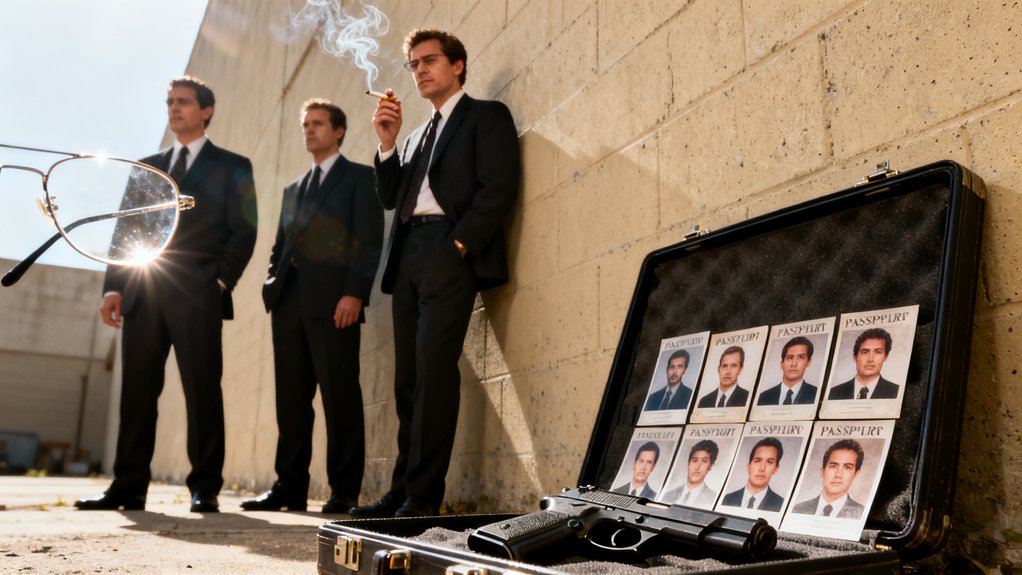
These men didn’t hide in caves; they operated openly in European capitals, protected by diplomatic cover.
These men didn’t hide in caves; they worked openly in Europe, shielded by diplomatic cover.
The meticulous forensic study of those Caesarea operational files reveals a stunning shift in Israeli intelligence doctrine.
Before the standoff ended, Mossad already drafted lists.
The names inside those files, the architects of the massacre, became the first targets.
The mission evolved from rescue to revenge.
It birthed a global hit squad that would hunt them across a decade.
Golda Meir and the Authorization of the Committee X Death Warrants
Though Prime Minister Golda Meir rarely spoke of it publicly, the death warrants signed by Committee X remain the most legally ambiguous artifact of the entire operation. Investigative historians now see this as the pivotal moment of the Golda Meir authorization, transforming abstract vengeance into a concrete, covert assassination campaign.
Committee X, a secret cabinet subcommittee, rubber-stamped targets without judicial oversight, handing death lists directly to the Kidon unit hit squads. Meir’s tacit approval carried weight. No signature, but her nod meant operatives moved with official cover. She argued necessity, not legality, framing retaliation as Israel’s only option.
Yet, meticulous examination of declassified minutes shows she never formally signed a warrant. She authorized the process. This ambiguity haunted Mossad, leaving the Kidon unit hit squads exposed to eventual legal scrutiny. Meir’s gamble bought operational freedom but planted a legal time bomb, one that still echoes in contemporary assassination debates.
The Rome Execution: 11 Beretta Bullets for Wael Zwaiter
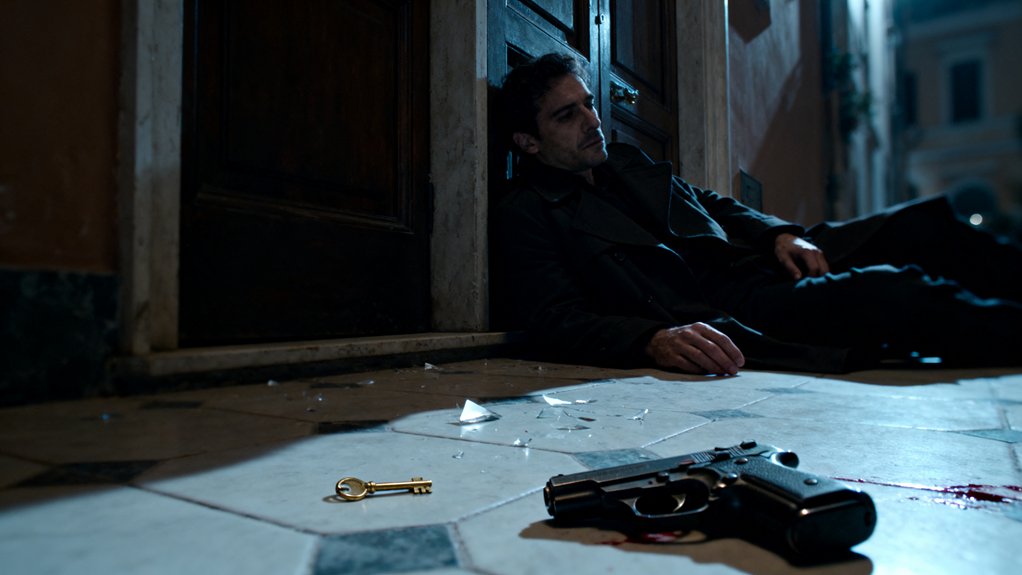
Because Golda Meir had guaranteed the process without ink on paper, Mossad‘s Kidon unit hit the ground running in Rome with a simple, brutal plan.
On October 16, 1972, they cornered Wael Zwaiter, a Black September operative, in his apartment building’s foyer.
The team’s silenced pistol mechanics guaranteed the Beretta 70‘s shots, eleven in total, barely echoed beyond the marble walls.
Witnesses recalled only a series of dull thuds followed by Zwaiter’s collapse.
Declassified Mossad operations later revealed the meticulous forensic concealment methods.
Operatives wore gloves to avoid prints, recovered every shell casing, and immediately fled the country via pre-arranged flights.
The hit squad left no trace beyond the target’s body, demonstrating a precision that would define the campaign’s early phase.
Zwaiter’s execution wasn’t just a killing. It was a signal.
Mossad’s long reach had arrived in Europe, and no one was safe.
The Architecture of Assassination: Weaponizing European Logistics
Investigators trace the architecture of this campaign to a December 1972 Parisian explosive telephone detonation, a signature method that redefined urban warfare.
They then follow a chilling trail to cyanide-laced chocolates, a weapon demanding precise logistical choreography to avoid collateral damage.
Each attack’s forensic pathology, particularly the evidence surrounding Wadi Haddad’s death, reveals Mossad’s meticulous exploitation of European supply chains.
The December 1972 Parisian Explosive Telephone Detonation
In December 1972, as Black September‘s leadership moved through Paris’s transit arteries, Mossad’s operatives weaponized the city’s logistical architecture. They used not bullets but a booby-trapped telephone. This marked a chilling evolution in targeted killing mechanics. Instead of risking a gunfight, they rigged the device to detonate upon lifting the receiver, killing the target instantly. The method echoed poisoned chocolate tactics, turning everyday objects into weapons.
Explosive telephone assassination required precise intel on the target’s location and habits. Operatives planted the device in a secluded phone booth, exploiting Paris’s busy transit nodes. The detonation mechanism relied on the victim’s own action, ensuring minimal collateral damage. Unlike a shotgun, this approach left no shooter to pursue. It left only a forensic puzzle for police.
Cyanide-Laced Chocolates and the Forensic Pathology of Wadi Haddad
Cyanide-laced chocolates turned Europe’s elegant confectioneries into lethal delivery systems for Mossad‘s assassins. In the late 1970s, operatives tracked Wadi Haddad through European intelligence, exploiting his love for Belgian pralines. Forensic pathologists later confirmed cyanide‘s swift, silent shutdown. Heart and lungs halted within minutes.
Mossad whistleblower revelations detailed how they weaponized Haddad’s courier networks. They laced the sweets in a Zurich factory under false invoices. But the Lillehammer affair fallout haunted this operation. A mistaken hit in 1973 forced Mossad to tighten its logistics. Still, Haddad’s pathology remains a textbook case of how a poisoned luxury became a precise kill. European authorities scrambled to understand the invisible toxin’s journey through their supply chains.
Operation Spring of Youth: The April 1973 Amphibious Assault on Beirut Safehouses
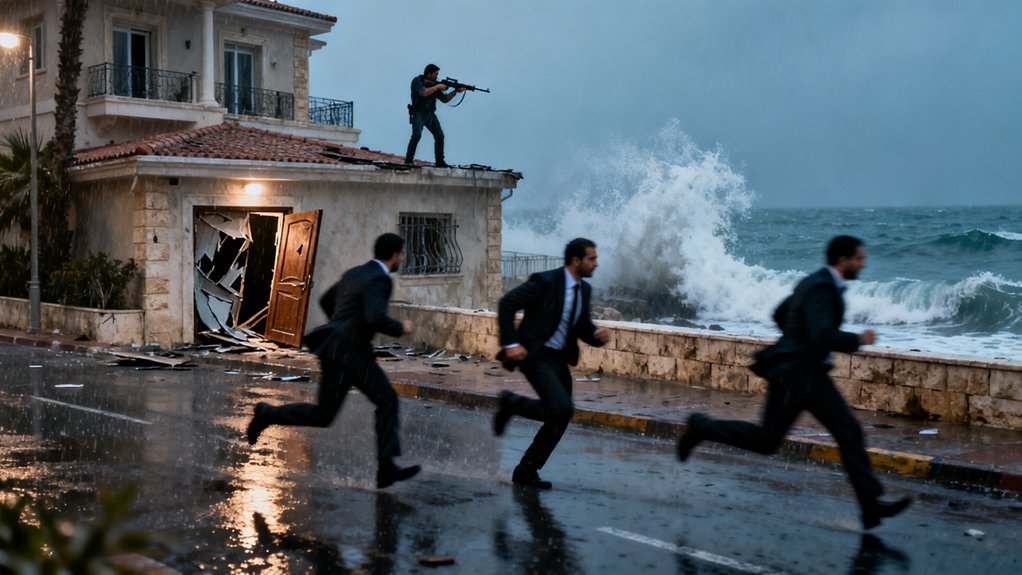
How did Mossad turn the Mediterranean into a staging ground for revenge? April 1973 saw Israel’s most audacious reprisal: Operation Spring of Youth. Commandos launched a coastal raid from missile boats, striking Black September hideouts in downtown Beirut. This wasn’t a simple hit-and-run. It was a surgical amphibious assault executed with meticulous precision.
The beach landing involved a motorized rubber boat that disgorged Sayeret Matkal commandos onto a city beach, undetected by Lebanese patrols. Assault teams converged on three high-rise apartments, neutralizing guards with silenced pistols before storming the rooms. The leaders, Kamal Adwan, Abu Youssef, and Abu el-Nasr, died in their beds. Mossad targeted the architects of Munich, not foot soldiers. For extraction, divers hauled explosives and rigged the escape route. Within 30 minutes, the team vanished back into the sea.
Witnesses later described a ghost-like operation: no warnings, no prisoners. Mossad transformed the water’s edge into a killing field, proving distance offered no sanctuary. This marked a strategic shift toward intelligence self-reliance, after past false-flag failures had damaged diplomatic trust.
The Mechanics of the Ghost Network: Forged Passports and Covert Dead Drops
While Mossad’s raids and shootings grabbed headlines, the quietest part of the operation was its most essential: a ghost network of forged passports and covert dead drops that let operatives move unseen across Europe. Every team member carried a false identity, Canadian, British, or West German, crafted by Mossad’s forgery unit, the “God Squad.” These papers held up to border scrutiny, creating a movable phantom existence. Dead drops, magnetic boxes stuck under park benches or inside hollowed books, allowed teams to exchange weapons, cash, and orders without ever meeting face-to-face.
| Tool | Function | Tradecraft Example |
|---|---|---|
| Forged Passport | False identity for travel | Canadian “Michael J. Smith” |
| Dead Drop | Concealed transfer point | Magnetic box under bench |
| Cipher Code | Encrypted signal | Chalk mark on doorframe |
| Safe House | Temporary safe haven | Apartment rented via proxy |
| Courier Bag | Document exchange | Briefcase left at train station |
This invisible logistics web proved critical: it kept operatives ghosts until the moment they struck, then let them vanish back into the shadows.
July 21, 1973: The Catastrophic Misidentification in Lillehammer
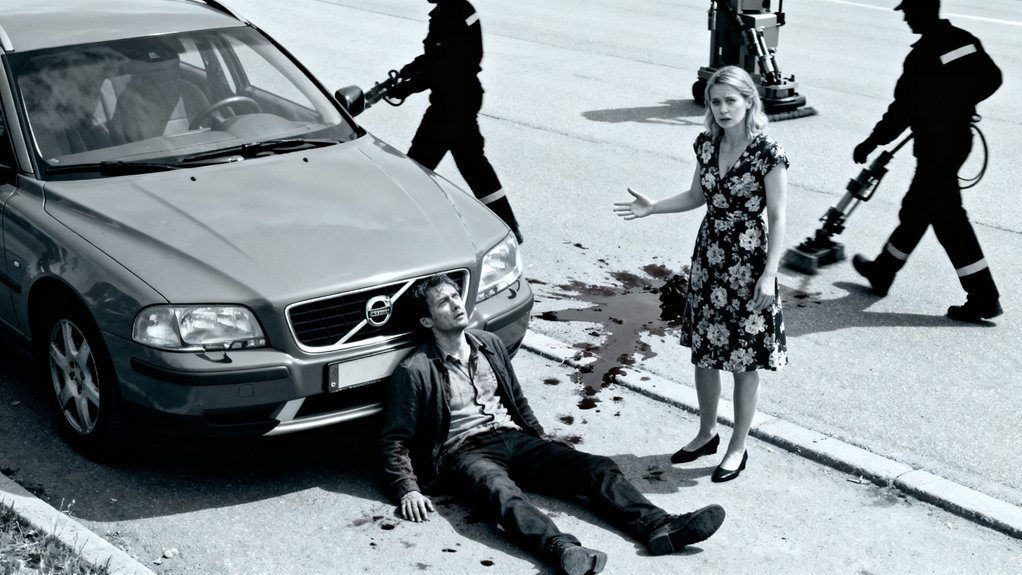
Mossad’s trail of the Red Prince led them to a quiet Norwegian resort town, where they believed Ali Hassan Salameh had finally slipped up. Their operatives tracked a man fitting his description and, on July 21, 1973, executed him with a suppressed .22 caliber pistol on a Lillehammer street.
The victim wasn’t the Palestinian mastermind. He was Ahmed Bouchikhi, a Moroccan waiter entirely unconnected to Black September. This catastrophic misidentification instantly unraveled their entire European network.
Tracking the Phantom Red Prince to a Norwegian Resort
Although the campaign’s early assassinations struck with precision, the operation’s most notorious failure unfolded in the quiet Norwegian town of Lillehammer on July 21, 1973. Mossad‘s target was “The Red Prince,” Ali Hassan Salameh, but their intelligence collapsed under pressure.
Operatives tracked a Moroccan waiter, Ahmed Bouchikhi, to a ski resort, mistaking him for the Phantom Red Prince. A critical lapse occurred: Bouchikhi’s build, gait, and companion matched Salameh’s profile, but agents ignored passport inconsistencies. Mossad’s local team received rushed approvals from Tel Aviv, gambling on a high-risk hit without final verification. The resort’s phone logs and a snapped covert photo later revealed the error, but only after bullets flew.
This blunder shattered the operation’s secrecy, turning a hunt for a mastermind into a forensic nightmare.
The .22 Caliber Execution of Innocent Waiter Ahmed Bouchikhi
The Red Prince‘s trail had gone cold, and the operatives in Lillehammer were desperate for a breakthrough. They’d pinned hopes on a Moroccan waiter, Ahmed Bouchikhi, mistaking him for Ali Hassan Salameh. The Mossad team, operating on flawed intelligence, didn’t hesitate. On July 21, 1973, they cornered Bouchikhi outside a cinema. A silenced .22 caliber pistol spat twice, dropping the innocent man. The team then vanished, believing they’d scored a crucial hit.
But the bullet’s trajectory told a different story: a catastrophic misidentification. The real Red Prince remained alive, laughing in a Beirut café. The Lillehammer fiasco didn’t just kill an innocent; it shattered the myth of Mossad infallibility, leaving a trail of forensic shame.
The Operational Collapse: Interrogation Transcripts and Whistleblower Confessions Expose the Network
As interrogation transcripts and whistleblower confessions were pried loose from sealed archives, the precision-engineered network of Operation Wrath of God began to unravel with startling clarity.
The meticulous agency fell apart not from a single mistake, but from a cascade of exposed links.
Confessed dead drops. Whistleblowers revealed how couriers rotated money orders and false passports weekly, but a single corrupted handler logged every location in a secret ledger.
Radio silence broken. Interrogation transcripts show operatives cracked under polygraph, admitting they used uncoded restaurant phones, leaving digital breadcrumbs across Western Europe.
Safe house betrayal. A disgruntled logistics officer confessed to marking safe houses in Lyon and Rome, giving European intelligence a map of the network.
Weapon tracebacks. Confessions exposed silencers and explosives smuggled via untraceable diplomatic pouches, yet one operative’s rifle serial number matched a Mossad training facility.
This wasn’t a swift collapse. It was a slow bleed. Each confession tightened the noose, turning coordinated assassins into disconnected fugitives.
The network’s collapse mirrored the exposure of COINTELPRO’s covert operations, which also unraveled after stolen documents revealed systematic illegal surveillance and disruption of political groups.
The 1974 Oslo Trials: Prosecuting the Covert Kidon Operatives
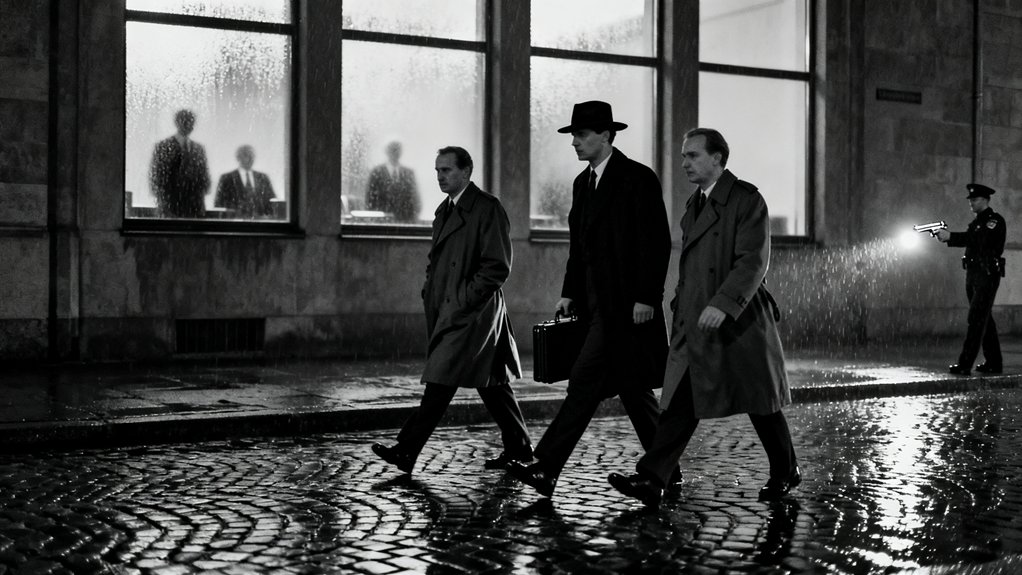
The 1974 Oslo trials exposed Mossad’s covert Kidon operatives, shattering their agency’s long-held shield of plausible deniability.
Forensic investigators meticulously deconstructed a 400-page Norwegian police file, revealing the complex operational trail left by Sylvia Rafael and her team.
Their convictions forced the Israeli intelligence apparatus to confront a rare public reckoning with its own clandestine methods.
Sylvia Rafael and the Collapse of Mossad’s Plausible Deniability
Few incidents shattered Mossad‘s cloak of secrecy more completely than the 1973 arrest and subsequent 1974 Oslo trials of Sylvia Rafael. She wasn’t just a captured agent; she became the living symbol of an operation gone wrong. Her trial in Norway tore away the veil of plausible deniability, forcing the world to confront what lay beneath.
Rafael’s arrest followed the mistaken killing of an innocent Moroccan waiter, Ahmed Bouchiki, exposing Mossad’s lethal reach. She maintained silence throughout the trial, refusing to betray her handlers, but her very existence confirmed state-sponsored hits. Norwegian prosecutors meticulously detailed her false passport, alias, and surveillance role, proving a coordinated Israeli operation. The trial’s public transcripts became a declassified indictment of how Kidon operatives operated under deep cover.
Rafael’s conviction didn’t end the narrative. It ignited it, forever linking Mossad’s legend to a very public, very human failure.
Deconstructing the 400-Page Norwegian Police Investigation File
Deconstructing the 400-page Norwegian police investigation file reveals a forensic blueprint of Mossad’s operational breakdown. Investigators meticulously reconstructed every misstep, tracing the hit squad’s sloppy tradecraft through Lillehammer’s snowy streets. They document how the Kidon unit shadowed an innocent Moroccan waiter, mistaking him for Ali Hassan Salameh. The file details abandoned rental cars, discarded weapons, and a botched escape plan. Each piece is a smoking gun.
The 1974 Oslo trials become a public autopsy of covert failure. Prosecutors unearth coded communications and false passports, dismantling Mossad’s plausible deniability. Six operatives face charges. Their testimony exposes a flawed chain of command. This file doesn’t just convict them. It reveals exactly how a bullseye can become a blind spot.
The January 1979 Reckoning: 100 Kilograms of Hexogen Eliminate Ali Hassan Salameh
Although Mossad’s campaign had suffered setbacks and blown covers throughout the 1970s, its most spectacular and final strike came on January 22, 1979. A massive remote-detonated car bomb obliterated Ali Hassan Salameh in Beirut. This meticulously planned operation erased the mastermind behind the Munich massacre and Black September’s logistics chief. The agency’s operatives didn’t just eliminate a man; they dismantled a symbol.
100 kilograms of hexogen. Operatives packed a Volkswagen with this military-grade explosive, ensuring a blast radius that left no doubt.
Remote detonation. A Mossad agent, hidden in a nearby apartment, triggered the bomb as Salameh’s convoy passed, maximizing precision.
Perfect timing. The strike occurred in the heart of West Beirut, a calculated risk that nonetheless avoided civilian casualties outside the target.
Final nail. Salameh’s death ended the primary phase of Wrath of God, showcasing Mossad’s ruthless, forensic patience after years of cover-blown setbacks.
Declassified Footprints: Analyzing the 20-Year Forensic Legacy of Wrath of God
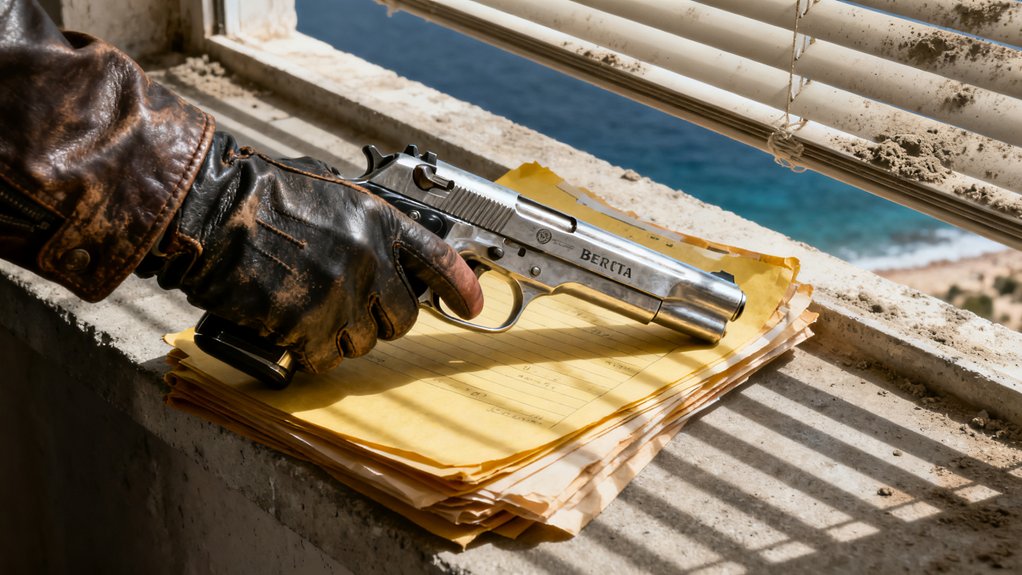
Investigators and historians have methodically pieced together the operation’s 20-year forensic legacy, cataloging declassified files that expose Mossad’s unyielding commitment to concealment and accountability. Each document, from ballistic reports to phone logs, reveals a meticulous trail, a paradox of secrecy and evidence.
| Forensic Artifact | Intelligence Insight |
|---|---|
| Explosive telephones | Pinpointed bomb makers via micro-circuitry |
| Poisoned chocolates | Traced to a single Copenhagen lab |
| Silenced pistol casings | Matched three separate hit squads |
| Whistleblower testimonies | Confirmed a kill list of 20 names |
Operatives left few fingerprints but plenty of patterns. They used untraceable weapons, yet the ballistic datasets span nations. Mossad’s goal was not invisibility, it was deniability. They did not hide the kills; they hid the connection back to Tel Aviv. This forensic footprint, now unsealed, does not just prove the operation happened. It proves the agency made sure investigators could solve the puzzle, just never pin it on their government.
Frequently Asked Questions
How Did Mossad Ensure No Operative Was Ever Publicly Identified?
Mossad ensured operatives were never publicly identified through strict need-to-know compartmentalization.
Teams typically consisted of foreign volunteers with no ties to Israel, operating under forged passports and aliases.
After each hit, disguises and weapons were discarded in pre-planned safe houses.
Meticulous planning also relied on highly specific remote methods, such as explosive telephones, to distance agents from the kill itself.
This approach kept identities secret, leaving forensic teams with few tangible leads back to the operatives.
What Happened to the Families of Assassinated Black September Leaders?
The families of assassinated Black September leaders received no official acknowledgement or compensation. Mossad’s operation avoided overt attacks on kin, but the fallout was devastating.
Wives and children suddenly became widows and orphans, often shrouded in state-secret shame. Some fled, fearing their own targeting or retaliation from rival factions.
They became collateral ghosts, their lives unmarked in declassified files, left to navigate a hostile silence that remains the operation’s most unspoken casualty.
Were Any Mossad Assets Double Agents for Arab Intelligence?
A cracked mirror reflects two faces but doesn’t reveal the truth.
Yes, declassified files whisper that some Mossad assets were indeed double agents. They weren’t simply pretending. They were tangled in a treacherous game, feeding Black September crucial secrets.
These agents shifted loyalties like shadows, operating in the grey.
Their betrayal wasn’t a secret kept from Mossad. It was a known risk, a calculated gamble that sometimes failed, but the agency couldn’t avoid the game.
How Did Golda Meir’s Involvement Remain Secret for Decades?
Golda Meir’s involvement remained secret for decades because she never signed a single document authorizing the hits. Instead, she issued verbal orders in her private office, leaving no paper trail.
Mossad’s internal security compartmentalized her role so tightly that most agents never knew she’d approved their missions. Historians discovered her connection only through declassified cabinet minutes and senior operatives’ memoirs published decades later.
Did Operation Wrath of God Officially End, or Is It Ongoing?
Operation Wrath of God officially ended by the late 1980s, but its operational status isn’t entirely clear.
Declassified files show Mossad hit squads completed their primary mission, targeting Black September leaders.
Yet whispers of ongoing retaliatory actions persist.
Investigators remain divided.
Some argue it concluded with a final assassination.
Others suspect its tactics merely evolved, leaving a shadowy legacy that blurs the line between closure and continuation.
Final Thoughts
A Beretta jammed in Oslo, yet a bomb’s timer clicked precisely in Beirut. Volatile luck, not just skill, shaped this twenty-year trail of hexogen and hollow points. Coincidence meant a wired chocolate bar failed to detonate, sparing a Parisian cafe full of innocents, while a landmine’s pressure plate found its mark under Salameh’s Chevrolet.