From 1967 to 1985, the Navy’s auditing system rubber-stamped classified document destruction logs without verifying a single burn. This process actively shielded warrant officer John Walker. He traded America’s entire nuclear submarine cryptographic system to the KGB while flaunting private planes and flashy cars. Lax oversight let a traitor operate openly for seventeen years. It was an institutional failure that dismantled the U.S. naval deterrent. The full story reveals how this radical breach was finally caught.
Key Takeaways
The Navy’s two-man rule for classified communication centers was unenforced. Lone workers often bypassed the requirement. Auditors accepted signed destruction logs without verifying that classified materials were actually burned. For decades, discrepancies in classified document records were dismissed as minor clerical errors. No inventory cross-checks occurred. This allowed Walker to steal keylists undetected for 17 years. The systemic auditing failure enabled the KGB to access submarine communications in real time, erasing the Navy’s stealth advantage.
The 1967 Soviet Embassy Walk-In: A Bankrupt Warrant Officer’s Treasonous Pitch
Although he’d never earned more than a modest Navy paycheck, John Walker arrived at the Soviet Embassy in Washington, D.C., in 1967 as a bankrupt petty officer desperate for a financial lifeline. His decision launched a john walker espionage operation that would last seventeen years.
Broke and bitter, he walked in with stolen keys and left with Soviet cash.
Walker didn’t come empty-handed. He brought stolen cryptographic keys for the KGB‘s immediate evaluation, high-value assets that opened U.S. naval communications. The offer was a concise deal: cash for secrets. He’d calculated that the Navy’s lax oversight would never catch him.
Walker felt no loyalty, only resentment toward an institution he believed shortchanged him. His pitch worked. The Soviets paid him thousands for the initial drop, securing a long-term asset who’d methodically plunder classified material. He didn’t need spycraft. He needed only access and a broken auditing system. The FBI’s own secret COINTELPRO program had proven that unchecked federal surveillance could operate for years without detection, a model of institutional failure Walker exploited.
That first meeting transformed a desperate man into a traitor, setting the stage for a catastrophic compromise.
Hemorrhaging the Cryptographic Vault: Handing Moscow the Keys to the Kingdom
Walker handed the KGB the technical schematics and keying material for the KL-7 and KW-37 cipher machines, the very backbone of U.S. naval communications.
This decryption windfall let Moscow read the Pentagon’s most secure traffic in near real time.
It blinded American commanders to Soviet submarine movements.
The Navy’s failure to even inventory these critical assets guaranteed the cryptologic vault hemorrhaged secrets for years.
Compromising the KL-7 and KW-37 Cipher Machines
The cryptographic vault hemorrhaged from the moment John Walker handed over the first key cards. He didn’t need to steal the machines themselves; he compromised cipher codes and provided classified naval manuals. This let the KGB peel back the Navy’s most secure communications layer by layer.
The KL-7 vulnerability stemmed from Walker’s key cards. They reset the cipher wheels, turning an unbreakable machine into a predictable one.
For the KW-37 compromise, monthly key lists allowed the Soviets to decrypt real-time fleet broadcasts without detection. Manual theft enabled Walker to steal detailed operating procedures. This taught the KGB exactly how to exploit each system.
Seventeen years of access persisted because Navy auditing never caught the missing documents or key cards, leaving the breach wide open.
The Soviets didn’t crack the code. Walker handed them the combination.
The Decryption Windfall That Blinded the Pentagon
Because Navy auditing remained virtually nonexistent, the Kremlin’s cryptanalysts received a direct pipeline into America’s most guarded naval communications. This windfall left the Pentagon blind to Soviet submarine movements for nearly two decades. Walker’s stolen key lists did not just open messages; they provided the KGB with a real-time roadmap of classified fleet movements. The Soviets did not need to break codes. They simply read the plaintext.
| Cryptographic Yield | KGB Advantage | Pentagon Blind Spot |
|---|---|---|
| KW-37 key lists | Decrypted fleet orders | Nuclear sub patrol routes |
| KL-7 cipher settings | Tracked carrier groups | Atlantic force deployments |
| KWR-37 crypto materials | Predicted port visits | Mediterranean maneuvers |
| Fleet broadcast schedules | Anticipated exercises | Pacific battle group locations |
| Updated key change protocols | Intercepted over-the-horizon targeting | Strategic weapons carrying subs |
This was not just espionage; it was the wholesale surrender of America’s naval communications intelligence.
Flashy Cars and Private Planes: A 17-Year Masterclass in Abysmal Operational Security
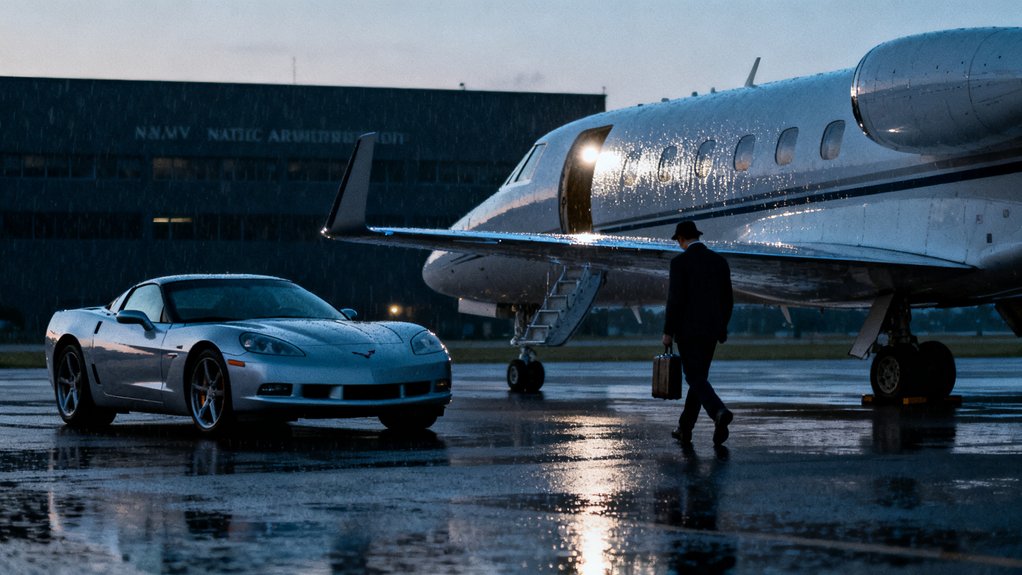
Although the Walker Spy Ring‘s 17-year success hinged on catastrophic Navy auditing failures, John Walker’s personal lifestyle choices made a mockery of any notion of espionage tradecraft. He didn’t operate from shadows; he flaunted his treachery. This was a masterclass in terrible operational security masked only by a systemic Navy failure to look.
- He bought a private plane and a fleet of flashy cars (including a Cadillac and a Lincoln) on a Navy warrant officer’s salary, prompting no questions.
- He threw lavish parties at his Norfolk home, where he openly discussed his unexplained wealth with neighbors.
- He divorced his wife, Barbara, who knew of his spying, yet he didn’t alter his behavior, assuming the Navy wouldn’t notice.
- He even recruited his son, Michael, directly into the ring, exposing a minor to high-risk espionage.
Walker didn’t hide the treasure; he flaunted it. The Navy just refused to see.
The Navy’s vaunted two-man rule in classified comm centers had become an illusion, a paper procedure no one enforced.
For nearly two decades, auditors simply ignored glaring holes in document destruction logs. These discrepancies, which Walker’s daily thefts created, formed a trail the Navy never bothered to follow.
This pattern of institutional denial mirrored the CIA’s destruction of MKUltra files, ordered by Richard Helms to erase evidence of illegal human experimentation.
The Illusion of the Two-Man Rule in Classified Comm Centers
In classified communications centers, the Navy’s vaunted two-man rule was designed to prevent a single person from stealing secrets. It was nothing more than a paper shield.
Walker exploited this illusion, bypassing a system that wasn’t truly enforced. Cold War counterintelligence assumed this rule made compartments secure, but it failed utterly. The reality was stark:
- Single-person access: Duty officers often worked alone, signing in absent colleagues.
- Fake countersignatures: Walker forged second signatures on logs.
- No verification: Supervisors never audited whether two people actually handled material.
- Real-time theft: Walker walked out with cryptographic keys during solo shifts.
This farce directly compromised global naval positioning. The Soviets tracked American subs because the two-man rule didn’t exist in practice.
Ignoring Decades of Document Destruction Discrepancies
The Navy never cross-checked its own classified document destruction records, so Walker’s theft went unnoticed for nearly two decades. Auditors routinely accepted signed destruction logs without verifying the documents actually burned. This bureaucratic blind spot allowed Walker to spirit away cryptographic materials, the very keys enabling Soviet nuclear submarine tracking.
The 17-year security breach persisted not through clever spycraft but because no one reconciled what was allegedly destroyed against what vanished. Each discrepancy represented a stolen secret, yet Navy censors dismissed them as clerical errors. They couldn’t imagine a warrant officer exploiting their trust so systematically. Walker’s operation thrived on this neglect; the Navy’s auditing failure didn’t just shield a traitor. It handed the Kremlin America’s most sensitive naval positioning intelligence.
Weaponizing the Family Tree: Expanding the Espionage Syndicate Through Blood and Bribes

Walker didn’t build his spy ring alone. He co-opted Chief Radioman Jerry Whitworth, whose prime access to Pacific Fleet communications opened a trove of naval intelligence.
He then groomed his own son, Michael, a seaman aboard the USS Nimitz, turning family loyalty into a direct pipeline for classified materials.
Co-Opting Jerry Whitworth for Prime Pacific Fleet Intelligence
As John Walker’s own reckless patterns began to invite unwanted scrutiny, he pivoted to a far more dangerous play: recruiting a fellow sailor with direct access to the Pacific Fleet’s most sensitive communications. Jerry Whitworth, a talented but disgruntled radioman, became the crown jewel of Walker’s operation, exploiting the same U.S. Navy auditing failure that had let Walker roam free.
Whitworth’s post at Naval Air Station Alameda gave him direct access to Pacific Fleet cryptographic keys. Walker bribed him systematically, paying thousands while Whitworth photographed entire keylists during midnight shifts. The KGB received real-time access to submarine communications, erasing America’s underwater stealth advantage. Whitworth’s treason continued for years, unchecked because no one cross-checked inventory against personnel access logs.
This wasn’t espionage genius. It was a gaping hole in Navy oversight.
Grooming Son Michael Walker Aboard the USS Nimitz
Having already corrupted his best friend, John Walker turned next to his own son. Warrant Officer John Walker saw Michael, a seaman aboard the USS Nimitz, as an extension of his espionage empire. He groomed him slowly, leveraging paternal authority to secure access to cryptographic materials and communications logs. Michael’s position aboard a nuclear-powered supercarrier provided direct intelligence on battle group movements, further tightening the Soviet strategic naval advantage.
| Year | Michael’s Role | Stolen Intelligence |
|---|---|---|
| 1983 | Seaman, USS Nimitz | Aircraft schedules |
| 1984 | Radio operator drafts | Ship movement codes |
| 1985 | Classified courier runs | Keylist fragments |
| 1986 | Intel briefings | Submarine patrol routes |
| 1987 | Full compliance | Encryption manuals |
Michael’s recruitment was not just nepotism. It was meticulous operational expansion. Through the Navy’s failures, father and son deepened the breach.
Neutralizing the American Nuclear Deterrent: The Soviet Submarine Tracking Advantage
How exactly did the KGB manage to neutralize the United States’ most critical strategic deterrent for nearly two decades? They didn’t build superior sonar. They simply read America’s mail. John Walker’s stolen cryptographic keys handed the Soviets an unfathomable advantage, allowing them to pinpoint the exact locations of America’s nuclear boomers in real time.
They didn’t build superior sonar. They simply read America’s mail.
- Key Compromise: Walker sold KRYPTON cipher keylists, directly unlocking encrypted Navy tactical messages.
- Position Tracking: With decrypted traffic, Soviet analysts reconstructed every U.S. submarine’s patrol route and communication schedule.
- Immediate Shadowing: Soviet attack subs then quietly tailed each American boomer, ready to destroy it the moment war began.
- Deterrence Void: This rendered the entire U.S. sea-based nuclear deterrent (the nation’s primary second-strike weapon) effectively blind and trackable for seventeen years.
The Soviets didn’t need technological breakthroughs. They just exploited a catastrophic auditing failure.
The November 1984 Tip-Off: How a Scorned Ex-Wife Pierced a Decades-Long Blind Spot
The FBI agents didn’t dismiss her as a vindictive ex. They meticulously read each letter, revealing Walker’s KGB operations.
Barbara’s tip-off didn’t just accuse him; it provided concrete proof. She described his meetings in dead drops, his payments, and his contempt for Navy audits. This wasn’t a hunch, it was a key that opened a decade and a half of overlooked signals.
Her disdain pierced what professional counterintelligence could not, a systemic failure finally exposed by a personal betrayal.
The cover-up echoed the same 50-year Allied suppression of the Katyn massacre, where truth was buried for political expediency.
Operation Windfly: The Bureau’s High-Stakes Wiretaps and Counter-Surveillance Grid
Why would the FBI trust an ex-wife’s word over seventeen years of failed Navy audits? They did not, not without corroboration. Starting March 1985, agents launched Operation Windfly, constructing a meticulous counter-surveillance grid around John Walker.
Parallel wiretaps on John’s home phone and mobile line captured his coded calls, revealing dead-drop scheduling without alerting him.
A 24-hour physical stakeout with rotating teams in unmarked vans mapped his routine, noting his habit of using payphones from odd locations like gas stations.
Covert electronic beacons placed inside his trash barrel and car undercarriage allowed the FBI to track his movements without direct tailing.
Signal intercepts from his ham radio transmitter confirmed encrypted bursts to handlers, matching the KGB’s known frequency patterns.
The Bureau didn’t need the Navy’s files. They needed hard evidence. And within weeks, the grid delivered it.
The May 1985 Poolesville Dead Drop: Intercepting the KGB Trash Bag
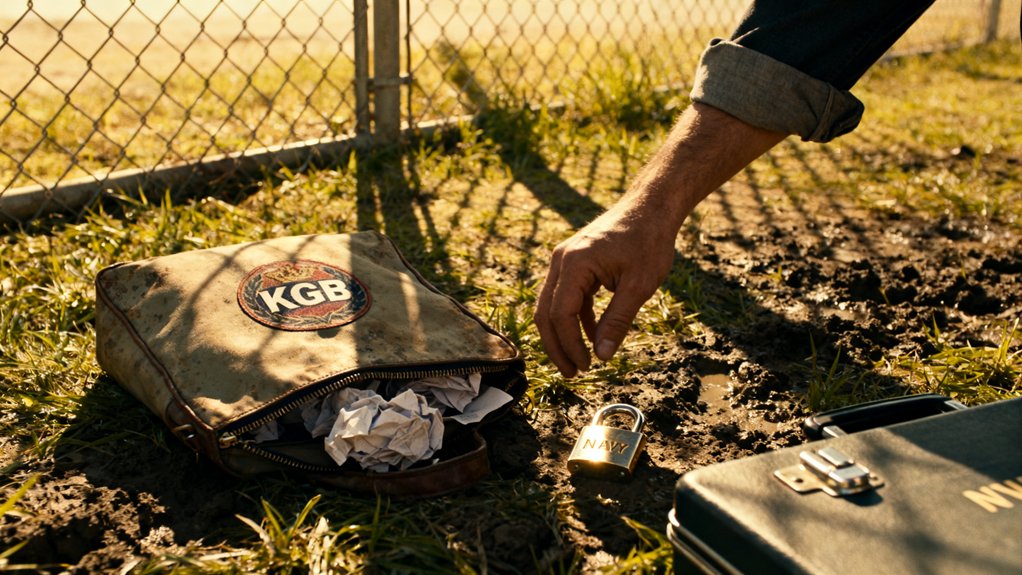
On a cool May night in 1985, FBI surveillance teams tracked John Walker to a remote dead drop near Poolesville, Maryland. Agents watched him deposit a plastic trash bag, its contents destined for KGB handlers, before slipping away into the darkness.
The midnight takedown at the Rockville Ramada Inn would soon follow, unraveling the rural brush pass mechanics that had kept the spy ring operational for 17 years.
Decoding the Rural Maryland Brush Pass Mechanics
Although John Walker had compromised US Navy communications for seventeen years, his downfall in May 1985 began not with a sophisticated KGB operation but with a remarkably sloppy dead drop in rural Poolesville, Maryland.
The brush pass mechanics weren’t elegant spycraft. They were a broken system.
- Abandoned bag: Walker left a white trash bag stuffed with classified documents at a prearranged roadside marker. The bag’s presence screamed that something was wrong.
- Broken signals: The KGB couldn’t signal a successful pickup. Walker drove back repeatedly, circling the drop zone like a lost tourist.
- Patrolman’s eye: A Maryland State Police officer noticed Walker’s erratic behavior and the bag. He called in the suspicious activity.
- Delayed pickup: When KGB handlers finally grabbed the bag, they’d already drawn law enforcement attention. This blundering sequence was one Walker’s own tradecraft couldn’t prevent.
The mechanics failed because nothing about them was mechanical.
The Midnight Takedown at the Rockville Ramada Inn
The trash bag’s presence in rural Poolesville had already shattered any pretense of covert tradecraft. Investigators didn’t just find a dead drop; they intercepted a KGB trash bag, a devastating breach in operational security. When FBI agents converged on the Rockville Ramada Inn just after midnight on May 20, 1985, they’d already connected that bag to John Walker.
They didn’t wait for dawn. They moved precisely, swiftly. FBI surveillance had tracked Walker’s movements from the dead drop to the motel. The midnight takedown became a surgical strike. Agents surrounded the room, closing in on a man who’d betrayed his country for seventeen years.
Walker offered no fight. He’d finally met the one thing his terrible tradecraft couldn’t evade: meticulous, unforgiving investigation. The ring shattered that night.
The Prosecution’s Leverage: Brokering a Federal Plea Deal to Shield a Traitorous Son
Because the KGB‘s stolen intel directly threatened the US nuclear submarine fleet, the Reagan administration and federal prosecutors faced an agonizing trade-off.
They’d to let John Walker‘s son, Michael, a Navy seaman complicit in the spy ring, walk away with a light sentence. Michael’s testimony represented the only clean shot at convicting his father, a man who’d navigated 17 years of Navy audit failures.
The prosecution’s calculus hinged on four stark realities.
- Michael offered direct evidence. He’d seen John hand over crypto keys and coded logs during a dead drop in 1983.
- A jury’s empathy. Prosecutors knew 17 years of unchecked spying would appear a Navy fault, not John’s lone crime; Michael softened that blow.
- Michael’s own culpability. He’d passed a bag of classified film to a KGB contact, yet in exchange for testimony, they reduced his charge from espionage to conspiracy.
- The family pact. John had recruited Michael; without the son’s cooperation, a father might’ve evaded accountability entirely.
Prosecutors leveraged Michael’s betrayal to break the ring, accepting a lesser sentence for a treasonous son to secure a conviction against the mastermind.
Quantifying a 17-Year Hemorrhage: The Devastating Defense Department Damage Assessment

When Michael Walker finally testified, he handed prosecutors the key to dismantling the spy ring, but the full scope of the damage remained classified. Years later, the Defense Department’s internal damage assessment revealed a staggering hemorrhage of secrets, one that defied quantification.
Analysts concluded Walker had handed the KGB the Navy’s entire cryptographic system, the master key to every coded message sent across the fleet. This wasn’t just a leak; it was a wholesale surrender of the Navy’s most sensitive communications. The Soviets could read real-time submarine patrol orders, predict carrier movements, and map the entire underwater nuclear deterrent.
The assessment’s only unclassified admission: the damage was “incalculable.” Yet, intelligence officers knew the true cost wasn’t in dollars but in lives forfeited. How many sailors died because their positions were compromised? That number remained the assessment’s most damning silence.
After exposing the Walker Spy Ring’s 17-year rampage, the Navy didn’t just patch a hole. It gutted its entire security apparatus. Investigators found an institution asleep at the wheel, so they tore the wheel off.
The Navy didn’t patch a hole in security—it gutted the entire apparatus.
- Cryptologic tear-down: The Navy scrapped every compromised key list and rebuilt its entire encryption architecture from scratch, leaving the KGB with useless paper.
- Audit invasion: It established a permanent, independent Inspector General for security, conducting unscheduled, full-spectrum audits. No more rubber-stamping.
- Personnel purge: Every sailor with access to classified material faced polygraph testing. Hundreds lost clearances. Walker’s own lax oversight was corrected by mandatory command-level reviews.
- Physical lockdown: Ships now required two-person integrity for crypto gear, and shore facilities installed biometric access controls. No single person could bypass the system again.
This wasn’t reform. It was reconstruction. The Navy conceded its prior culture enabled the betrayal, then methodically dismantled every vulnerability Walker exploited.
Frequently Asked Questions
How Was Walker First Recruited by the KGB?
He wasn’t recruited; he actively volunteered his services. In 1967, John Walker walked into the Soviet embassy in Washington, D.C., and offered to sell classified U.S. Navy documents for cash.
He didn’t wait for an approach. He initiated the betrayal himself. This bold, direct action launched his devastating 17-year spy ring, exploiting a trusting Navy that never audited his access. The KGB simply accepted his unexpected gift.
What Specific Cryptographic Keys Were Stolen?
The specific stolen cryptographic keys remain classified, but investigators confirmed Walker compromised the KL-47 and KW-7 cipher machines’ keylists. These weren’t just any codes. They controlled communications for the entire U.S. fleet.
Did Walker Ever Face a Polygraph Test?
Yes, Walker did face a polygraph test, but the machine’s needle betrayed nothing. It wasn’t a lie detector’s fault; it was a paper tiger, easily defeated.
The test was a mere formality, a fleeting pause in a 17-year betrayal. Walker simply passed it, a quiet victory against a system that had already failed.
The polygraph’s silence became a symbol of how deeply the Navy’s auditing had rotted, allowing a spy to slip through its fingers.
How Much Money Did the KGB Pay Walker?
The KGB paid John Walker approximately $1 million over 17 years. That’s a modest sum for the access he sold.
The Soviets valued the cryptographic keys and naval manuals far more, gaining a decisive edge in tracking U.S. nuclear submarines.
His greed, not sophisticated tradecraft, fueled the betrayal.
The payment structure was irregular, often funneled through drops, reflecting Moscow’s own careful management of its most damaging asset.
It wasn’t about the money; it was about the intelligence.
Yes, the Navy was warned about Walker’s behavior, though not with the specificity needed to stop him. Ex-wives reported his unexplained wealth and lavish spending. A former colleague flagged his odd hours and secretive behavior.
Yet the Navy dismissed each warning, failing to connect the dots. Bureaucracy stifled inquiry; trust in a warrant officer blinded them. They didn’t investigate the red flags, only noting them after his arrest.
The system’s negligence, not Walker’s cleverness, let him deceive for so long.
Final Thoughts
The Navy’s failure was not a single moment but a slow, systemic rot. It resembled a ship’s bilge pump left broken while the ocean poured in. For seventeen years, Walker sold nuclear submarine secrets while driving a gold Cadillac, yet no one counted the keys. The Pentagon’s post-1985 damage assessment tallied the cost: every submarine at risk, every code compromised. The true failure was not his treason, but their negligence.