In 1963, the CIA’s KUBARK manual formally codified psychological interrogation into a 128-page blueprint. It weaponized sensory disorientation through the “Alice in Wonderland” protocol, shattered cognitive anchors, and buried its existence beneath euphemisms like “debility” and “prolonged interrogation.” Compartmentalization limited distribution, ensuring that no single operative held a complete copy. Systematic concealment insulated the agency from accountability for decades, until FOIA requests and whistleblowers forced partial exposure. The manual’s forensic legacy persists, with identical tactics reappearing in post-9/11 doctrines. The full story of institutional complicity remains carefully sanitized.
Key Takeaways
The CIA KUBARK manual codified psychological torture tactics in 1963 as official CIA policy. The manual’s existence was concealed for over 30 years through bureaucratic stonewalling. “Alice in Wonderland” weaponized sensory disorientation to shatter cognitive anchors. Sanitized euphemisms like “debility” masked starvation and sleep deprivation. Post-9/11 enhanced interrogation techniques were structurally identical to KUBARK protocols.
Codifying the Mind: The 1963 Birth of the KUBARK Directive
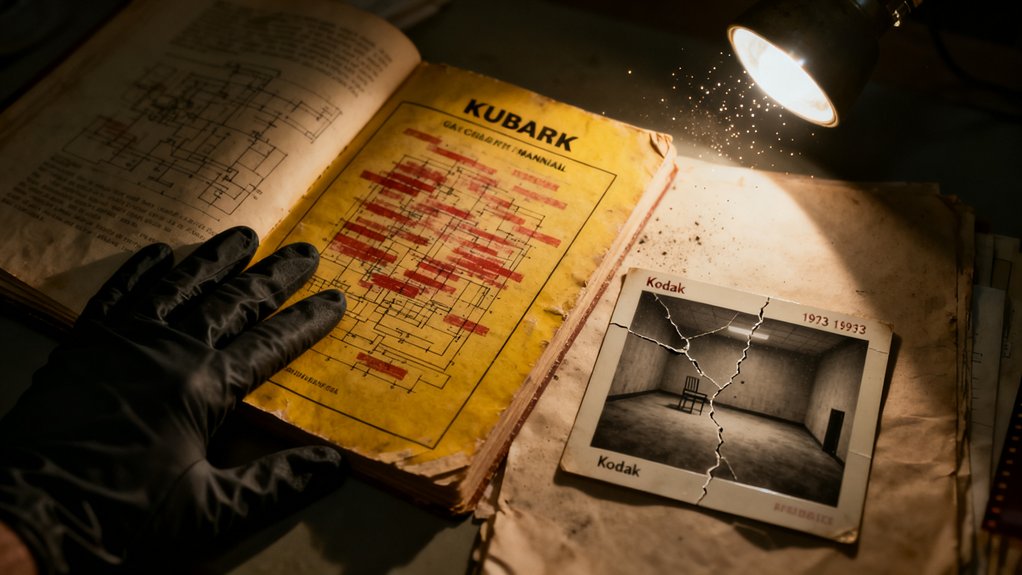
Although the Central Intelligence Agency had long employed psychological tactics, it wasn’t until 1963 that it formally codified those practices into a single, confidential directive: the KUBARK Counterintelligence Interrogation manual.
Although the CIA long used psychological tactics, it wasn’t until 1963 that these were formally codified in the KUBARK manual.
This document didn’t merely list techniques; it built a systematic framework for dismantling a subject’s mental defenses.
Its creators carefully wove the 1963 kubark manual into a structure of institutional concealment, ensuring its methods remained hidden from both the public and most agency personnel.
The manual’s existence itself became a secret, filed away under layers of classification.
The directive standardized non-physical coercion, replacing ad-hoc brutality with calculated psychological pressure.
Agents learned to manipulate perception, silence, and time, all without leaving physical marks.
These methods traced their origins directly to experiments like Project MKUltra, where drugs and sensory assault had been used to break down mental resistance.
The KUBARK manual therefore represents a pivotal moment: the transformation of ad-hoc methods into a coherent, documented, and deliberately obscured operational doctrine.
Its legacy is a blueprint for control, hidden in plain sight for decades.
Engineering the Psychologically Fractured Subject
The manual weaponizes sensory deprivation as a scalpel, carving away the subject’s temporal anchors to fracture their grip on reality. The KUBARK directive mirrors the Cold War logic of CIA mind control programs like MKUltra, which dosed unwitting subjects with LSD and combined drug experiments with sensory deprivation and electroshock.
This isn’t ad-hoc cruelty.
The KUBARK directive standardizes non-kinetic extraction into a cold, bureaucratic process.
It systematically engineers a fractured subject, ensuring the psychological breakdown becomes a repeatable, documented procedure.
Weaponizing Sensory Deprivation and Time Disorientation
How precisely does an interrogator engineer a psychological fracture without laying a hand on the subject? The KUBARK manual weaponizes sensory deprivation to dismantle the subject’s internal framework.
By isolating the subject from all environmental cues, no light, no sound, no human contact, the interrogator systematically starves the brain of its usual anchors. This isn’t passive waiting; it’s a deliberate assault on the senses.
The manual specifically details how this sensory deprivation accelerates cognitive disorientation. The subject’s grip on time dissolves. Minutes feel like hours; days blur into an endless, featureless void.
The interrogator then introduces controlled noise or light, not to torment, but to actively fragment the subject’s ability to maintain a coherent chronology. The result is a profound, weaponized confusion, priming the subject for compliance.
The Bureaucracy of Coercion: Standardizing Non-Kinetic Extraction
Once the subject’s internal clock has been shattered by sensory deprivation and time disorientation, the interrogator moves from disassembling perception to exploiting a far more systematic vulnerability: the subject’s dependence on institutional routine.
The KUBARK manual codifies this shift into a bureaucracy of coercion. It standardizes non-kinetic extraction by turning scheduled interrogations, meal times, and even sleep cycles into tools of psychological operations. The interrogator, acting as the sole gatekeeper of structure, manipulates these rhythms to deepen dependence.
This isn’t improvisation; it’s a calculated script. By formalizing these covert interrogation tactics, the agency transforms the fractured subject into a predictable asset, engineering compliance through the very order the subject now desperately craves. The manual provides the blueprint for this meticulous, institutionalized unraveling.
Executing the “Alice in Wonderland” Protocol: Inducing Cognitive Collapse

CIA case officers, executing the “Alice in Wonderland” protocol, methodically weaponized disorientation to shatter a subject’s cognitive anchor. They didn’t rely on physical duress.
Instead, the alice in wonderland technique deployed a systematic assault on reality, twisting time perception and sensory feedback loops. An interrogator might present contradictory visual cues while flooding the subject with conflicting auditory signals.
The Alice in Wonderland technique twists time perception and sensory feedback, weaponizing reality itself.
This wasn’t random chaos. It was a calculated form of psychological manipulation. Every step followed a scripted sequence designed to erode the subject’s belief in their own logical faculties.
The KUBARK manual explicitly details how officers would disrupt cause-and-effect reasoning. By dismantling predictable consequences, they forced the brain into a state of profound confusion. The subject, unable to trust their own senses, loses the will to resist.
This cognitive rupture forms the core extraction mechanism, leaving psychological ruins where a coherent mind once stood.
Calibrating Fear: The Institutional Calculus of Debility, Exhaustion, and Threat
Why would an institution like the CIA deliberately calibrate fear as a precise instrument rather than a blunt weapon?
The KUBARK manual’s calculus suggests a cold logic. Controlled debility and exhaustion maximize vulnerability for intelligence extraction without leaving visible marks.
The agency didn’t seek panic. It sought a measured breakdown.
By manipulating sleep deprivation and sustained threat, interrogators could erode resistance precisely, turning a subject’s own biology into a lever. This wasn’t cruelty for its own sake. It was a calculation.
Each increment of fatigue or fear was timed to produce specific compliance thresholds.
The institutional fallout from this documented calibration proves devastating. When the manual emerged, it exposed an agency that had commodified psychological suffering as a repeatable tool.
The calculus wasn’t an accident. It was a system designed to dismantle will with clinical efficiency, leaving a legacy of accountability the institution could never fully bury.
Architecture of Deniability: Burying the 128-Page Operational Blueprint

The agency didn’t simply write the manual; it built a system to bury it.
Compartmentalized distribution limited the 128-page blueprint to only a handful of black site interrogators.
A sanitized paper trail replaced explicit language with vague euphemisms.
This created institutional blind spots, ensuring no single person could trace the operational thread from the manual’s authorization to its field application.
The FBI employed similar tactics of covert and illegal tactics, including warrantless break-ins, wiretaps, and planting informants to provoke illegal actions.
Compartmentalizing the Distribution to Black Site Interrogators
Despite the manual’s exhaustive 128-page operational blueprint, its distribution to black site interrogators was ruthlessly compartmentalized. No single operative ever possessed a complete copy. This operational deployment of fragmented knowledge created a deliberate architecture of deniability. Each interrogator understood only isolated tactics. The manual’s systemic concealment relied on the willful ignorance of its field practitioners.
Select pages were issued piecemeal to different teams, preventing thorough understanding. No formal training revealed the manual’s full scope, only its sanctioned techniques. Whistleblower disclosures later confirmed that supervisors verbally extracted protocols to avoid paper trails. Interrogators received specific psychological methods without context of their clinical origins or potential consequences.
Such compartmentalization insulated the agency while enabling the manual’s brutal application.
Sanitizing the Paper Trail: Euphemisms and Institutional Blind Spots
Sanitizing the paper trail required far more than simply burning copies. The CIA’s KUBARK manual achieved its concealment through a deliberate lexicon of euphemisms that cloaked psychological torture in clinical, bureaucratic language.
“Debility” masked starvation. “Prolonged interrogation” sanitized sleep deprivation.
These institutional blind spots didn’t just hide the truth; they let operatives deny knowledge. Declassified CIA documents, pried loose through FOIA declassification, finally reveal how the 128-page blueprint buried its own intent.
The agency constructed an architecture of deniability so effective that even today, its exact psychological tactics remain unacknowledged. The euphemisms performed their duty, ensuring the true stain stayed off the official record.
Exporting KUBARK: Field Deployment and the Systematic Mechanics of Concealment
Field stations received the manual under non-descript cover titles like “Interrogation Handbook.” This masked its true origin. Allies were taught the mechanics without receiving the full document, limiting exposure of the concealment blueprint.
Local handlers used euphemisms. They described disorientation tactics in after-action reports as “enhanced rapport building.”
Supervisors destroyed or never generated copies of the manual’s deployment schedules. This left no paper trail to headquarters.
The Three-Decade Blackout: Sustaining the Cover-Up Through Bureaucratic Stonewalling

Those field-level concealment tactics proved to be just the first layer of a far more durable cover-up. The CIA’s subsequent bureaucratic stonewalling effectively blacked out the KUBARK manual for over three decades.
Those field-level concealment tactics proved to be just the first layer of a far more durable cover-up.
For thirty years, the agency didn’t just hide the document; they buried its very existence beneath an impenetrable fortress of denials and procedural delays. Investigators and journalists requesting the manual met a wall of silence, often redirected to nonexistent files or told the document wasn’t relevant.
This wasn’t passive neglect; it was an active, calculated strategy. The agency’s internal classification system, layered with need-to-know restrictions, guaranteed that even within Langley, few could access the full text. Each request triggered a meticulous protocol of obfuscation, stalling for years.
This deliberate opacity allowed the agency to maintain plausible deniability, protecting institutional legitimacy while the manual’s psychological tactics continued shaping interrogation protocols far from public scrutiny.
Breaching the Vault: Declassification and the Whistleblower Revelations
The catalyst for transparency arrived not from internal reform but from relentless external pressure.
Court orders and Freedom of Information Act requests finally forced the agency to surrender unredacted copies of the KUBARK manual.
These now decoded artifacts from the Langley archives laid bare the precise mechanics of the psychological cover up.
The Catalyst for Transparency: Forcing the Unredacted Truth
The catalyst for KUBARK’s unredacted exposure wasn’t government transparency but whistleblowers willing to break the agency’s own cover.
These insiders forced the manual into public view, dismantling the institutional narrative that denied systemic psychological tactics.
Insider leaks allowed former agents to directly smuggle copies past Langley’s security, bypassing official redaction processes.
Judicial pressure compelled the CIA to release incomplete versions through lawsuits, yet whistleblowers provided the missing pages.
Media verification involved journalists cross-referencing leaked documents against official releases, exposing deliberate omissions.
Congressional scrutiny gave lawmakers access to unredacted material that challenged agency testimony and eroded deniability.
Transparency arrived not through voluntary compliance but through calculated defiance, breaking the agency’s silence from within.
Decoding Classified Artifacts from the Langley Archives
Whistleblowers forced the manual into public view, but decoding its classified artifacts required more than possession of the raw pages. Analysts meticulously cross-referenced the document’s dry, clinical language against declassified memos from the Langley archives. They traced the codified “Alice in Wonderland” technique back to internal field reports, confirming its real-world deployment.
The manual’s sterile directives, they found, didn’t just describe theory; they authorized a systematic assault on perception. One artifact revealed how agents tracked a subject’s cognitive collapse hour by hour. Another mapped the specific environmental controls (dim lights, irregular sounds) meant to fracture reality.
Each jotted note and stamped authorization from the vaults reconstructs the operational spine of a psychological operation carefully concealed for decades.
Subpoenaing the Shadows: Investigating the Scope of Agency Directives

Although declassification eventually unsealed the manual‘s text, subpoenaing the agency’s internal directives reveals a far more elaborate architecture of concealment.
Investigators don’t just see a single document; they trace a web of procedural commands that governed its application. The manual itself wasn’t the whole story. It was merely the public-facing tip of a deeply buried operational iceberg.
Legal subpoenas pry loose memos detailing which divisions received authorization to use the manual’s techniques. They uncover requisition logs for psychological training materials, linking budgets directly to doctrine. They force disclosure of inter-office communications that discuss the manual’s distribution limits and security classifications. They expose the chain of command that signed off on field tests of the “Alice in Wonderland” technique before its codification. This pattern of concealment echoes the BCCI scandal, where national security claims repeatedly overrode legal accountability and regulatory oversight for over a decade.
Each subpoenaed document pulls another veil aside, compelling the agency to account for the vast, shadowy infrastructure that sustained KUBARK’s psychological operations.
The Smoking Gun of Coercion: KUBARK as Verifiable Physical Evidence
Plausible deniability no longer shields the agency’s methods when a physical document exists as a fixed reference point.
KUBARK’s declassified pages shift the interrogation narrative from rumor to recorded fact, transforming a former defense into a structural liability.
This manual doesn’t merely suggest coercion. It codifies it, making the institution’s systemic responsibility unavoidable.
Transitioning from Plausible Deniability to Documented Systemic Liability
Because the KUBARK manual was a classified, agency-wide directive and not a rogue agent’s notebook, it shifts the burden of proof from individual misconduct to systemic liability.
This document doesn’t simply accuse one interrogator. It indicts an entire institution‘s command structure.
It transforms a fuzzy allegation into a fixed, physical artifact, forcing accountability.
It codifies psychological coercion into official, mandatory procedures.
It establishes a top-down chain of authorization for manipulating subjects.
It exposes the “Alice in Wonderland” technique as institutional policy, not improvisation.
It provides a single, irrefutable source to trace orders back to Langley.
Consequently, the manual’s very existence dismantles the old shield of plausible deniability.
It locks the agency’s leadership into documented, verifiable responsibility for these methods.
Rewriting the Rules of Extraction: The Institutional Fallout and Forced Overhaul
Once the KUBARK manual’s declassified pages entered the public record, the institutional fallout was immediate and corrosive. The CIA couldn’t deny what now sat in plain view. Congressional oversight committees demanded answers. They didn’t get evasions. The agency’s leadership faced a stark choice. They could rewrite the rules of extraction, or they could watch their operational credibility collapse entirely. The Nixon administration’s similar attempt to block the Pentagon Papers had already established the Supreme Court’s landmark ruling against prior restraint, limiting government power to censor the press. They chose the overhaul. Internal directives silently scrapped the “Alice in Wonderland” technique. New interrogation guidelines mandated explicit legal boundaries. They scrubbed the manual’s systematic disorientation protocols. Agency lawyers raced to craft a policy that wouldn’t replicate the document’s damning evidence. The whistleblowers had forced a structural reset. They transformed a classified playbook into a liability. The extraction game changed forever. This change happened not because morality won, but because the cover-up’s failure made the old rules untenable.
Echoes of 1963: The Enduring Forensic Legacy of Psychological Manipulation

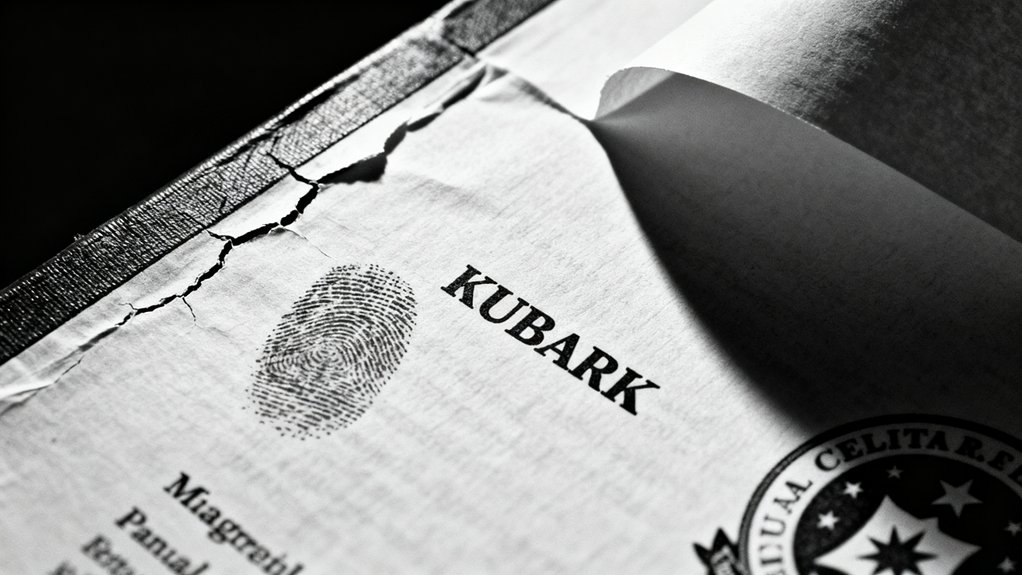
The structural reset forced by KUBARK‘s exposure didn’t erase the manual’s methods. Instead, they solidified into an enduring forensic legacy, haunting interrogation protocols decades later. Investigators still trace the manual’s fingerprints inside modern psychological operations, where its core tactics survive under new classifications.
Declassified documents reveal KUBARK’s “Alice in Wonderland” technique still appears in post-9/11 enhanced interrogation doctrines. It’s rebranded but structurally identical. Whistleblowers confirm agencies continue leveraging sensory disorientation and reality manipulation. These are direct descendants of 1963’s codified instructions. Academic forensic psychologists now use KUBARK as a baseline case study, mapping its influence onto contemporary coercion patterns. Legal proceedings increasingly cite the manual’s exposure as precedent, forcing courts to scrutinize psychological interrogation’s hidden lineage. This pattern of granting full war crimes immunity in exchange for classified data eerily mirrors the U.S. postwar cover-up of Unit 731’s atrocities. The manual didn’t vanish. It became a ghost protocol, its echoes measurable in every forensic analysis of psychological manipulation.
Frequently Asked Questions
What Is the “Alice in Wonderland” Technique’s Exact Psychological Mechanism?
The “Alice in Wonderland” technique’s exact psychological mechanism is sensory disorientation achieved through contradictory commands and reality distortions. It systematically disrupts a subject’s cognitive mapping, creating confusion between cause and effect, time and space.
This induces a state of learned helplessness where the subject’s own logic becomes unreliable. By breaking down familiar patterns, such as suggesting a door is a wall, the interrogator forces the mind to cling to any anchor. This makes the subject more suggestible and vulnerable to manipulation.
Were KUBARK Techniques Ever Tested on Unwitting Human Subjects Before 1963?
Yes, evidence suggests similar psychological manipulation techniques were tested on unwitting subjects before 1963. The CIA‘s MKUltra program, active since the early 1950s, conducted extensive experiments using disorienting sensory deprivation, drugs, and stress.
These components were later codified in KUBARK. Declassified files reveal both willing and unwilling participants in these studies, often without informed consent.
This prior testing isn’t a conspiracy; it’s documented institutional behavior, deliberately obscured, that directly informed the manual’s finalized procedures.
How Did the CIA Ensure Field Operatives Followed KUBARK Protocols Without Written Records?
The CIA relied on compartmentalized verbal directives and on-site training by experienced interrogators to enforce KUBARK protocols without paper trails.
It used informal “moot courts,” mock interrogations, to drill operatives on the “Alice in Wonderland” technique.
Standardized psychological tactics were taught orally, ensuring plausible deniability.
This oral tradition, combined with strict internal oversight, allowed the agency to embed these methods covertly, leaving no written evidence for auditors or historians to trace.
Which Specific Whistleblowers First Exposed the KUBARK Manual’s Existence?
No single whistleblower first exposed the KUBARK manual. The document surfaced through a process of declassification and investigative journalism.
The 1997 publication of *The CIA’s Vietnam* by author John Prados cited the manual. Researcher and journalist David Valentine, in the early 2000s, meticulously connected the manual’s psychological techniques to broader interrogation abuses. Their combined efforts unraveled the agency’s covert psychological operations.
Has the CIA Ever Formally Admitted Liability for Kubark-Derived Interrogations?
No, the CIA hasn’t formally admitted liability for KUBARK-derived interrogations. That door remains firmly bolted shut. The agency’s official stance has been a careful dance of denial, acknowledging the manual’s existence without accepting legal responsibility for its psychological techniques.
Documented fallout from whistleblower revelations triggered internal reviews, but admissions of guilt have stayed buried in classified chambers.
The KUBARK manual’s legacy hangs like a ghost in the agency’s institutional conscience, acknowledged yet unclaimed.
Final Thoughts
The KUBARK blueprint does not gather dust; it is a mirror held to the agency’s soul. Like Poe’s tell-tale heart, the 128-page directive thumps beneath the floorboards of institutional denial. It is an inescapable echo of sanctioned fractures and shattered psyches. Declassification did not bury this truth; it exhumed a smoking gun of coercion. The cover-up’s architecture crumbles, leaving only the damning, physical evidence of a calculated mind-war. The interrogation of power has just begun.