
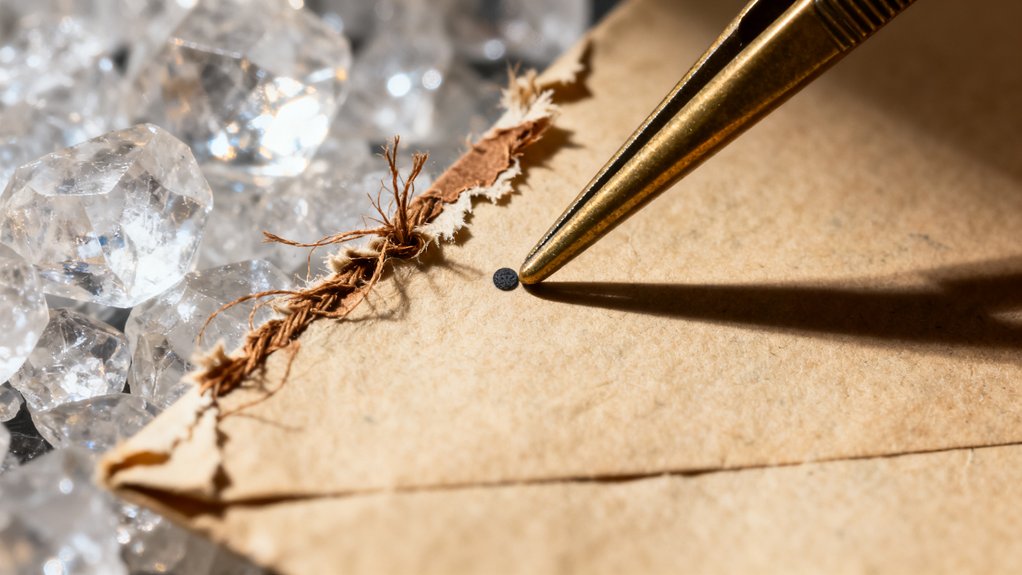
By 1941, Allied censors in Sweden inspected every letter leaving the country, hunting for hidden codes. German spies fought back with microdots, entire war-room reports chemically shrunk to a one-millimeter speck, then glued over a period. The human eye could not spot the difference. Physical deception transformed punctuation into a weapon. But the glue betrayed them. Degraded adhesives left chemical halos, forcing the FBI to reverse engineer a secret war fought in plain sight. The full story remains buried in the ink.
Key Takeaways
Microdots concealed entire documents in punctuation marks, such as periods within letters. Allied censors missed microdots because they searched for hidden ink, not punctuation. Microdots were created using photographic reduction and embedded under paper with glue. The FBI discovered microdots in 1941 via a double agent's letter from German spies. Microdot intelligence revealed Japanese naval coordinates and timing before Pearl Harbor.
Subverting the Allied Postal Blockade: The 1941 Data Smuggling Crisis
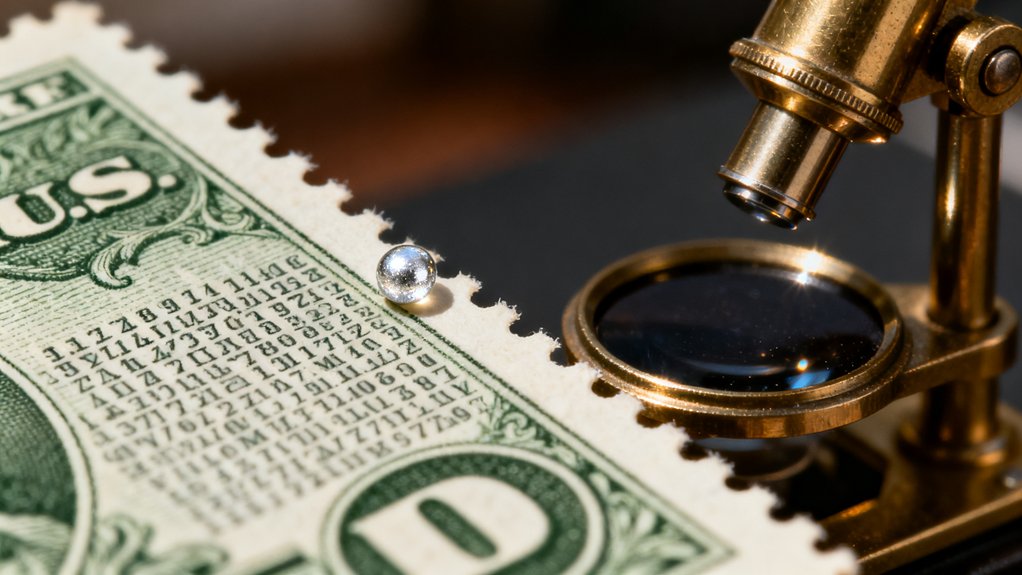
By 1941, the Allied postal blockade had transformed neutral Sweden into a critical intelligence bottleneck, and operatives needed a way to bypass the censors' prying eyes. Letters leaving the country faced invasive inspection from allied military censors, who dissected every word for hidden codes. The risk of detection was immense, forcing a revolution in physical data smuggling.
Operatives developed a cunning method of covert punctuation manipulation. They'd chemically reduce entire reports to a single, grain-sized film, a microdot and physically paste it over a period in an innocent civilian letter.
This wasn't just steganography; it was precise, physical data smuggling that exploited the censors' trust in mundane punctuation. By hiding intelligence right where nobody thought to look inside dots and commas, agents achieved military censorship evasion without a single suspicious phrase. The Allied blockade's guards, trained to find secrets in language, never thought to inspect the punctuation. The crisis in Sweden demanded this extreme, microscopic deception.
The Zapp Technique: Shrinking Espionage to a One-Millimeter Speck
The agent's craft demanded the elimination of paper itself. He relied on the silver halide photographic reduction process, capturing entire documents onto collodion film no thicker than a microscopic bubble.
This wasn't just shrinking text; it was eradicating the bulk that could betray a spy, reducing a war-room report to a one-millimeter speck.
The Silver Halide Photographic Reduction Process
The Zapp technique transformed photographic reduction into a clandestine manufacturing process, weaponizing the silver halide photographic reduction process to shrink entire documents into a one-millimeter speck.
This wasn't simple scaling but a triumph of concealment mechanics. Engineers forced light through a microscope lens, focusing intelligence onto a single grain of film while preserving every detail.
The resulting microdot, a ghost of text, could hide in plain sight within a regular letter. Today, forensic microdot analysis reveals these secrets, studying grain patterns to authenticate these declassified espionage methods.
World War II microdot steganography relied on this precise chemistry, transforming a simple camera into a spy's most powerful tool, shrinking a file into a period.
Collodion Film and the Eradication of Paper Bulk
Although the silver halide process could shrink a document, it was the collodion film that truly eradicated paper bulk, turning a spy's payload into an invisible speck. This was the Zapp technique‘s breakthrough for WWII intelligence networks, embedding entire reports inside a single, one-millimeter dot.
The steganography operational timeline suddenly accelerated, no more bulky microfilm rolls. Instead, operatives stripped the collodion layer from its glass plate, peeling away the substrate's weight. This collateral film became a ghost: transparent, flexible, and impossible to spot without magnification.
Now, microscopic data smuggling meant pasting these specks over periods in civilian correspondence espionage. A spy's entire mission fit inside a letter's punctuation, vanishing in plain sight.
Hijacking the Full Stop: Weaponizing Innocuous Punctuation
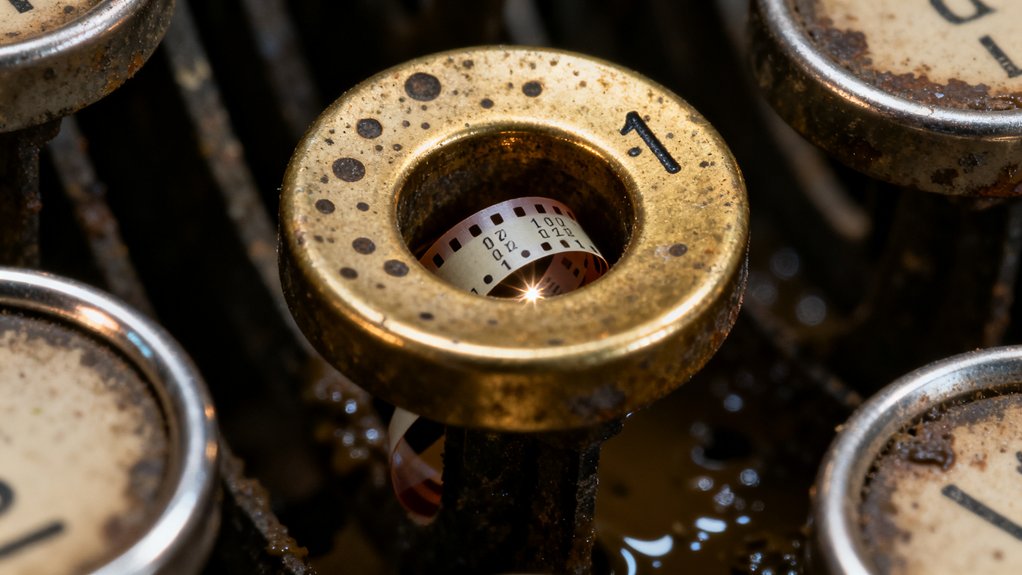
Because censors rarely questioned the integrity of a simple period, operatives turned the humble full stop into a weapon of concealment. They didn't rewrite secrets, they hid them in plain typographic sight.
The process was surgical: a microdot, a reduced photograph of an entire intelligence report, nestled under a layer of gelatin. Once glued over a legitimate period, the letter became a Trojan horse. No one thought to scrape punctuation. This wasn't clever writing; it was physical manipulation.
The technique's genius lay in its banality. The intelligence oversight fallout proved catastrophic for counterintelligence, they couldn't find what they weren't looking for. The whistleblower revelation, decades later, forced a complete reassessment. A period could now hide an army's movements. The threat wasn't in the words between the lines, it was in the lines themselves.
Fabricating the Civilian Decoy: The Psychological Engineering of Cover Letters
The microdot's physical concealment meant nothing without a credible vessel to carry it. Operatives didn't just hide information; they engineered entire personas into the letters that formed the decoy's backbone.
Psychological profiling tailored every detail to evade suspicion:
- Handwriting forgery: Experts replicated the target's script, matching pressure, slant, and tremor, ensuring censors saw no mechanical flaw.
- Emotional tone: Letters mimicked mundane concerns, waiting for a pay raise, complaining about rationing, or gossiping about neighbors, to anchor the sender in believable civilian life.
- Physical wear: Operatives artificially aged the paper by crumpling it or smudging ink with coffee, simulating a journey through mailbags and rain-soaked post offices.
Each letter became a theater prop, crafted to bore any watcher into glancing past it. The microdot rested on a period, but the cover letter's psychological engineering guaranteed nobody would ever question that comma.
The Operative’s Toolkit: Executing the Micro-Splice in Hostile Territory
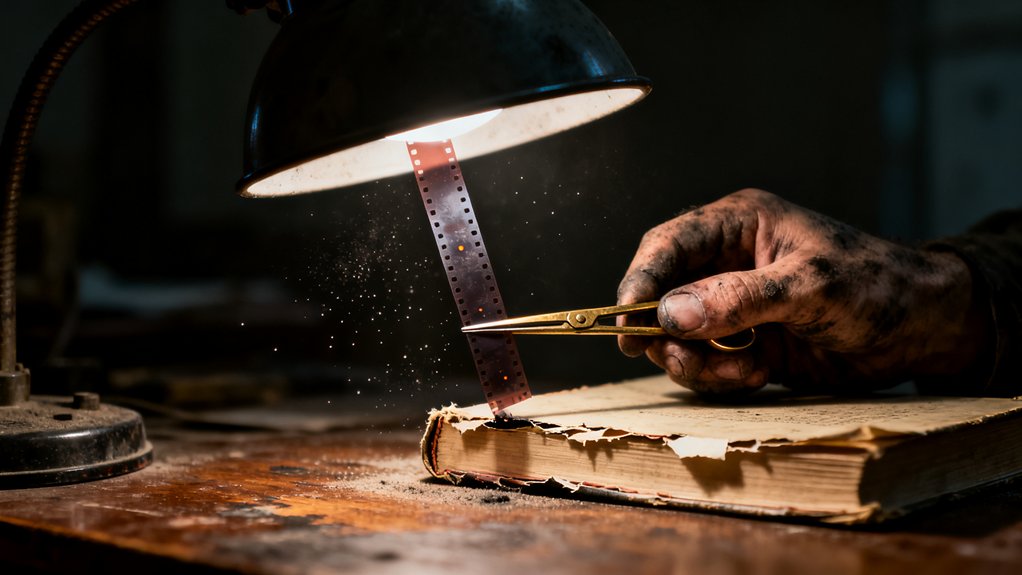
The operative's toolkit for the micro-splice bypassed chemical reagents that military censors routinely used. Instead of risking detection with those telltale substances, he employed a modified hypodermic syringe to directly implant the microdot.
This allowed him to physically insert the intelligence into a period's ink without leaving any chemical signature behind.
The Hypodermic Syringe Insertion Method
Once an operative had prepared the microdot, a photographic reduction smaller than a full stop, the next challenge was insertion. To accomplish this stealthy splice, they'd wield a modified hypodermic syringe, its needle's tip precisely ground to lift a single punctuation mark without tearing the paper fiber. The process demanded a surgeon's steadiness.
- Engrave: A tiny scalpel etched a barely visible crescent cut under the period or comma, creating a tiny flap.
- Inject: The hollow needle slid the microdot into this pocket, aligning its grain exactly with the host letter's paper.
- Seal: A microscopic dab of cellulose adhesive fused the flap shut, leaving no residue, the letter's surface remained entirely smooth to the touch.
Bypassing Chemical Reagents Used by Military Censors
How could a microdot survive the chemical baths that military censors routinely used to develop hidden text? The operative’s plan wasn’t just about reduction, it was about material science. They’d coat the microdot in a resin that rendered it chemically inert, a clever synthetic shield that repelled reagents like iodine vapor or ninhydrin. Censors would soak suspect letters, seeking invisible ink; the dot simply refused to react, lying dormant under their noses.
| Reagent | Microdot Reaction |
|---|---|
| Iodine vapor | No color change |
| Ninhydrin | No purple trace |
| Silver nitrate | No darkening |
| Ultraviolet light | No fluorescence |
| Heat development | No distortion |
This wasn't luck; it was premeditated chemistry. The dot’s emulsion and adhesive also matched the paper’s own chemical response, blending into the background noise. The censor saw a clean batch; the operative saw a perfect splice.
August 12, 1941: Agent Tricycle and the FBI’s Microscopic Epiphany
August 12, 1941: Agent Tricycle and the FBI's Microscopic Epiphany
Although microdots had been theorized for years, the FBI didn't grasp their terrifying potential until August 12, 1941, when a double agent codenamed “Tricycle” handed them a seemingly innocent letter. He wasn't just playing a game. He was revealing a ghost.
The drop: Tricycle, a Yugoslavian playboy working for British intelligence, gave the FBI a letter from a German spy. He insisted they examine the punctuation, something felt physically off.
The discovery: Under a microscope, a single period above an “i” wasn't ink. It was a tiny, gelatinous lens. The FBI's analysts couldn't believe their eyes.
The payload: They gingerly soaked the dot, and it unspooled. Inside that pinpoint sat a full typewritten page listing Allied ship movements. An entire intelligence report hid in a single, sterile mark.
That afternoon, the Bureau realized they weren't fighting spy novels anymore. They were fighting physics. The era of invisible espionage had arrived and they were late to the party.
Deconstructing the Dot: The FBI Laboratory’s Reverse Engineering Protocol
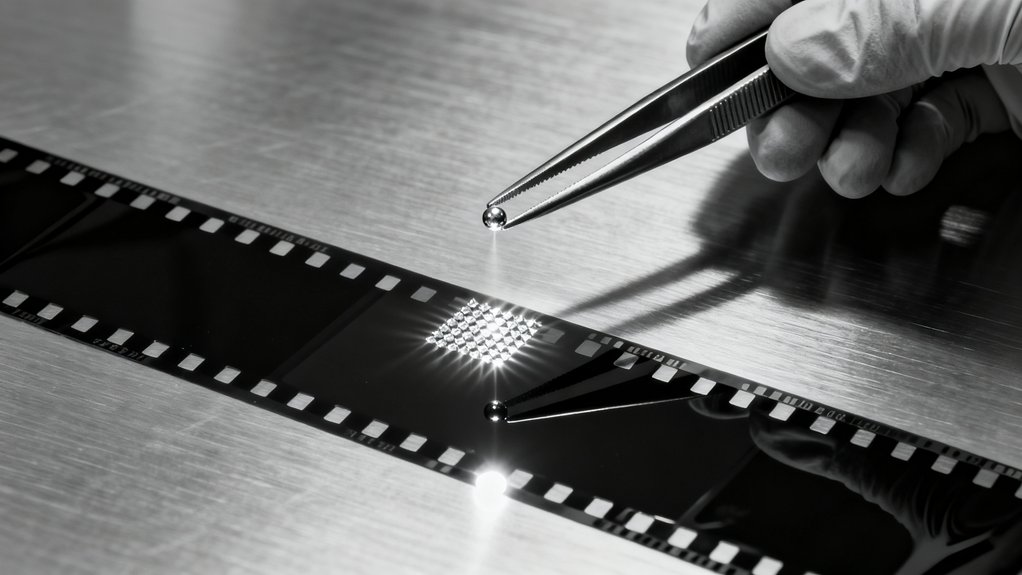
The FBI's analysts first isolated the foreign adhesives clinging to the dot's underside under high-powered optics, a painstaking hunt for any chemical signature.
They then chemically extracted the sabotage dossier from within the microdot's gelatin layers, dissolving the photographic emulsion to free the intelligence. This reverse engineering protocol peeled back the enemy's trick, revealing every operational secret trapped inside the period.
Isolating Foreign Adhesives Under High-Powered Optics
Because microdots were physically affixed to letters, their most vulnerable point was the adhesive bond. FBI lab analysts turned this weakness into their primary identification tool, scrutinizing the glue under high-powered optics before touching anything else. They weren't just looking for stickiness; they were looking for provenance.
The process demanded surgical precision:
- Magnified Analysis: Stereo microscopes at 100x revealed the adhesive's texture, crystal formations, dust inclusions, or unnatural gloss, distinguishing enemy synthetic blends from civilian pastes.
- UV Fluorescence Check: Potassium permanganate stains under ultraviolet light made mineral-based German adhesives glow milky blue, a signature no Allied stationer ever used.
- Refractive Index Match: Immersion oils of varying densities on the microdot's edge let analysts measure light bend, confirming the adhesive's chemical family without dissolving the evidence.
Each test isolated a foreign substance long before a single dot was lifted.
Chemical Extraction of the Sabotage Dossier
Once the adhesive's origin was confirmed, FBI chemists moved to the trickiest part, extracting the microdot intact without dissolving the sabotage dossier concealed within. They couldn't simply peel; they'd risk tearing the fragile emulsion.
Instead, they bathed the paper in a precise solvent cocktail, a volatile brew designed to weaken the glue's bond without touching the gelatin base. Under a stereoscope, a chemist's steady hand introduced a micro-scalpel, gently prying the dot free.
The successful extraction revealed a crisp, fully legible page of German ordnance details and sabotage instructions. This wasn't theoretical science; it was forensic archaeology at 500x magnification, deconstructing a spy's best trick chemical layer by chemical layer.
The Pearl Harbor Questionnaire: Decoding the 14-Point Micro-Dossier
While military censors scrutinized envelopes for bulky inserts or suspicious stains, they never thought to examine the period at the end of a sentence, a fatal blind spot that operatives exploited with a 14-point micro-dossier detailing Japanese naval preparations in Pearl Harbor.
While military censors searched envelopes, they overlooked a period, a fatally exploited blind spot.
This document wasn't vague; it demanded specifics. Decoding it revealed a chillingly precise threat assessment.
- Ship Sighting Coordinates: Each micro-point listed exact grid positions for U.S. Pacific Fleet vessels, from carriers to fuel tankers, mapping their daily anchorage routines.
- Attack-Phase Timings: Operatives encoded the best wind direction for aerial strikes and the precise lunar phase for night approach, narrowing the window to a single week.
- Pentagon's Own Weaknesses: The dossier cataloged a glaring gap in West Coast radar coverage, a vulnerability the Navy hadn't bothered to patch.
The microdot's 14 questions weren't idle curiosity. They were a signed work order for destruction, a blueprint already handed to Tokyo's admirals before American intelligence even knew it existed.
Screening 30 Million Letters: The Allied Bureaucracy’s Postal Dragnet
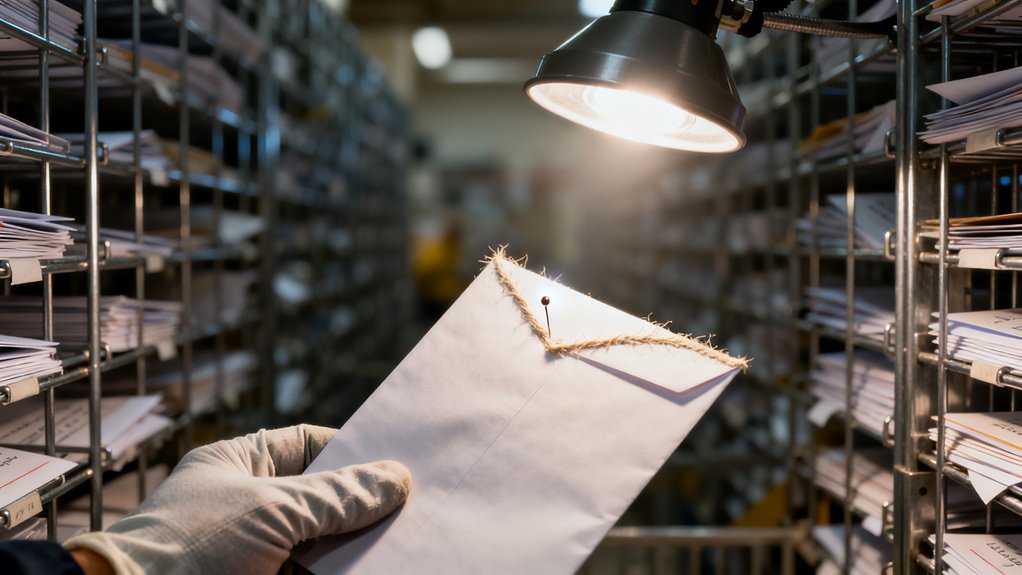
Censors didn't just glance at envelopes; they implemented the Oblique Angle Detection Protocol, a painstaking method for spotting the telltale glint of a microdot.
Postal workers held each letter up to a light source at a precise 45-degree angle, searching for any unnatural reflection or shadow cast by a pasted-over dot.
This manual sweep of over 30 million letters turned the Allied postal system into a silent frontline in the war's intelligence battle.
The Implementation of the Oblique Angle Detection Protocol
How could Allied intelligence possibly detect a dot that was, by design, indistinguishable from a printed period? Censors didn't need to see the secret; they needed to see the surface. They implemented the Oblique Angle Detection Protocol, a deceptively simple technique requiring nothing more than a strong lamp and a sharp eye:
- The shine test: Holding each letter at a severe angle, sunlight or lamplight creates a telltale glint from the microdot's gelatinous glue, flat punctuation remains matte.
- The embossment feel: Trained fingers run across the paper; microdots raise the surface by hundredths of an inch, imperceptible to the naked eye but palpable under oblique pressure.
- The depth check: Using a pinprick needle, examiners gently probe the period's center, a real period absorbs the needle; a dot resists, revealing a solid lens.
The Double-Cross System: Feeding Fabricated Dots Back to the Abwehr

The Double-Cross System's architects turned the Abwehr's own microdot tradecraft against it. They didn't just intercept German spy mail; they actively fabricated the microdots themselves. MI5's Section B1A meticulously reproduced the exact photographic reduction, the precise emulsion thickness, and the period-sized adhesive placements. Each fabricated dot looked indistinguishable from a genuine Abwehr communication, but it carried a lethal payload: carefully curated deception.
Operatives pasted these false dots over punctuation marks in letters destined for Hamburg or Berlin. The Germans, trusting their own creation, magnified them, read the lies, and acted on them. They couldn't tell the difference, the paste matched, the grain matched, the paper fiber indentation matched. The British fed the Abwehr a steady diet of controlled falsehoods about troop movements, bombing targets, and naval routes, turning the microdot from a tool of stealth into a weapon of strategic misdirection. It was a perfect espionage paradox: the Abwehr's own technology now served to blind them.
Forensic Anomalies: How Degraded Adhesives Condemned the Operatives
Not every microdot pasted into a letter survived the journey intact. The cold war of adhesives betrayed them. Operatives used homemade glues, starch pastes, gelatin, or collodion, that reacted poorly to humidity and temperature shifts during postal transit. By the time a letter reached the Abwehr, the dot often looked like a raised, brittle blister under a low-powered microscope, not a natural punctuation mark.
- The dry-peel test: Censors found microdots lifting at their edges, revealing a distinct circular gap between the dot and the paper. A healthy period wouldn't peel.
- The chlorate stain: Degraded adhesives left a faint yellow-brown halo around the dot. This wasn't ink; it was a chemical ghost of the paste's own decay.
- The crease fracture: Folded in transit, brittle microdots cracked along their center. A period doesn't crack.
British forensic analysts exploited these failures. They didn't search for dots; they searched for “sick” dots, imperfectly glued secrets that couldn't hold a cover identity. The adhesive's weakness became the spy's vulnerability.
The Analog Precursor to Digital Encryption: Legacy of the One-Millimeter Spy
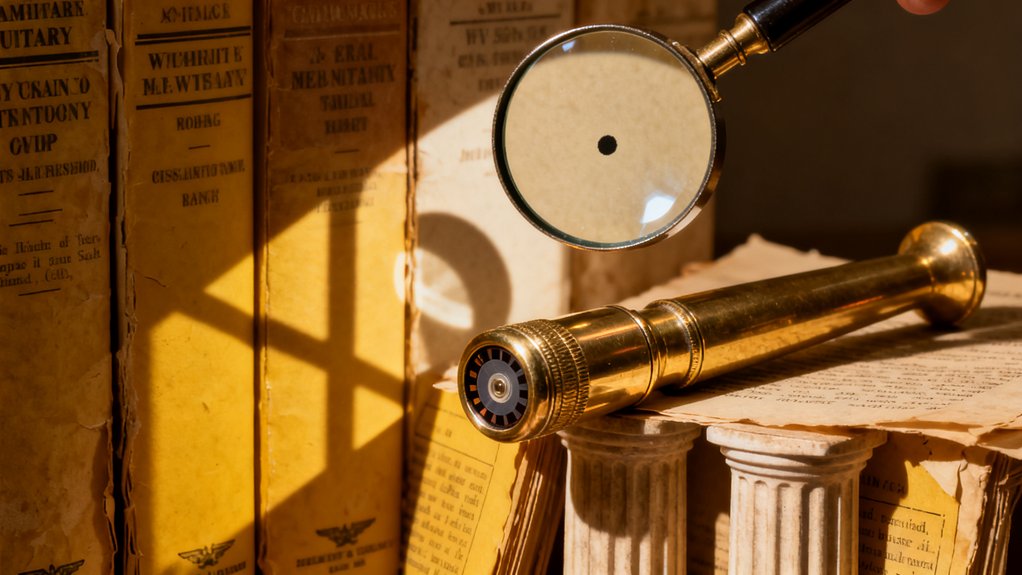
Although microdots were physical artifacts, shards of emulsion glued to paper, their operational logic presaged the binary foundations of digital encryption. They forced the human eye to discern a pixel-thin presence of data from a noise of paper fibers. Fundamentally, a microdot wasn't merely a reduced document; it was a compressed signal. The spy transformed continuous information into discrete, stoppable points, a one-millimeter payload of intelligence, readable only with the correct lens.
That's the same core problem digital encryption solves: how to hide a message within a stream of ordinary traffic. A modern router doesn't see microdots, but it sees packets. Both systems compress, encode, and then decode only for authorized viewers. The spy's analog decay, however, had a weakness: observable glue. Digital encryption's advantage wasn't conceptual, it was purely material, escaping physical scrutiny. The one-millimeter spy's legacy isn't his success, but his proof that data can be hidden right where the enemy looks.
Frequently Asked Questions
How Were Microdots Developed Without Alerting Local Photo Labs?
Operatives avoided local photo labs by constructing covert darkrooms. A trusted agent would shrink an entire page to a single speck and conceal it over a letter's period. Censors never detected the trick, scanning for full messages, not microscopic ones.
It was a high-stakes gamble that paid off, hiding intelligence in plain sight without alerting a suspicious chemist.
What Happened if a Microdot Was Accidentally Covered by a Postmark?
A microdot smothered by a postmark wasn't just an inconvenience, it was a catastrophe, a tiny universe of secrets obliterated by a careless stamp. The postal ink bled across the microscopic photograph, rendering its condensed typewritten page illegible, a silent black hole swallowing months of intelligence work. Operators couldn't retrieve the data; the dot's physical placement meant total loss.
They'd forge a fresh letter, embedding a new microdot elsewhere, praying censors never noticed the substitution, each failure tightening the noose around their operation.
Did Operatives Ever Swallow Microdots to Evade Capture?
Yes, they did, but it wasn't common. Microdots weren't designed for swallowing, they were fragile photographic film, not capsules.
An operative might do it in desperation, but the dot's tiny size made retrieval impossible without destroying the intel. The risk wasn't just loss; stomach acids could ruin the evidence.
Instead, operatives favored hiding dots in clothing seams or letter punctuation, ensuring capture didn't erase their work. Swallowing was a last resort, not standard practice.
How Did Censors Distinguish a Microdot From a Printing Defect?
Censors didn't easily distinguish a microdot from a printing defect; it's like searching for a single altered grain of sand on a vast beach.
They relied on brute-force suspicion, randomly examining letters under magnification. A microdot's edge often betrayed it: under scrutiny, its crisp, photographic border clashed with a period's organic, ink-spread fuzziness. This tiny irregularity, a shadow of human tampering, whispered what the naked eye couldn't see; it was a flaw that only a trained lens could catch.
Were Any Microdots Successfully Smuggled Inside Envelopes, Not on Paper?
Yes, microdots were successfully smuggled inside envelopes, not just on paper.
Operatives didn't always paste them over punctuation marks; they hid them within envelope seams, under stamps, or inside glued flaps.
Censors rarely inspected these areas with the necessary magnification.
This tactic bypassed visual scans entirely, exploiting a blind spot in the screening process.
It's a stark reminder that the smallest details often hide the biggest secrets, a lesson still echoing in modern surveillance debates.
Final Thoughts
The microdot’s legacy isn’t just history’s footnote, it’s the analog father of today’s encryption. After all, how different is hiding data in a full stop from burying it in a codec? The Allies caught them by spotting faded glue, not clever tech. That’s the rub: no matter how small you go, human error still leaks the secret.