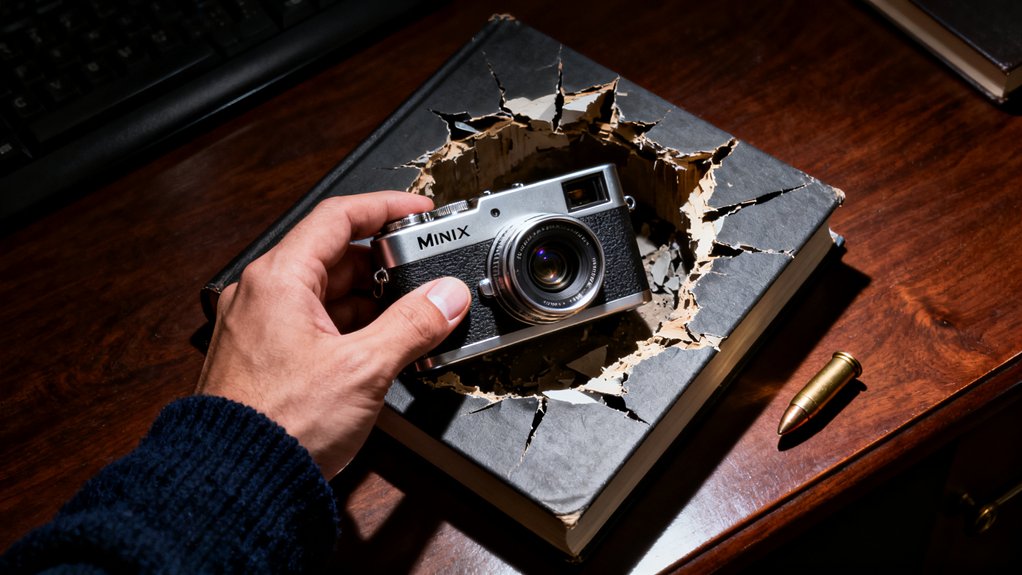
The Minox wasn’t a gadget; it was a logistical weapon. Walter Zapp’s 1938 prototype let operatives photograph 2,160 classified pages in a single 30-minute session. Hidden inside a shaving brush or lighter, the camera bypassed primitive X-rays by lacking metal. A millimeter’s error in focal distance could ruin an entire mission and trigger arrests. Operatives turned mundane items into tools of betrayal, but one slip meant the photograph captured the spy instead of secrets. The full architecture of this miniaturized treachery awaits.
Key Takeaways
- Minox revolutionized espionage by capturing hundreds of documents in minutes with subminiature size.
- Operatives concealed the camera inside everyday objects like shaving brushes and cigarette lighters.
- Covert film supply chains used dead drops, couriers, and fake radio components to avoid detection.
- Precise focal distances required high skill; a millimeter error could ruin a mission.
- The camera’s operational simplicity exploited counter-intelligence blind spots, tilting Cold War power balances.
The 1938 Zapp Prototype: Engineering a Global Intelligence Crisis
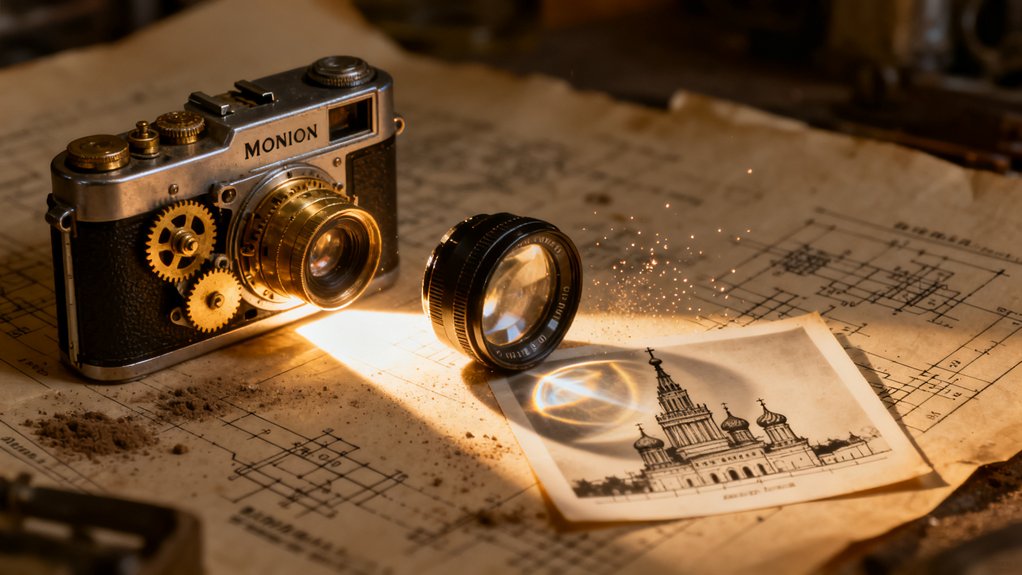
Although Walter Zapp revealed the Minox subminiature camera in 1938, engineers had no idea they were crafting the catalyst for a global intelligence crisis. They simply designed a compact precision instrument. Yet, this unassuming device fundamentally rewired cold war covert intelligence. The walter zapp subminiature camera wasn’t a mere gadget; it was a logistical revolution.
Espionage micro-photography transformed from a risky, bulky endeavor into a streamlined process. Suddenly, an operative could photograph hundreds of classified documents in minutes, all while concealing the device inside a hollowed shaving brush. This wasn’t about better spy gear; it was about redefining intelligence gathering logistics entirely.
The camera’s true genius lay in its operational simplicity. It removed the colossal risk of carrying obvious equipment. By mastering precise focal distances, agents turned mundane objects into tools of classified document photography. Engineers saw a technical challenge; they never realized they’d just handed every intelligence service a blueprint for betrayal, a silent key to every locked file cabinet across the Iron Curtain.
Miniaturizing Treason: The Mechanical Anatomy of the Espionage Trade
Operatives didn’t simply point and shoot; they first had to master the brutal high-skill focal distance parameters, a demanding discipline that turned field photography into a precision art. The camera’s success then hinged on solving the complex logistics of sourcing subminiature emulsions, a fragile supply chain that could break an entire operation. This extreme secrecy meant that 85% of UFO reports submitted to Project Blue Book were later linked to U-2 missions, a startling parallel to the hidden nature of spy camera operations.
This harsh mechanical anatomy reveals a trade built not on gadgetry alone, but on the relentless pursuit of technical perfection under constant surveillance.
Mastering the Brutal High-Skill Focal Distance Parameters
Because the Minox demanded focal precision down to fractions of an inch, espionage photography wasn’t a point-and-shoot exercise but a brutal study in optical physics. Operatives had to internalize high-skill focal distance parameters, calculating depth of field on the fly while a target’s guard moved nearby.
This wasn’t casual snapshooting; it was a covert operational methodology where a millimeter’s error meant a useless negative and a wasted mission.
The camera’s genius lay in its physical concealment mechanics, hidden inside shaving brushes or cigarette lighters, but its true power derived from historical espionage engineering that forced the user to master light before triggering the shutter. Specialized film logistics merely supplied the medium; the agent’s trained eye and steady hand completed the treason.
The Complex Logistics of Sourcing Subminiature Emulsions
How could a spy trust his mission to film that required its own shadowy supply chain? Intelligence officers deployment behind enemy lines espionage hinged on more than just taking pictures, they needed the film itself.
Sourcing subminiature emulsions demanded covert procurement networks, often operating through CIA declassified spy gadgets. The film rolled into tiny cassettes, hidden in a hollowed-out shaving brush or tucked inside a cigarette lighter concealment. A single mistake in the supply chain could expose an entire operation. Operatives couldn’t walk into a store; they relied on dead drops, couriers, and coded signals. The film’s scarcity meant every frame carried weight, a burned roll wasn’t just data lost, it was a trail of breadcrumbs for counterintelligence. This logistical nightmare shaped every mission’s success.
Breaching the Iron Curtain: Deep-Cover Deployment Behind Enemy Lines
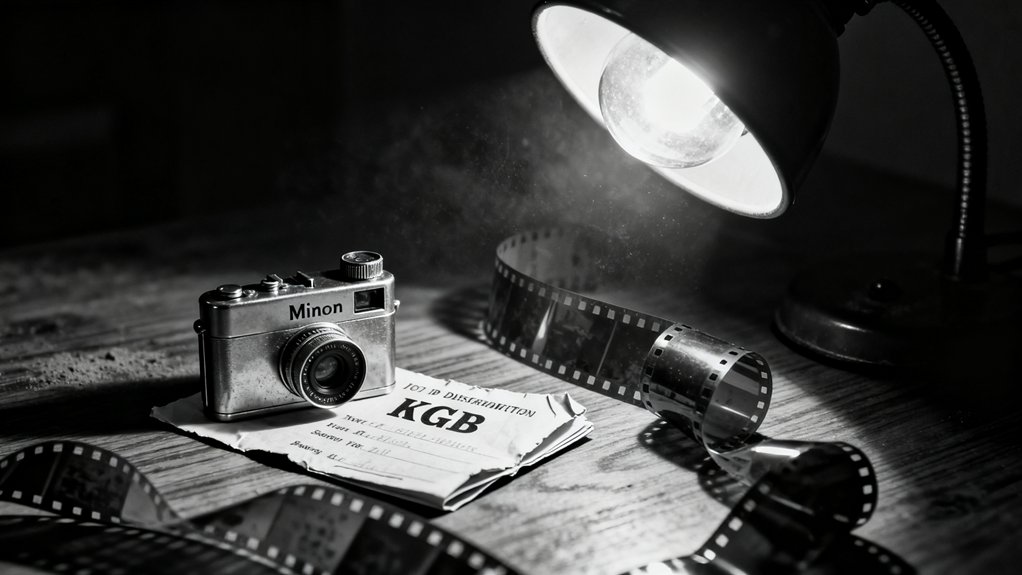
Although the Cold War‘s division of Europe hardened into an impenetrable barrier, intelligence officers armed with the Minox camera still slipped through the cracks. They crossed checkpoints not with bravado but with surgical precision, exploiting gaps in surveillance routines. The camera’s size alone wasn’t enough; operatives relied on deep-cover identities, painstakingly constructed over months, to survive routine scrutiny. A misplaced accent or a suspicious document could unravel everything.
Behind enemy lines, the Minox transformed mundane settings into intelligence bonanzas. Officers photographed troop movements from apartment windows, copied blueprints in government offices, and captured arms shipments from public benches. all in under ninety seconds per roll. They weren’t taking chances; they were engineering moments of invisibility. The stakes were absolute: one wrong step meant exposure, interrogation, or a lifetime behind the Gulag’s walls. Yet, for those who mastered the camera’s demanding focal distances and their own nerve, the Iron Curtain became just another border to breach.
The Architecture of Physical Concealment: Bypassing Counter-Intelligence
Counter-intelligence agents searched for cameras, not for shaving brushes or cigarette lighters.
The Minox’s concealment exploited this blind spot, hiding the critical film transport and lens within modified, everyday housings.
This architectural deception turned mundane objects into the operative’s primary smuggling route and operational shelter.
The Hollowed-Out Shaving Brush Smuggling Route
Why would a KGB officer carry a shaving brush across a border checkpoint? The answer lies not in hygiene but in hollowed-out deception. Counter-intelligence agents scrutinized luggage, not grooming kits.
The brush’s handle became a seamless vault for a Minox camera, its film spool, and spare batteries. X-ray machines were primitive; wooden handles didn’t trigger suspicion.
Operatives relied on this mundane disguise‘s perfect invisibility. They’d unscrew the base, slide the camera inside, and reassemble it in seconds.
No metal components, no awkward bulges, just a routine item. This route bypassed guards who searched for contraband, not everyday objects.
The brush’s banality became its brilliance: a critical, low-tech exploit quietly defeating high-tech paranoia.
Cigarette Lighters as Covert Operational Housings
A cigarette lighters’ flick could expose an entire network, or conceal one. Counter-intelligence rarely searched a man’s pocket for his lighter, making it the perfect housing for a Minox. Operatives didn’t just hide the camera; they rebuilt the lighter around it. Precision machining created a hollow cavity, accessible only by unscrewing the base.
The spring mechanism still sparked, masking the deception with functional normalcy. This wasn’t simple concealment, it was a psychological bypass. Guards interrogated the smoker, not the object. They never considered that the lighter’s weight felt slightly off or that its flame served a purpose beyond tobacco.
The architecture of the housing turned a daily prop into a dead drop. Every flick could ignite photographic evidence, or extinguish suspicion.
Hundreds of Classified Pages in Minutes: The Mathematics of Data Theft
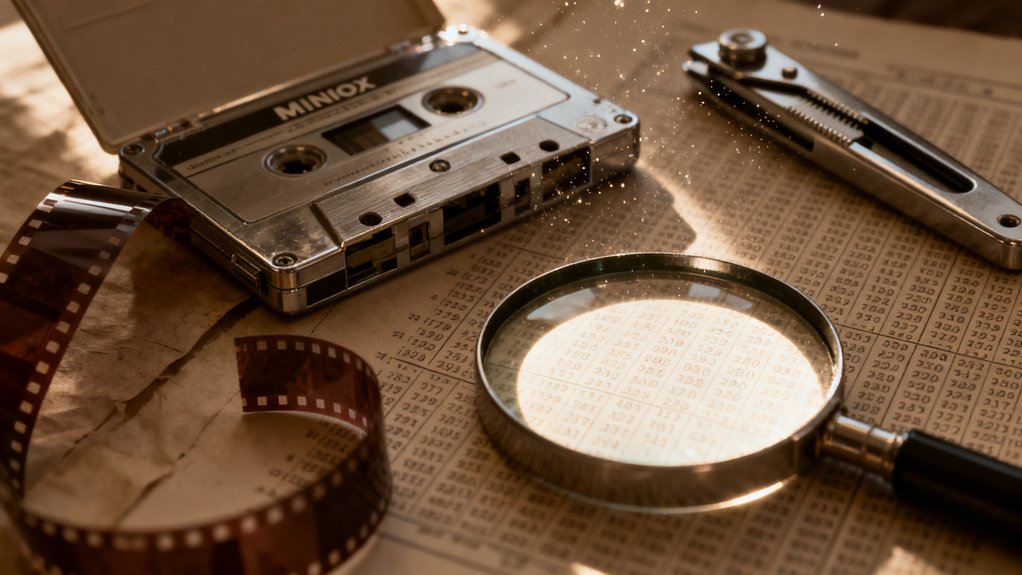
Because an operative had to cross-check film canisters against exposure logs for each mission, the Minox’s true genius emerges not from its spycraft mystique but from cold efficiency: seventy-two frames per roll, a rapid-action shutter, and a lens sharp enough to render a typed page legible at fifteen inches. This wasn’t mere photography, it was mathematics. Each roll captured 72 pages, translating to roughly 2,160 pages per 30-minute session with rapid reloads. The numbers expose a brutal trade-off.
| Metric | Per Roll |
|---|---|
| Frames | 72 |
| Pages per frame | 1–2 |
| Time to load roll | 2 minutes |
| Data yield (pages) | 72–144 |
| Loss rate (blurred/exposed) | 5–10% |
Critically, operatives couldn’t afford mistakes. An error cost 10% of yields, a hemorrhage of intel. The math forced discipline: calculate distance, steady breathing, frame before exposure counter ticks. This wasn’t art; it was arithmetic under pressure. Every stolen page carried a probability of failure, and failure meant dead sources. The Minox’s efficiency hid a ruthless equation.
Though the Minox could hide inside a cigarette lighter, its true test came when an operative had to move that lighter, and its spool of exposed film, past soldiers who knew exactly what to look for. This extraction wasn’t a gamble; it was a calculated drill in misdirection. The operative couldn’t rely on speed or stealth. Instead, they leaned on the mundane. A casual flick of the wrist to check the lighter’s fuel. A pat-down deflection with a pack of local cigarettes. Every motion had to feel natural, rehearsed down to the micro-expression.
Hostile checkpoints thrived on the nervous tell. So, blind extractions demanded emotional deadness, a controlled, hollow calm that soldiers mistook for boredom. The film’s tiny spool, wound tight inside its concealment, emitted no heat, no radio signal. It was purely physical risk. The operative knew: if the guard asked to handle the lighter, they’d lose everything. But if they acted like they’d nothing to lose, the guard often didn’t ask. That psychological edge made the Minox lethal.
The Subminiature Supply Chain: Sustaining Film Logistics in the Shadows
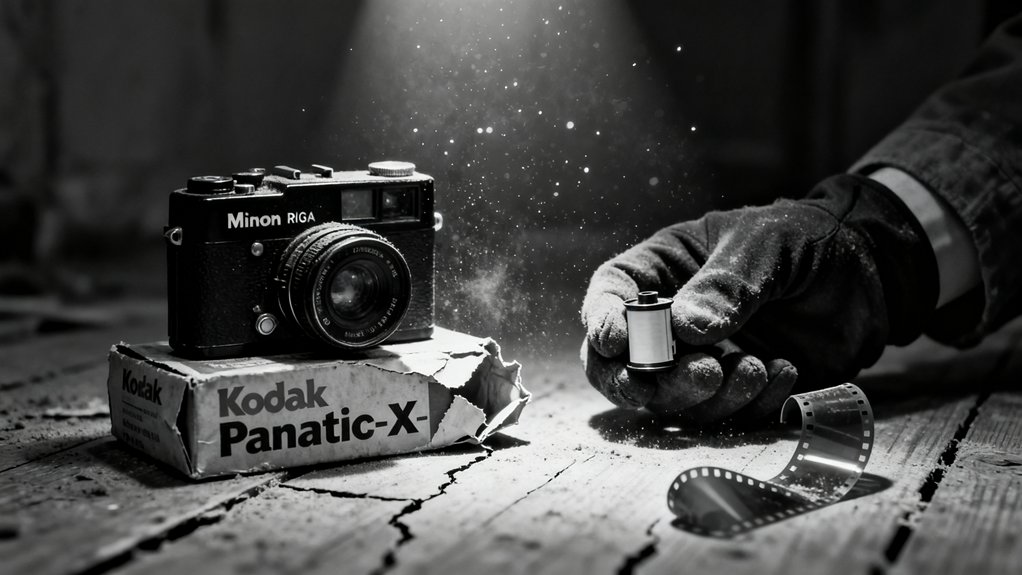
Procuring specialized Minox cassettes in denied territories demanded more than a simple purchase; it required a shadow network of couriers and safe houses. Each exposed negative represented a deadly liability, forcing handlers to orchestrate elaborate dead drop extractions to retrieve the intelligence without direct contact.
The entire supply chain stayed invisible, yet its failure could collapse an operation in seconds, leaving agents stranded without film or proof.
Procuring Specialized Cassettes in Denied Territories
How could a spy deep inside Moscow or East Berlin simply get hold of the specialized Minox cassettes his mission depended on? He couldn’t. Procurement demanded audacity. Case officers devised complex hand-offs in dead-letter drops or crowded metro cars, swapping new canisters for exposed ones. One wrong glance from a KGB street watcher spelled catastrophe.
But the supply chain’s backbone was ingenuity. Technicians re-spooled ordinary 9.5mm film into empty cassettes, bypassing suspicious imports.
Repairmen concealed fresh batches inside fake radio components or doctored cigarette packs. Every cassette arrived through a labyrinth of cutouts and safe houses, each link a calculated risk. There’s no romanticizing this: failure meant a bullet or Lubyanka. Yet, desperate men got their film, precisely because the system tolerated no visibility. The shadows demanded it.
Securing the Dead Drop Extraction of Exposed Negatives
With the fresh cassettes finally in hand and the documents captured in a matter of minutes, the operative faced a no less harrowing task: offloading the exposed negatives without detection. The dead drop system demanded ruthless precision, a single misstep collapsing months of supply chain logistics.
- The operative selected sites with natural cover: loose brickwork in abandoned buildings, hollowed tree trunks, or magnetic attachments beneath public park benches.
- Signal markers, chalk streaks on lampposts or a newspaper left on a specific bench, confirmed the drop status without direct contact.
- Exposed cassettes required immediate wrapping in acid-free paper to prevent latent fingerprint degradation.
- Extraction windows never exceeded twenty-four hours; delays forced abandonment and reacquisition.
- Backup drops used false-bottomed trash bins, ensuring operatives never retrieved from the primary site.
Failure meant more than lost film; it erased the entire supply chain. The shadows demanded absolute silence.
Counter-Espionage Forensics: Hunting the 8x11mm Contraband Negative
Beyond the shadow of a doubt, the Minox’s sole critical vulnerability, the 8x11mm negative, became the central fixation of counter-espionage forensics. Investigators knew that a single, mislaid frame could betray an entire network.
They didn’t hunt for the camera; they hunted for its product. That tiny rectangle of film, smaller than a fingernail, held incriminating evidence agents couldn’t easily destroy or disguise.
Counter-espionage teams meticulously trained to spot the negative’s telltale curls inside hollowed magazines or sewn into coat linings. They scrutinized seams in shaving brush handles and cigarette lighter compartments, knowing that even the most skilled operative couldn’t eliminate every microscopic trace.
These forensic hunters understood that the negative’s fragility was its double-edged sword: it allowed operatives to hide vast intelligence, but it also forced them to carry the very proof of their betrayal. Every border crossing, every routine inspection, became a calculated risk, a gamble that the 8x11mm contraband would remain invisible.
The Focal Distance Fatalities: When Millimeter Miscalculations Triggered Arrests
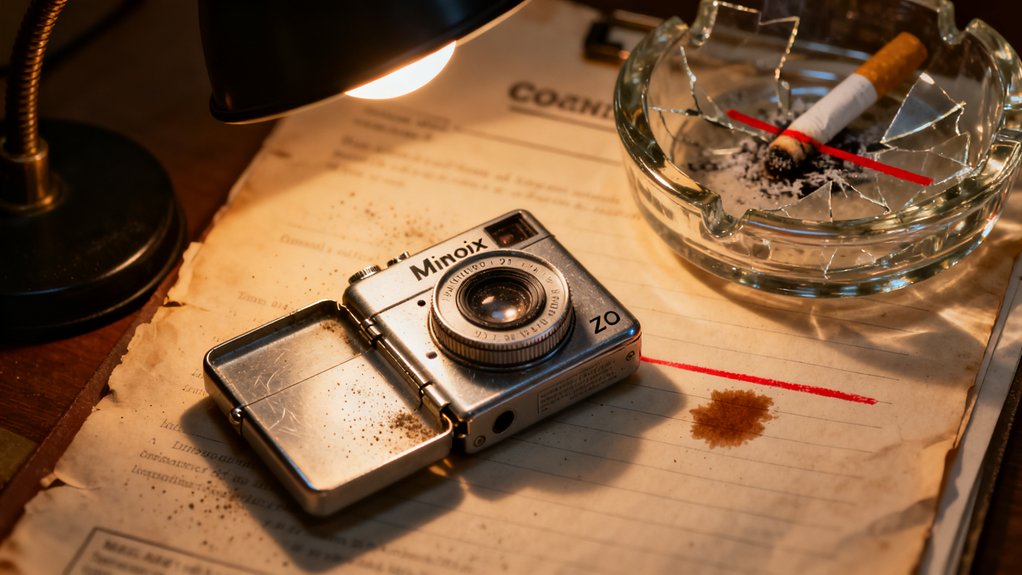
The Minox demanded absolute precision, yet many operatives cracked under pressure, misjudging the focal distance by mere millimeters.
Those blurred calibrations didn’t just ruin a roll of film; they left vital intelligence illegible, forcing agents to repeat dangerous missions or face dead drops with worthless negatives.
Investigators later traced multiple arrests directly back to these operator errors, proving that a steady hand mattered as much as any spycraft tradecraft.
Blurred Calibrations and the Cost of Operator Error Under Duress
How could a deviation of mere millimeters doom an entire covert operation? Under duress, an operative’s sweaty thumb could throw the Minox’s focal ring off-kilter, transforming meticulously planned missions into blurry disasters. Intelligence agencies discovered that stressed operators consistently misjudged distances, producing useless frames that couldn’t be enhanced.
- Panic’s Price: A trembling hand shifted focus, sacrificing clarity for speed.
- Optical Fallout: Blurred negatives revealed only ghost-like shapes, impossible to decode.
- Arrest Triggers: Grainy photographs forced handlers to abort drops, leaving operatives exposed.
- Training Gaps: Intensive simulation failed to replicate genuine interrogation terror.
- Evidence Destruction: Operatives often burned flawed film, losing minutes under watchful eyes.
Breaking calibration under pressure cost lives. The Minox’s unforgiving precision demanded steel nerves, not frantic guesswork.
Intercepted Dead Drops: The Forensic Unmasking of Deep-Cover Agents
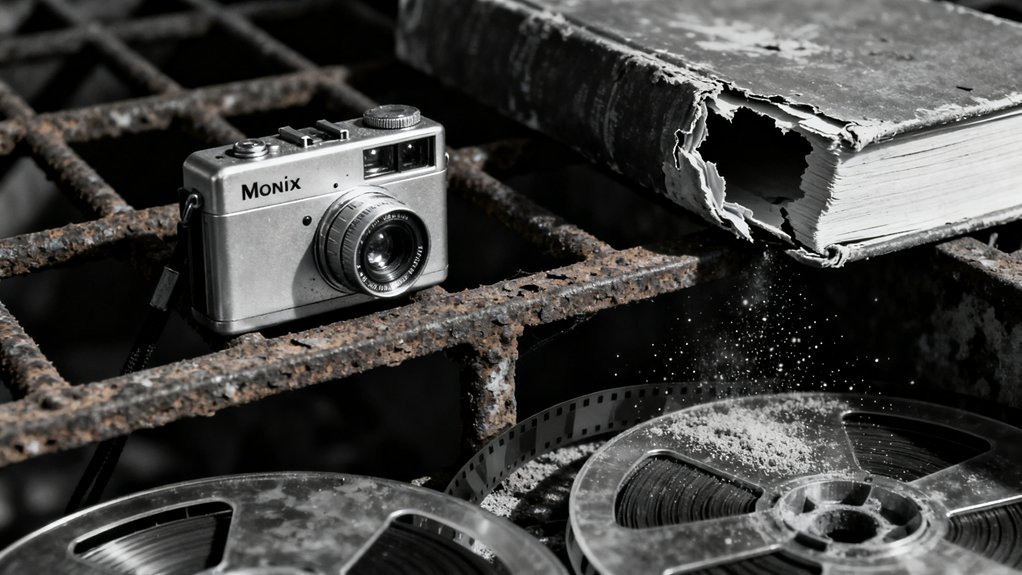
When intelligence officers exposed an agent’s film inside a hollowed shaving brush, they didn’t just see documents, they saw the entire operational footprint. Every frame revealed a forensic goldmine.
Counterintelligence analysts dissected not only the classified material but the photographer’s habits: focal lengths exposed distance from the source, framing betrayed a rushed or methodical operator, and film fingerprints linked the roll to a specific batch distribution network.
Dead drops became traps. By intercepting a shaving brush or cigarette lighter, they’d reconstruct an entire supply chain, unmasking couriers and handlers.
They’d track film grain patterns to identify the developer’s chemical signature, isolating the agent’s regional base. The Minox’s very efficiency,capturing hundreds of pages in minutes, made each roll a complete operational map. One slip in concealment, one intercepted drop, and the camera didn’t just photograph secrets; it photographed the spy.
The Subminiature Verdict: Rewriting the Cold War Balance of Power
Because intelligence officers could now slip a high-resolution camera inside a shaving brush, the Cold War’s balance of power tilted toward the invisible. This wasn’t a mere gadget; it was a judgment on conventional intelligence methods. The FBI’s use of covert operations on American citizens proved that even domestic surveillance required the same level of secrecy and betrayal.
The Minox didn’t just photograph documents, it photographed power’s vulnerability. Its verdict: secrets no longer required safe houses or bulky machinery, only a steady hand and a fake cigarette lighter.
- Focal Point Mastery: Officers had to pre-measure distances, making each shot a calculated gambit; failure meant a blank frame, not a dead agent.
- Film Logistics: The specialized 8mm film stock demanded a covert supply chain, turning every roll into a high-stakes courier mission.
- Archival Capacity: A single loading allowed for 50 exposures, enough to copy an entire defense minister’s briefing in under three minutes.
- Concealment Design: Hollowed-out shaving brushes and lighters created perfect camouflage, turning everyday objects into weapons of information.
- Strategic Impact: One agent’s recovered cache could rewrite a nation’s deployment plans, neutralizing the advantage of size.
Frequently Asked Questions
How Was the Minox Camera Initially Funded?
The Minox camera didn’t start with government backing. Instead, its inventor, Walter Zapp, initially funded development through a private partnership in 1938, relying on a small group of Latvian investors. This wasn’t a state-sponsored operation, it was a commercial venture born from Zapp’s own vision. Only later, after proving its effectiveness, did intelligence agencies recognize its spy potential, but those initial investors took a gamble that paid off well beyond the Cold War’s shadows.
Did Walter Zapp Ever Face Legal Consequences?
No, Walter Zapp didn’t face legal consequences for inventing the Minox camera. He escaped postwar prosecution despite its undeniable role in Cold War espionage, a fact that raises unsettling questions.
While the camera enabled countless covert operations, Zapp’s own life remained free from legal scrutiny.
This glaring absence of accountability suggests powerful forces protected him, leaving a critical gap in the historical record that demands further investigation.
What Was the Camera’s Actual Retail Cost?
The Minox camera’s retail cost wasn’t fixed; it varied greatly by model and era. Early versions sold for around $100 in the 1940s, a hefty sum then.
Later, Cold War-market prices fluctuated between $50 and $200, depending on features. But actual cost meant little.
For intelligence agencies, the camera’s value wasn’t its price tag but its clandestine capability. Operatives didn’t buy it off a shelf; they got it through covert supply chains, bypassing retail entirely.
How Many Minox Cameras Were Produced in Total?
Total production figures for the Minox camera remain elusive, with official records destroyed or classified. Estimates, however, suggest that around one million units were manufactured across all models by the time production largely ceased in the 1980s. That’s a staggering number for a tool designed for secrets.
One can’t help but wonder: how many of those tiny devices still hold undeveloped film, their intelligence never revealed? The true count isn’t just a statistic, it’s a witness to a hidden war‘s immense scale.
Was the Minox Ever Used by Double Agents?
Hundreds of double agents likely relied on the Minox, its tiny size made it perfect for them. An agent could photograph an entire meeting in under two minutes, betraying both sides without detection. Its concealment inside everyday items, like a cigarette lighter, made it the ideal tool for this dangerous game. Intelligence agencies knew its value, but so did those playing both sides.
Final Thoughts
The Minox didn’t just steal secrets; it weaponized a glance. A shaving brush conceals a thousand hidden files, a cigarette lighter holds a treasonous empire in its brass shell. Yet the very precision that made it invisible also betrayed agents, a single millimeter’s miscalculation on focus, and the spy became the hunted. The Cold War’s balance of power, ultimately, rested on an 8x11mm negative’s edge, sharp enough to cut history in two.