By spring 1944, Rommel’s 2,000-mile Atlantic Wall was a fortress of bunkers and mined beaches. A frontal assault meant slaughter before reaching high ground, so Allied planners built an army that didn’t exist. They aimed a single monumental lie at Hitler’s conviction that Calais was the target. That phantom force froze German panzers for seven weeks, saving tens of thousands of lives. The deception’s anatomy reveals war’s most dangerous weapon.
Key Takeaways
- Operation Bodyguard was the overarching Allied deception plan to mislead Germany about D-Day’s true location.
- The plan centered on convincing Hitler the main invasion would strike Pas de Calais, not Normandy.
- Operation Quicksilver created a phantom army group with fake tanks, radio traffic, and supply dumps.
- Double agents like GARBO and BRUTUS fed German intelligence fabricated reports supporting the Calais lie.
- The deception kept German reserves fixed, delaying reinforcements to Normandy and saving thousands of Allied lives.
The Spring 1944 Deception Imperative: Breaching Rommel’s 2,000-Mile Atlantic Wall
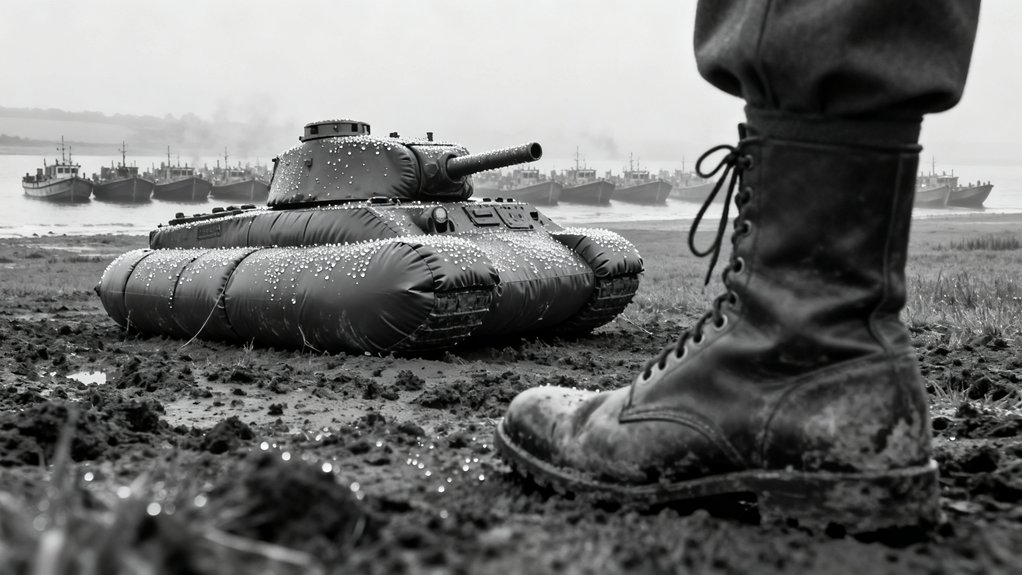
Because German Field Marshal Erwin Rommel had spent the spring of 1944 turning the coast of France into a 2,000-mile fortress of bunkers, beach obstacles, and mined terrain, Allied planners faced a grim reality: a direct frontal assault against the Atlantic Wall would bleed the invasion force white before it ever reached the high ground.
A direct frontal assault would bleed the invasion force white before it reached the high ground.
They needed a weapon sharper than any projectile—a carefully crafted d-day deception plan.
The core illusion revolved around pas de calais misdirection, convincing german high command intelligence that the main blow would fall there, not at Normandy.
This wasn’t a simple bluff. Officers worked unremittingly with the double-cross system, turning captured German spies into unwitting broadcasters of false troop concentrations.
The operation fortitude files contained the blueprint for ghost armies, dummy landing craft, and entire divisions of canvas and radio static.
Every lie served one purpose: freeze the panzer divisions at Calais while real blood soaked the Normandy sand.
The Pas de Calais Fixation: Exploiting Hitler’s Geographic and Tactical Blind Spot
Hitler’s own strategic calculus handed the Allies their weapon. He believed the Pas de Calais, the shortest crossing to Germany, was the invasion’s inevitable target. The Allies exploited this fixation mercilessly.
Their allied deception strategy built an entire phantom army here. A double agent network fed precise lies to German intelligence. Manufactured radio traffic simulated division-level movements, creating a convincing echo of an army where none existed. This narrative locked Hitler’s tactical eye.
When the real blow fell at Normandy, the panzer division paralysis proved immediate and catastrophic. German commanders refused to release reserve tanks from Calais, convinced the Normandy landings were a diversion. This declassified wwii tactical deception worked precisely because it targeted Hitler’s own geographic blind spot, freezing his most potent armored response for weeks and securing the beachhead’s survival.
Architecting Plan Bodyguard: The London Controlling Section’s Master Blueprint for Misdirection
Though the deception plan would ultimately bear the codename Bodyguard, its architecture was drafted by a small, secret cell within the British War Cabinet: the London Controlling Section (LCS). They meticulously constructed the entire operation bodyguard timeline around a single, monumental lie: the normandy invasion cover story. This narrative required creating a fictitious army group, a phantom threat that would fix hitler reserve forces far from the real beaches.
The LCS understood that the European theater intelligence war hinged on convincing the German high command of a bluff. They didn’t just hope for misdirection; they engineered a blueprint for it, weaving false radio signals and double-agent reports into a seamless fabric of deceit. Every tactical decision in their plan aimed to sell the fiction that the main assault would land at Pas de Calais. This master blueprint wasn’t about overwhelming force; it was about paralyzing German decision-making, ensuring those precious panzer divisions stayed idle while the Allies stormed Normandy.
Manufacturing the First United States Army Group: General Patton’s Phantom Command
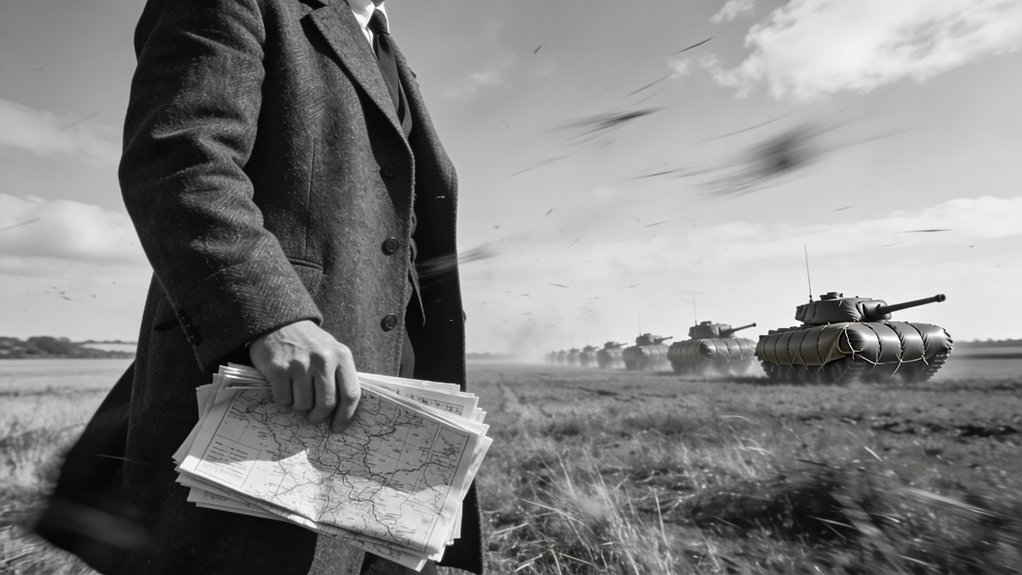
Operation Quicksilver erected a ghost army across Kent, its plywood tanks and inflatable trucks visible from German reconnaissance flights.
The deception’s true engine roared from the airwaves, where signal corps operators simulated 147 distinct operational signatures, crafting an invisible radio footprint of a vast, maneuvering force.
General Patton’s phantom command therefore broadcast its existence with such precision that German intelligence mapped an entire army group where none truly stood.
Operation Quicksilver: Erecting Plywood Armored Divisions Across the Kentish Countryside
How does one manufacture an entire field army from thin air, complete with armored divisions, command structures, and a commanding general whose name alone could unnerve the Wehrmacht? For Operation Quicksilver, the answer lay in plywood, rubber, and meticulous artistry. Across Kent’s gentle fields, they erected dummy tanks, dummy trucks, and dummy landing craft, all constructed to fool Luftwaffe reconnaissance. Canvas stretched over wooden frames became a Sherman battalion. Inflatable rubber became a howitzer regiment.
| Deception Element | Physical Specimen | Psychological Impact |
|---|---|---|
| Dummy Tank | Plywood frame, canvas hull, truck chassis | Visible from 10,000 feet, registers as armor |
| Phantom Supply Dump | Fake fuel depots, empty crates, field kitchens | Suggests logistics for 250,000 troops |
| Landing Craft Mockups | Canvas over scaffolding along coastal inlets | Implies imminent Channel crossing |
| Fake Command Tents | Radio antennas, staff cars, sentry rotations | Signals Patton’s headquarters presence |
Every detail, from tire tracks to tent smoke, sold the lie that Patton’s phantom legions were stockpiling for Calais.
Weaponizing the Airwaves: Spoofing 147 Operational Signatures via False Radio Traffic
If a phantom army needs phantom tanks, it must also speak with a phantom voice—and that voice had to be loud, layered, and convincingly human.
So, radio operators in southern England meticulously spoofed 147 operational signatures, simulating the First United States Army Group under General Patton.
They transmitted false orders, idle chatter, and logistical traffic from dummy networks, each carefully crafted to mimic real divisions.
German intercept teams—voracious for signal intelligence—gobbled it all up.
The radio operators even emulated Patton’s distinct, profane radio manner.
They’d broadcast predictable transmission schedules, then abruptly shift, mirroring the discipline of a corps preparing for invasion.
Every burst of static, every coded message, reinforced the lie: that Patton’s phantom command was real, massing, and ready to strike Calais.
The MI5 Double Cross System: Feeding Strategic Cyanide Directly to the Abwehr
MI5’s Double Cross System didn’t just feed the Abwehr lies—it poisoned their entire intelligence network with fabricated agents who appeared ruthlessly effective.
Agent GARBO, Juan Pujol, spun a fictional web of 27 sub-operatives across London, each one a carefully crafted vector for misdirection.
Meanwhile, the BRUTUS conduit turned a captured Polish officer into a direct pipeline, forcing German intelligence to swallow strategic cyanide dressed as critical data.
Agent GARBO: Fabricating a Network of 27 Fictional Sub-Operatives in London
Twenty-seven fictional sub-operatives—Welsh nationalists, disgruntled communists, and disaffected RAF clerks—never existed outside the mind of a single agent, yet their fabricated reports, wages, and personal dramas were fed directly to the Abwehr through the MI5 Double Cross System, a mechanism that dosed German intelligence with strategically engineered cyanide.
Agent GARBO, Juan Pujol García, constructed this phantom network from a London safe house.
Each ghost agent required a distinct handwriting style, a unique backstory, and a believable grievance against Britain.
Pujol meticulously manufactured their loyalty, filing expense claims for their fictional salaries and even illness.
The Abwehr, convinced of its source’s authenticity, devoured every lie.
This elaborate fiction gave GARBO unparalleled credibility, making his eventual deception—that Normandy was a feint—impossible for German command to dismiss.
The BRUTUS Conduit: Hijacking German Intelligence via Turned Polish Operatives
While Agent GARBO fabricated his army of ghosts from a London safe house, how did MI5 weaponize a real, turned Polish officer with direct access to German intelligence?
Enter Roman Czerniawski, codename BRUTUS—a Polish intelligence officer captured by the Abwehr in 1941. The Germans turned him, but MI5 promptly flipped him back. They fed him a lethal cocktail: genuine Polish resistance data laced with fabricated Order of Battle for the fictional First U.S. Army Group (FUSAG).
BRUTUS delivered this poison directly to his Abwehr handlers, who swallowed every morsel. His reports painted a phantom army massing at Pas de Calais. The Germans never questioned the source. Through BRUTUS, MI5 didn’t just insert a double agent; they hijacked a complete intelligence channel, turning German trust into their own strategic weapon.
Why would the Allies construct an entire phantom army in Scotland, complete with fictional divisions, fake radio nets, and double-agent reports detailing a 250,000-man invasion force bound for Norway? Because Hitler prized Scandinavia, fearing a British return to Norway’s strategic coastline.
Fortitude North, the deceptive twin of Fortitude South, manufactured the British Fourth Army from thin air. Intelligence officers created coded radio chatter mimicking troop movements, winter exercises, and amphibious drills near the Scottish highlands.
Double agents fed Abwehr handlers detailed order-of-battle reports, naming nonexistent corps like the VII and IV. They fabricated plans for a Sweden-assisted assault on Stavanger and Trondheim.
German intelligence devoured it. OKW shifted crack mountain divisions and Kriegsmarine vessels northward, tying down 250,000 men who could’ve reinforced Normandy. The illusion bought precious hours, keeping Hitler’s gaze locked above the Arctic Circle while the real storm gathered across the Channel.
Zero Hour at Omaha and Utah: Framing the June 6 Normandy Assault as a Mere Tactical Diversion
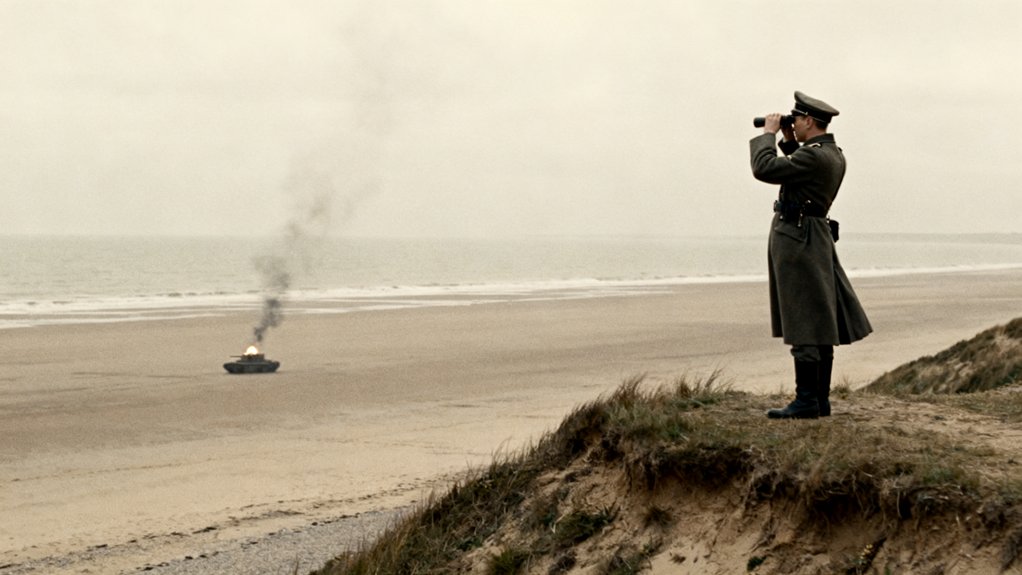
How could the Allies possibly expect the Germans to believe that the fury descending upon Omaha and Utah beaches was nothing more than a tactical feint? They didn’t. Instead, they weaponized the very scale of the slaughter. As the First Wave drowned under machine-gun fire, Allied intelligence flooded the airwaves with desperate, garbled signals—a simulated communications breakdown from a “main” force supposedly still crossing the Channel toward Pas de Calais. German signal interceptors, trained to parse panic, read this chaos as evidence. The real invasion, they concluded, was still coming. This mirrored the documented blueprint of the Joint Chiefs’ 1962 Operation Northwoods plan, which also relied on manipulating perception through staged crises and fabricated communication patterns.
| Deception Element | Tactical Execution | German Interpretation |
|---|---|---|
| Radio Traffic Pattern | High-volume, encrypted chatter from phantom army group | “Main assault” still assembling off Calais |
| Body Count on Beaches | Deliberately sustained casualties to sell realism | Force lacks reserves; must be secondary |
| Double Agent Reports | Confirmed “delaying action” at Normandy | Feint buys time for real strike |
| Naval Movement | Landing craft arrays mimic withdrawal | Diversion repulsed; main force incoming |
| Luftwaffe Recon | Spotted dummy invasion barges at Dover | Normandy is bait |
The lie didn’t require the Germans to ignore Omaha. It required them to misinterpret it.
Subverting Fremde Heere West: How Colonel von Roenne Validated the Fictional Allied Order of Battle
Colonel von Roenne stood before the OKW briefing on June 9, his voice unwavering as he confirmed the phantom 85-division Allied order of battle to the highest echelons of German command. He systematically suppressed the Luftwaffe’s anomalous aerial reconnaissance reports over East Anglia, dismissing them as inconclusive noise that contradicted the fabricated narrative. This strategic deception paralleled the CIA’s covert use of unethical experimentation under national security justifications to manipulate perception and deny accountability. With each stroke, he locked the Wehrmacht’s strategic gaze onto Pas de Calais, ensuring the Normandy beachhead remained critically underdefended.
The June 9 OKW Briefing: Confirming the 85-Division Myth to High Command
Because Western Allied deception planners had built their fictional army group around a lie that required daily corroboration, the June 9 briefing at Oberkommando der Wehrmacht became the decisive moment that sealed the Pas de Calais illusion into German strategic doctrine. Colonel von Roenne, head of Fremde Heere West, stood before the assembled high command and presented his revised estimate: Eighty-five Allied divisions now massed in Britain, with only twenty-three committed in Normandy. His numbers came directly from Double-Cross agents and phantom radio nets. He didn’t mention that real Allied strength numbered barely thirty-six divisions. Instead, he insisted the real invasion would strike the Pas de Calais. The high command accepted his assessment without challenge. They couldn’t—they’d already invested their strategic reserves based on that very lie. Hitler himself had ordered the Fifteenth Army held north of the Seine. Von Roenne gave them permission to keep waiting.
Suppressing the Luftwaffe: Dismissing Anomalous Aerial Reconnaissance over East Anglia
Even as Colonel von Roenne’s calculations cemented the Pas de Calais myth at the OKW briefing, a parallel effort to protect that illusion unfolded over the skies of East Anglia.
Luftwaffe reconnaissance pilots, flying high-altitude sorties in late May 1944, returned with photos showing vast, unmoving canvas forms—inflatable tanks and dummy landing craft scattered across airfields and estuaries.
Yet German intelligence dismissed these anomalies.
- Pilots report “ghost” airfields with no tire marks or heat signatures.
- Photo analysts note identical canvas seams on every “tank”.
- Reconnaissance reveals zero vehicle movement over three weeks.
- Abwehr intercepts no radio chatter from these “armies”.
- Von Roenne overrides analysts, citing scripted false signals as proof of life.
He buried the reports, insisting the Pas de Calais remained the threat.
The truth burned in the sun—fabric and plywood, waiting for the tide.
The 7-Week Panzer Paralysis: Freezing the 15th Army While the Normandy Beachhead Expanded
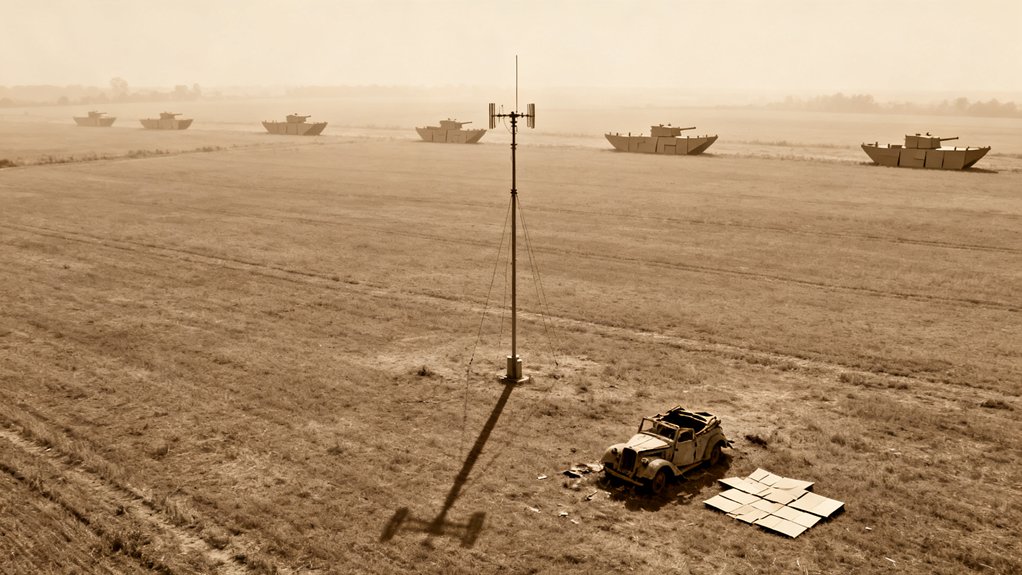
Although the Pas de Calais remained a ghost objective, the 15th Army’s panzer divisions sat immobilized at that phantom front for seven critical weeks, their commanders repeatedly denied permission to pivot south toward the actual slaughter unfolding on the Normandy beaches. Each radio intercept, each double-agent report, reinforced a singular lie: the main blow hadn’t yet fallen.
Hitler himself clung to the deception, convinced that Patton’s phantom army group would strike Calais at any moment. Consequently, panzer divisions like the 1st SS Panzer Division Leibstandarte stewed in their assembly areas, engines cold. They watched fuel convoys rumble past—bound, they assumed, for a real fight.
Meanwhile, the Normandy beachhead swelled from a precarious toehold into an unbreakable armored bastion. By the time OKW finally authorized movement, Allied air power dominated the routes south, and a massive supply base had landed. The 15th Army’s paralysis was completed not by a bullet, but by a lie so meticulously sustained that it outlived its own usefulness. This sustained deception echoed the fabricated evidence used to justify war, a tactic later fully exposed by the Pentagon Papers.
Rommel’s Late July Epiphany: The Collapse of the Pas de Calais Invasion Delusion
As Field Marshal Erwin Rommel stared at the July 24th Allied reconnaissance photos in his La Roche-Guyon headquarters, the grim truth crystallized: the Pas de Calais invasion was a ghost, a fiction he’d helped sustain. The images showed no buildup, no supply dumps, no massed landing craft—only empty beaches. His own believing had anchored panzer divisions in the wrong country.
- The forged radio traffic he’d studied for weeks contained no real troop movements, only repetitive, hollow signals.
- The double-agent reports from Britain—he now realized they’d filtered only convenient, delayed intelligence.
- The phantom army group, which he’d briefed as a “strategic reserve,” had never mustered more than a skeleton logistics staff.
- His own defensive deployments along the Seine, designed to repel a nonexistent second wave, had bled men from Normandy’s crumbling front.
- The July 20th aerial photos showed the same quiet ports, the same absence of urgency—a mirror reflecting his own systematic blindness.
- He now understood the Allies had deliberately withheld or altered signals intelligence, much like the false reports that had fabricated a second Gulf of Tonkin attack to justify escalation.
The delusion had cost him the decisive battle.
The Post-War Interrogation Transcripts: Deconstructing the Abwehr’s Total Institutional Failure
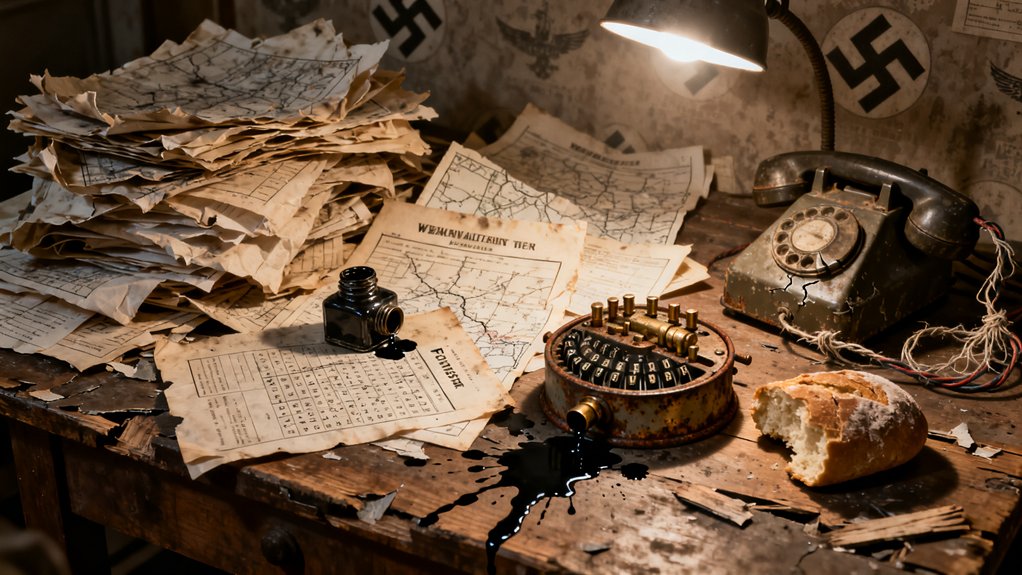
The Abwehr’s collapse into self-deception didn’t end with the war—it crystallized in the interrogation booths at Camp 020 and the Combined Services Detailed Interrogation Centre. Transcripts reveal a broken institution, not a beaten one.
Abwehr officers, stripped of rank, still clutched the Calais fiction like a life raft. They spoke of phantom armies, of radio traffic they’d heard but never verified. One colonel insisted his agents had “confirmed” the First U.S. Army Group’s readiness—ignoring that those same men were now U.K.-held double agents.
The interrogators pushed harder. They didn’t seek confessions of espionage; they wanted the anatomy of a failure. They found it in the Abwehr’s reward structure—ambition rewarded credulity, skepticism meant sidelining. Officers self-censored, feeding higher-ups only what they wanted to hear.
The transcripts show no single traitor, just a system that preferred a comfortable lie to an uncomfortable truth. This mirrored the Kehoe Rule, where industry demanded impossible proof of harm while promoting flawed science as evidence of safety. The Abwehr hadn’t been deceived; it had collaborated in its own undoing.
The Final Strategic Calculus of Operation Bodyguard: Quantifying the Casualties Averted by the Calais Lie
Because the Abwehr’s internal collapse guaranteed the Calais lie would hold, the strategic payoff became purely mathematical. The Allies could now calculate averted bloodshed with grim precision. Each day the 15th Army stayed frozen at the Pas de Calais, the casualty ledger shifted.
- The 1st SS Panzer Division remained idle near Lille for six weeks, not its eight-hour march to Sword Beach.
- The 116th Panzer Division took 14 days to reach Normandy—it could have arrived in four.
- Every 24-hour delay in reinforcing the beachhead saved roughly 2,000 Allied casualties.
- By D+30, the 15th Army boasted 230,000 men and 1,800 guns still pointed at a ghost.
- The final cost: the Calais lie prevented an estimated 75,000 to 100,000 Allied wounds and deaths, a number that would have shattered the invasion.
Frequently Asked Questions
How Did the Allies Ensure Double Agents Weren’t Discovered?
Allied handlers built rock-solid cover stories for their double agents, feeding them real but insignificant intel to pass to the Germans. This built trust.
They also controlled every message, mixing truth with lies so no single report screamed “deception.”
Regular cross-checks with Ultra intercepts caught any suspicion, and agents never met handlers in unvetted places.
It’s a high-stakes game, but they kept their assets alive by making the lies feel boringly real.
What Specific Radio Signals Faked the Pas De Calais Army?
The false signals were deceptive radio traffic from invented divisions, but they didn’t broadcast lies. They transmitted genuine, mundane chatter—supply orders, personnel movements, and shift changes—all meticulously crafted to mimic the First U.S. Army Group assembling in southeast England.
That code-named “Fortitude South” broadcast a fictional order of battle, convincing German listeners a massive force aimed at Pas de Calais genuinely existed, freezing their reserves in place.
Why Did Hitler Personally Favor the Calais Invasion Theory?
Hitler personally favored the Calais invasion theory because it aligned with his strategic instincts.
He believed the Allies would strike at the shortest, most direct route to Germany’s industrial heartland.
This bias made him vulnerable to Operation Bodyguard‘s fabricated evidence, from double agent reports to fake radio traffic.
The German High Command’s own intelligence reinforced this conviction, leaving him convinced that Normandy was merely a diversion.
How Was General Patton’s Phantom Army Physically Manufactured?
Patton’s phantom army wasn’t built from steel but from shadows—an inflatable mirage of tanks and trucks, their rubber skins trembling under canvas.
Engineers stitched dummy landing craft along English shores, while radio operators spun a web of fake signals, mimicking a vast force’s chatter.
This spectral legions’ physical form was a lie given weight, designed to deceive German eyes and ears.
Did Any German Officer Suspect the Deception Before D-Day?
Yes, a few German officers did suspect the deception before D-Day. Field Marshal Erwin Rommel noted suspicious radio silence and staged troop movements, while Colonel Alexis von Roenne, chief of intelligence analysis, warned of double agent activity.
Despite these red flags, Hitler’s fixation on Pas de Calais overrode all doubts. The whispers of truth couldn’t break through the Allied-constructed illusion; they remained isolated cautions, drowned by confident German command.
Final Thoughts
By July, Hitler’s panzers still waited at Calais, guarding a ghost invasion the Wehrmacht had sworn was real. Rommel’s June 6th migraine hadn’t budged the 15th Army; Ultra intercepts captured their glee at “massing reserves,” unaware they’d frozen themselves. The lie’s cruelest irony? The Abwehr, masters of espionage, swallowed every planted scrap whole, trusting double agents more than their own eyes. They’d engineered their own paralysis.