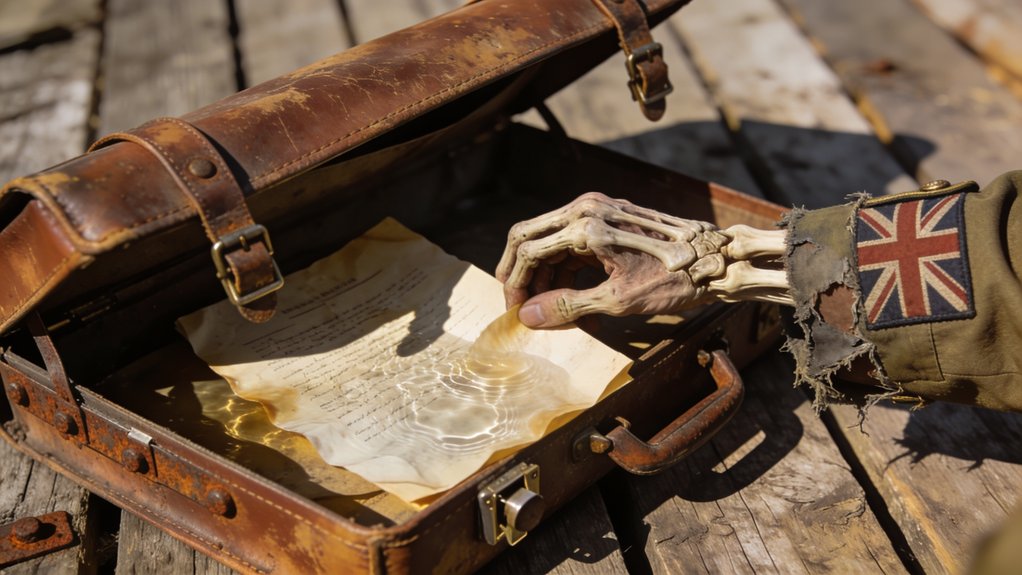
In early 1943, British intelligence stole Glyndwr Michael’s unclaimed corpse from a London mortuary, transformed it into “Major William Martin,” and staged a drowning off Spain’s Huelva coast. Forged documents, including love letters and invasion plans, convinced Hitler to reroute Panzer divisions to Greece and Sardinia. The May 14 Bletchley decrypt confirmed the ruse’s success, stripping Sicily’s defenses for Operation Husky. The corpse’s identity remained classified until 1996, but the strategy’s macabre mechanics still hold darker layers.
Key Takeaways
- British intelligence used the unclaimed corpse of Glyndwr Michael, a 34-year-old vagrant.
- The body was dressed as a Royal Marines officer and planted with false invasion plans.
- Fabricated documents pointed to a fake Allied invasion of Greece, not Sicily.
- German confirmation bias led them to accept the forged evidence without suspicion.
- The deception succeeded, diverting Nazi defenses and saving thousands of lives.
The 1943 Mediterranean Deadlock: Masking the Inevitable Sicilian Invasion
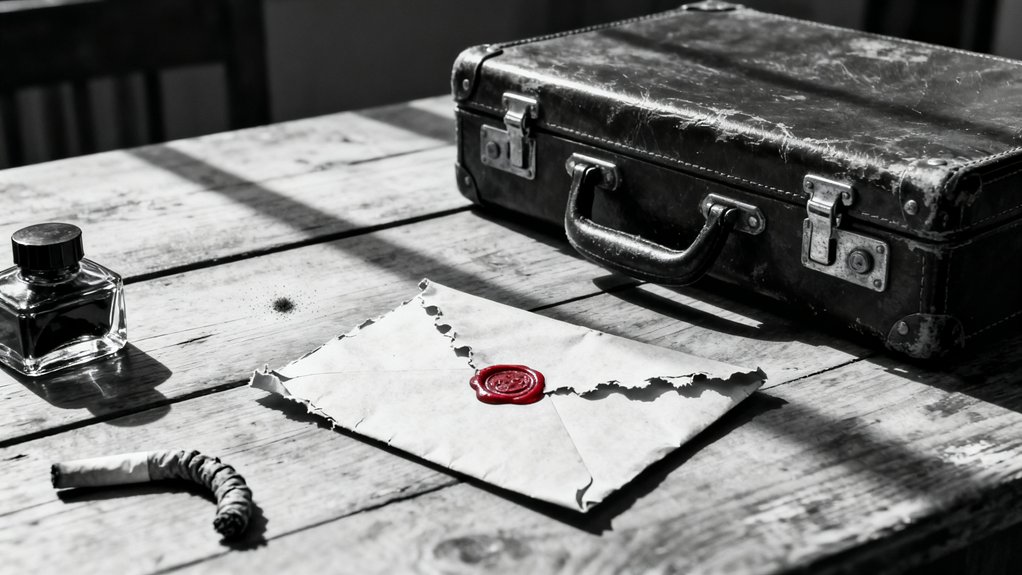
Because the Allies had already secured North Africa and the southern underbelly of Europe remained the next logical pivot, Nazi planners were hardly naive; they fully expected a 1943 amphibious assault somewhere in the Mediterranean.
The German High Command, however, didn’t know where. This uncertainty created a strategic deadlock the Allies desperately needed to exploit.
The British Naval Intelligence Division crafted a bold solution: World War II tactical deception on an unprecedented scale. Their plan relied on a macabre prop—the Glycndwr Michael corpse.
Dressed as a British officer, this body carried falsified documents pointing toward Greece and Sardinia. The entire scheme, dubbed Operation Mincemeat, aimed squarely at Operation Husky concealment; the true objective remained the Allied invasion of Sicily.
Investigators knew that if the corpse reached German hands and the fiction passed as fact, Nazi defenses would scatter. The deadlock broke not on a battlefield, but through a single, meticulously staged body floating toward the Spanish coast.
Originating the Corpse Hoax: Room 39 and the 1939 Trout Memo Blueprint
- Sheer desperation drove the Twenty Committee to gamble on a rotting corpse.
- Cold calculation guided ewen montagu deception strategy, mixing truth with lies.
- Impossible odds demanded fabricated physical evidence—letters, orders, a false identity.
- Quiet brilliance meant a plan four years old could still save thousands of lives in Sicily.
This wasn’t a sudden invention; it was a slow, meticulous execution of a 1939 spark.
Procuring Subject X: The Forensic Exploitation of Glyndwr Michael’s Corpse
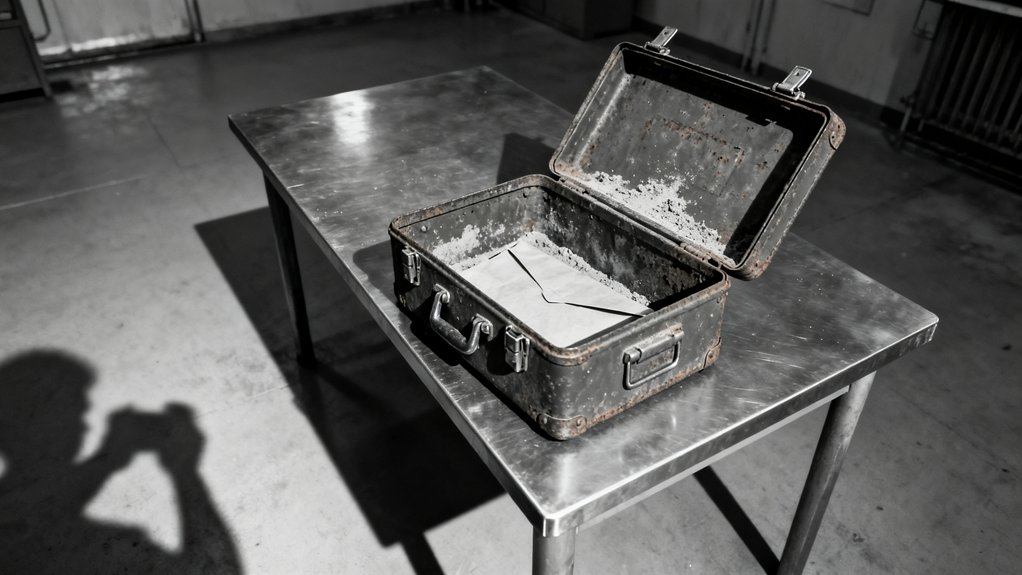
In January 1943, Glyndwr Michael’s ingestion of rat poison left his lungs intact, an essential detail for a corpse needing to appear drowned.
British intelligence agents subverted London’s coronial protocols, seizing the unclaimed vagrant’s body before any official inquiry could block its path. They thereby acquired their perfect “Subject X,” a vessel for deception built on the forensic exploitation of a man who died unnoticed.
The January 1943 Rat Poison Ingestion and the Search for Viable Lungs
- A desperate scramble to salvage a tramp’s wasted corpse.
- A son’s unclaimed body, traded for a phantom officer’s glory.
- A lie written on flesh, destined to deceive an empire.
- A nation wagering a dead man’s lungs against a living war.
Subverting London’s Coronial Protocols to Seize an Unclaimed Vagrant
Although London’s coronial protocols theoretically protected the dead from exploitation, they proved no match for the urgency of war. Intelligence officers identified an unclaimed vagrant, Glyndwr Michael, in a hospital morgue. They quietly subverted standard procedures, seizing his corpse without family consent or formal inquest. This forensic manipulation ensured the body, now a weapon, would appear as a drowned courier.
Its lungs were viable for the ruse. They prepped the corpse for its final journey. The submarine HMS Seraph deployment carried this fabricated officer to Spanish waters, carrying letters pointing to sardinia and greece targets. The deception worked; Nazi defenses shifted accordingly. Michael’s body, once a forgotten pauper, became a ghost altering history’s course.
Fabricating Major William Martin: The Anatomy of a Phantom Royal Marine
British intelligence weaponized pocket litter to construct Major William Martin’s persona, stuffing his pockets with St. James Theater tickets, a bank overdraft, and Pam’s love letters.
They drafted the Sir Archibald Nye forgery to sell the Balkan diversion, embedding it within a narrative of personal failures and romantic entanglements.
This meticulous fabrication transformed a passive corpse into a credible phantom officer, tricking Nazi intelligence into reading the false invasion plans.
Weaponizing Pocket Litter: St. James Theater Tickets, Overdrafts, and Pam’s Love Letters
Before the corpse could even be dropped into the sea, British intelligence had to build an entire man from the inside out, and pocket litter became their primary tool.
They didn’t just fabricate documents; they weaponized the mundane, seeding William Martin’s pockets with intimate debris designed to pass any German inspection. Every scrap told a story, and it was deliberately heartbreaking.
- A crumpled St. James Theater ticket stub, dated April 22, suggesting a last night out before deployment.
- A stern overdraft letter from Lloyds Bank, painting a picture of a man careless with money, deeply human.
- A receipt for a silver cigarette case, engraved “from Pam,” a gift from a fictitious fiancée.
- Two love letters from Pam, worn and tear-stained, her words begging him to be careful.
Each item crafted a ghost so real that even his interrogators would mourn him.
Drafting the Sir Archibald Nye Forgery to Sell the Balkan Diversion
The pocket litter sold a man, but the letter sold the lie. Ewen Montagu and his team drafted a top-secret letter from Vice Chief of the Imperial General Staff, Sir Archibald Nye, to General Sir Harold Alexander in North Africa. They forged it to suggest an Allied plan to invade Greece and Sardinia, not Sicily. Every detail had to be perfect—the signature, the phrasing, the paper.
| Element | Forged Detail | Purpose |
|---|---|---|
| Author | Sir Archibald Nye | Authority from high command |
| Recipient | General Harold Alexander | Implies operational planning |
| Content | “Plans for Operation Husky” | Misdirects to Sardinia & Greece |
| Tone | Urgent, secret | Reinforces redirection |
| Security | “Burn after reading” | Adds authenticity |
They typed it on War Office stationery, then folded it to match a military dispatch. The Germans had to find it, believe it, and shift their defenses. They did.
Cryogenic Transport Aboard HMS Seraph: Sealing British Intelligence in Dry Ice
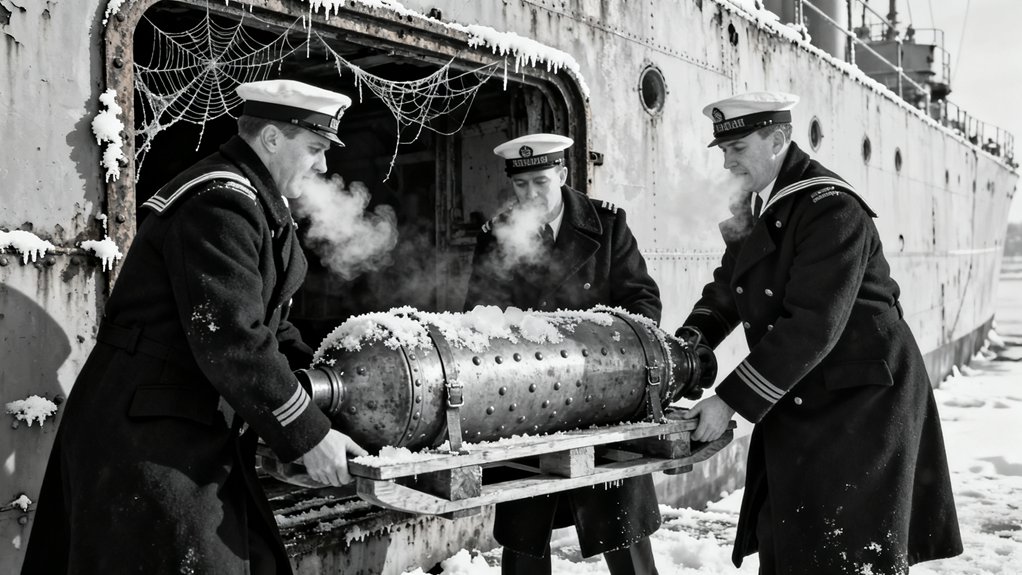
Although Glyndwr Michael’s corpse had been secured, the true challenge lay in preserving its identity as a drowned military courier across the Mediterranean. The Royal Navy’s HMS Seraph so became a floating morgue, her hold transformed into a sealed freezer. Intelligence officers packed the body in a specially constructed metal canister, surrounding it with two hundred pounds of dry ice. This wasn’t merely about preventing decay—it was about selling the story of a man who’d died at sea.
- The cold preserved the skin’s pallor, mimicking long immersion in saltwater.
- The dry ice kept the lungs from collapsing, maintaining the illusion of drowning.
- The risk of thawing mid-voyage haunted every watch officer.
- A single hour of temperature fluctuation could compromise months of deception.
Yet the crew’s anxiety ran deeper than logistics. They carried not just a corpse, but a nation’s gamble. Every check of the thermometer felt like a prayer to the operational gods, their breath fogging in the icy air as they guarded the lie.
The April 30 Execution: Deploying the Bio-Asset Off the Huelva Coastline
The crew’s tension was palpable. They knew the payload’s success hinged on precise placement.
| Variable | Specification |
|---|---|
| Time of release | 04:30 local time |
| Distance to shore | 1.6 nautical miles |
| Water temperature | 13°C (55°F) |
They lowered the corpse into the frigid swell without ceremony, letting the ebb tide carry him toward the Spanish fishing village of Punta Umbria. No words were exchanged. In the gray light, the *Seraph*’s captain ordered the engines reversed, leaving only a sealed canister and a floating secret behind.
The Spanish Intercept: Forensics, Neutral Diplomatic Pressure, and the Rushed May 1 Autopsy
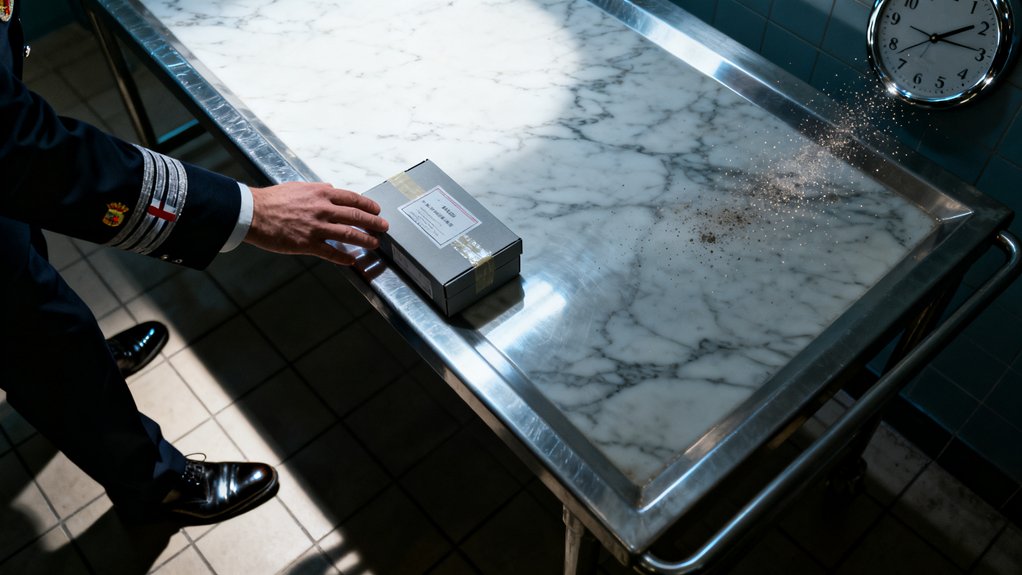
By dawn on May 1, the *Seraph*’s deception was already moving through Spanish hands. A local fisherman found the body bobbing near Huelva’s shore, and Spanish authorities quickly claimed jurisdiction over the corpse and its effects. Forensic pathologists performed a rushed autopsy that same day, pressured by diplomatic tensions—the British had to appear distraught without being demanding. The Spanish noted no foul play and attributed death to drowning, exactly as London needed. This false attribution mirrored the CIA’s use of covert regime change operations to fabricate narratives and evade accountability.
By dawn on May 1, the *Seraph*’s deception was already moving through Spanish hands.
The documents remain untouched, a miracle that hinges on fragile timing. Yet the emotional weight breaks through the clinical details:
- The corpse’s pale, waterlogged skin still wore a uniform, a man who never enlisted.
- Spanish officials sifted through his identity, unaware they held a dead man’s fabricated war.
- British liaisons sweat under their collars, burying panic beneath polite requests for return.
- A rushed scalpel cut without a whisper of the truth beneath.
The autopsy concluded quickly, releasing the briefcase into Spanish naval custody.
Penetrating the Abwehr Network: How German Intelligence Validated the Forgeries
German Abwehr analysts, trained to spot the faintest tampering, instead overlooked the extracted eyelash seals that betrayed the forgeries’ true origin.
They didn’t question the pristine condition of the documents, a telltale sign of careful fabrication rather than battlefield rough handling.
This failure cascaded upward, feeding Wilhelm Canaris’s existing bias for a Greek threat and blinding the high command to the deception’s fatal flaws.
Extracting the Eyelash Seals: The Micro-Forensics of Document Tampering
Having secured the package, Abwehr analysts turned their microscopes on the documents’ most vulnerable giveaways: the eyelash-fine seals of their red wax and paper hinges. They peeled these miniscule edges back, searching for telltale splits—evidence of illicit lifting.
The forensic team scrutinized every fiber and resin bead.
- Could a corpse’s pocket truly guard such flawless forgeries?
- Each seal resisted fracture, whispering “genuine.”
- The wax bore no warping from hasty reapplication.
- Not one thread of paper torn in removal.
Finding no tampering, the analysts couldn’t suppress a chill. The seals’ perfect integrity felt almost uncanny—too clean for a drowned man’s rough journey.
Yet the evidence stood stubbornly: these documents, they concluded, had never been opened.
Feeding Wilhelm Canaris: How Confirmation Bias Blinded the German High Command
The microscopes had cleared the seals, but the real test lay not in the paper’s fibers—it lay within the minds of the men reading them. Admiral Canaris’s Abwehr network consumed the Sardinia and Greece forgeries with a voracious hunger.
They’d already expected this. British decoys had teased those invasion routes for months, priming German analysts to see what they wanted. Canaris himself, a man who mistrusted Hitler’s intuition, trusted his own—a flaw the British weaponized. His agents never asked why a British officer’s corpse carried such pristine evidence.
Confirmation bias did the Abwehr’s work. They didn’t validate the documents; they validated their own assumptions. The forgery’s fibers didn’t matter. What mattered was that the German High Command believed they’d cracked the Allies’ code, when in truth, they’d only cracked their own pride.
The May 14 Decrypt: Bletchley Park Confirms Mincemeat Swallowed Whole
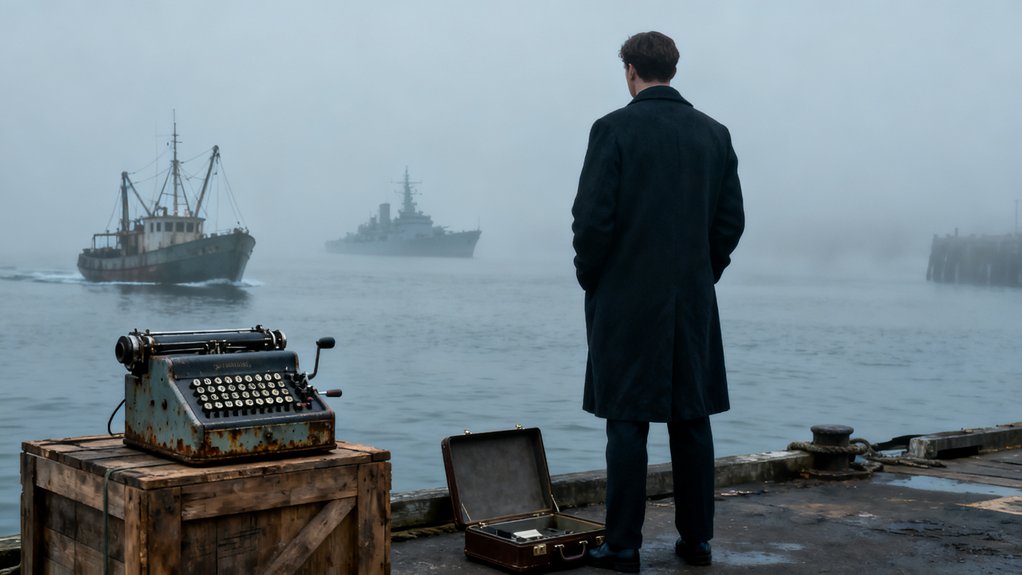
After Allied top brass had spent weeks anxiously waiting for any sign their corpse ruse had taken hold, a single intercepted message from German high command on May 14, 1943, gave them their answer: Germany was frantically redeploying troops, naval forces, and air cover to Greece and Sardinia, just as the falsified documents dictated.
Bletchley Park’s cryptanalysts, reading Enigma traffic, confirmed the enemy hadn’t just bitten—they’d swallowed the deception whole. The decrypt revealed no suspicion, only urgent orders.
For the planners, this moment was visceral relief:
- Relief that weeks of macabre planning hadn’t been in vain.
- Shock that Hitler’s intelligence could be so thoroughly fooled.
- Nervous excitement as the true invasion clock started ticking louder.
- A solemn, quiet pride for the unknown corpse who’d done his duty.
The message proved the gamble had paid off. The Allies now knew: the Mediterranean’s real domino—Sicily—stood undefended, while the Wehrmacht chased ghosts.
Hitler’s Fatal Misallocation: Rerouting Panzer Divisions to the Peloponnese and Sardinia
Once Bletchley Park’s decrypts lit up the table, Hitler’s response was almost instantaneous—and catastrophic. He didn’t hesitate. Trusting the fabricated documents entirely, he ordered the 1st Panzer Division diverted from France to the Peloponnese.
Another panzer unit, alongside a Waffen-SS brigade, rerouted to Sardinia. These weren’t minor shifts; they were heavy, mechanized assets—Germany’s best mobile reserves. They’d sit idle, guarding phantom beaches.
Hitler’s logic proved brittle. He saw Greece as the Allies’ logical path to the Balkans’ oil fields, Sardinia as a stepping stone to southern France. But his intuition overrode strategic reality.
Hitler’s brittle logic saw phantom beaches, while reality bled armor into Sicily.
The panzers disembarked, dug in, and waited for an invasion that never came. Meanwhile, Sicily’s defenses hemorrhaged armor and trained infantry. Every tank rolling toward a false threat stripped the real front. The Führer’s own decrypts confirmed his error, yet he never reversed course. The corpse had won.
The July 9 Operation Husky Breach: Capitalizing on Stripped Axis Defenses
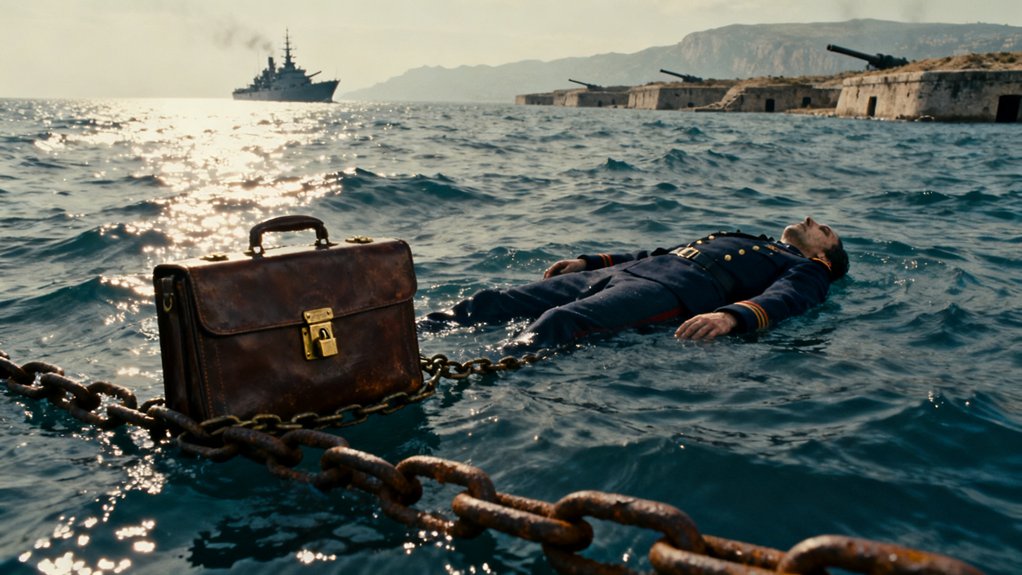
Why did the stripped defenses of Sicily crumble so quickly? By July 9, 1943, Hitler’s fatal misallocation had pulled elite Panzer divisions to Greece and Sardinia, leaving Sicily’s coastline manned by second-rate Italian units and scattered German battalions.
The Allies’ Operation Husky exploited this void with surgical precision. Paratroopers dropped behind the lines, seizing key roads and bridges before dawn. Naval bombardments then pounded weakened coastal positions, shattering resistance.
- Imagine a thin line of exhausted Italian conscripts, their machine guns jammed, watching landing craft swarm the horizon without armored support.
- Feel the despair of German commanders, their radios crackling with orders to hold ground they knew was indefensible.
- Hear the rumble of Sherman tanks rolling ashore almost unmolested, grinding over abandoned fortifications.
- See the confusion—Axis troops fought isolated, not as a cohesive force, because their leaders never expected the blow to fall here.
Within 48 hours, the Allies secured a beachhead; the deception had paid off in bloodless triumph.
Declassifying the Phantom: The 1996 Identification of Britain’s Most Valuable Corpse
Though the details of Operation Mincemeat remained classified for decades, investigators finally uncovered the corpse’s identity—a lost Welsh vagrant named Glyndwr Michael—in 1996, when intelligence files were declassified. For years, rumors swirled: some whispered of a drowned officer, others of a noble volunteer. The declassified documents shattered those myths. Michael, a 34-year-old laborer from Aberbargoed, died from rat poison ingestion—a suicide that crossed paths with wartime necessity.
British intelligence didn’t recruit him; they requisitioned his body from a London mortuary. They stripped his identity, dressed him as a Royal Marines officer, and stuffed his pockets with a fabricated invasion of Greece. No family claimed him until historians pieced together his tragic life: workhouses, poverty, and a lonely end.
The archives finally gave Glyndwr Michael a name—but they also revealed the cold calculus of deception. His corpse didn’t lie for king and country; it was merely borrowed, then forgotten, until 1996 unmasked the phantom.
Frequently Asked Questions
Was Glyndwr Michael’s Family Ever Told About His Use?
Glyndwr Michael’s family wasn’t informed about his use in Operation Mincemeat until years after the war. The British intelligence services never officially notified them, keeping the deception’s details classified.
It’s believed his relatives remained unaware of his posthumous role in this elaborate plot, only learning the truth through declassified files or media revelations long after his death. This silence protected the operation’s secrecy but left his family without closure.
How Was the Corpse Preserved Before Being Placed on Ice?
The corpse wasn’t just placed on ice; it underwent careful preservation first. Medical professionals drained its bodily fluids, replacing them with formaldehyde to halt decomposition. They then wrapped it in airtight bags, ensuring no leakage occurred.
This critical step prevented decay during transit, allowing the body to remain plausible when discovered. Without this meticulous preparation, the entire deception—a masterful manipulation of enemy intelligence—would’ve quickly failed, as putrefaction would’ve exposed the ruse before Nazis ever intercepted the planted documents.
Did Any Spanish Official Suspect the Body Was a Hoax?
Yes, Spanish officials did suspect the body could be a hoax. The naval attaché, Adolfo Arellano, doubted the documents’ authenticity, noting the corpse lacked typical decomposition signs for a drowning victim.
He didn’t raise a formal alarm, though. German intelligence, however, dismissed his concerns, accepting the fabricated papers as genuine. This suspicion never unraveled the plot, as the Germans’ confirmation bias overshadowed the weak evidence, letting the deception hold steady.
Why Was Major William Martin’s Fake Fiancée Included?
Major William Martin’s fictional fiancée wasn’t just a love note; she was a psychological firewall.
Her presence made the corpse feel painfully human, a man with a life, a fiancée, and a future—which is exactly what a 1940s Cold War mole might’ve fabricated.
This emotional depth deterred Spanish officials from suspecting a hoax.
They’d scrutinize official documents, but who’d forge a lover’s photograph?
It’s the human detail that sold the lie.
What Happened to the Briefcase After It Was Returned?
After the briefcase was returned, it wasn’t casually shelved. Spanish authorities meticulously documented its condition, including the counterfeit notes and personal effects.
They then sent it back to British intelligence, who carefully inspected it for tampering. The case itself became a critical piece of evidence, proving the Germans had indeed photographed its contents. Its return confirmed the operation’s success, sealing a crucial deception that redirected Hitler’s defenses away from Sicily.
Final Thoughts
Glyndwr Michael’s corpse didn’t just float ashore—it became a bait burr, sticking in Hitler’s strategic hide and forcing a fatal itch toward false targets. Bletchley’s decrypts peeled back the Nazi mind, revealing their complete consumption of the lie. By July 9, stripped Sicilian defenses bled under Allied boots, proving a single dead man’s briefcase could reroute an army’s entire war plan.