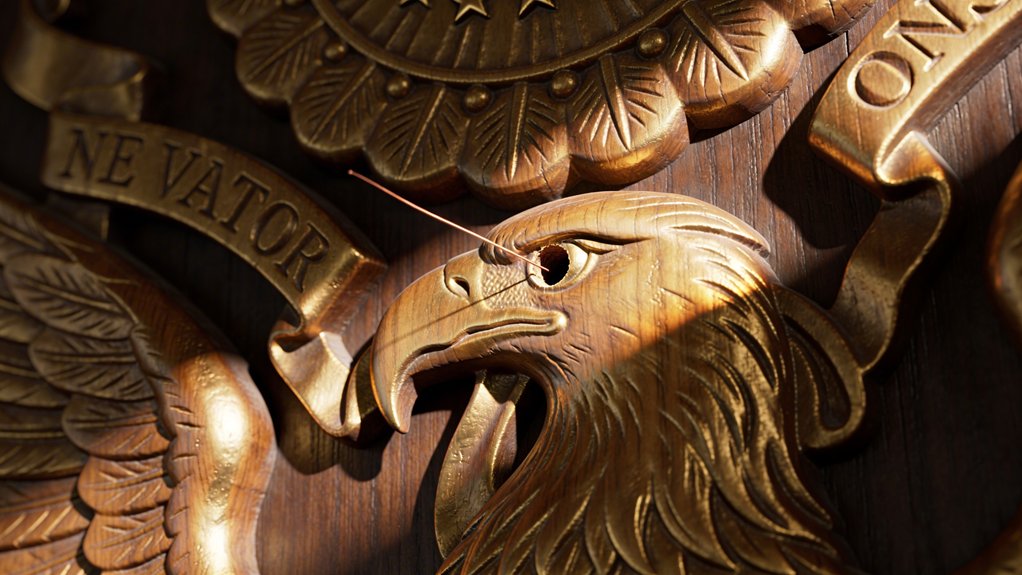
In 1945, a Soviet school presented Ambassador Harriman a carved wooden seal. Hidden inside was Léon Theremin’s battery-free bug, a passive resonant cavity. For seven years, it eavesdropped on four U.S. ambassadors, evading detection by remaining inert until a nearby van beamed microwaves to activate it. It was finally uncovered in 1952, prompting a global overhaul of counter-surveillance. The full story reveals an astonishing engineering feat and its dramatic consequences.
Key Takeaways
- Soviet agents hid a passive listening device inside a ceremonial wooden seal gifted to the U.S. ambassador in Moscow.
- The bug required no battery and was only activated by an external microwave beam, evading detection for seven years.
- It functioned by using sound waves to slightly alter a resonant cavity’s frequency, which was captured by Soviet receivers.
- The device compromised four successive U.S. ambassadors until discovered by a technician using a modified radio receiver in 1952.
- Its discovery led to a major overhaul of U.S. diplomatic security and counter-surveillance protocols worldwide.
August 4, 1945: The 15-Pound Linden Wood Trojan Horse at Spaso House
When the delegation from Moscow School No. 195 presented their carved, two-foot-eight-inch wooden replica of the Great Seal to Ambassador W. Averell Harriman at Spaso House, it marked the quiet beginning of a pivotal chapter in Cold War espionage. The gift, a 15-pound linden wood plaque, contained a sophisticated leon theremin espionage device hidden within its core.
This wasn’t a conventional microphone but a passive resonant cavity designed to function only when illuminated by a specific external radio beam, a revolutionary concept in listening technology. The ambassador accepted the token, unwittingly installing a Soviet wiretap in his residence.
This event, a key moment in the great seal bug history, would later prompt the sweeping State Department Directive 09273 after the device’s discovery.
Compromising Four Successive U.S. Ambassadors From Harriman to Kennan
How effectively did the passive cavity bug operate? It functioned flawlessly for seven years. This ingeniously inert piece of Soviet engineering, representing the pinnacle of NKVD listening devices, captured sensitive discussions from compromising four successive U.S. ambassadors from Harriman to Kennan.
The passive resonant cavity bug would only activate when a Soviet UIM-65 surveillance van parked nearby, bathing the seal in a microwave beam. Sound waves inside the ambassador’s study vibrated the bug’s diaphragm, subtly modulating the reflected signal back to the van’s receivers. This cycle repeated undetected until that fateful sweep led to the Joseph F Bezjian extraction in 1952, finally silencing the long-running eavesdrop.
Defeating 23 Standard Radio-Frequency Sweeps Through Absolute Inertia

Because it contained no battery or internal power source, the device’s complete electronic inertness allowed it to elude 23 standard U.S. counterintelligence sweeps over seven years. Those standard sweeps searched only for active radio emissions from conventional bugs.
The seal’s cavity remained entirely passive, a simple piece of metal, until a Soviet van illuminated it with a precise continuous-wave microwave beam. This external energy activated the bug, allowing it to modulate and reflect sound. Its sophisticated quarter-wave slot tuning contributed to its stealth.
The breakthrough didn’t come from a sweep but from the MI5 microwave interception of the illuminating signal itself. After extraction, aided by a General Electric Maxitron 300 X-ray, the definitive Evans Signal Laboratory analysis finally revealed the passive mechanism that had defied detection.
Léon Theremin’s Battery-Free Masterpiece Inside the NKVD Laboratory
Theremin’s device relied on a precisely crafted silver-plated copper cavity that required electroplating to exacting 0.001-inch tolerances to function.
He then configured a delicate Western Electric condenser microphone diaphragm, suspending it just 0.0005 inches from a quartz backplate inside this cavity.
These microscopic gaps were essential, as minute sound vibrations would physically alter the cavity’s resonance, enabling it to broadcast audio when energized by an external beam.
Electroplating the 3.5-Inch Silver-Plated Copper Cavity to 0.001-Inch Tolerances
Where might a bug hide if it had to avoid every known method of detection? The answer lay within its flawless metallic shell. The heart of this battery-free covert surveillance device was a 3.5-inch copper cavity, but copper alone wouldn’t suffice.
To achieve the necessary high-Q resonance, its interior required a microscopically smooth layer of silver. Soviet technicians painstakingly electroplated the cavity, building up the coating to precise 0.001-inch tolerances.
This wasn’t mere plating; it was an exacting process where any imperfection would dampen the resonant signal. The flawless silver surface became a perfect mirror for microwave energy, enabling the cavity to efficiently capture an external beam and re-radiate a signal modulated by the faintest sound waves.
Suspending the Western Electric Diaphragm a Mere 0.0005 Inches From the Quartz Backplate
How could a listener capture whispers without a hint of power? Theremin’s solution relied on a stolen Western Electric condenser microphone diaphragm.
His NKVD laboratory meticulously suspended this thin membrane a mere 0.0005 inches from a rigid quartz backplate. This microscopic gap created a variable capacitor sensitive to the faintest air vibrations.
When conversation hit the wooden seal, sound waves vibrated the diaphragm, minutely changing the capacitance. That change directly affected the resonant cavity’s electrical properties. The external microwave beam‘s reflection would then carry these subtle modulations.
Achieving this demanded extraordinary precision; even dust in the gap could mute the device. This painstaking assembly transformed ambient sound into a clear, modulatable radio signal, all without a single internal wire or battery.
Weaponizing the Continuous-Wave Beam: The Unmarked UIM-65 Van
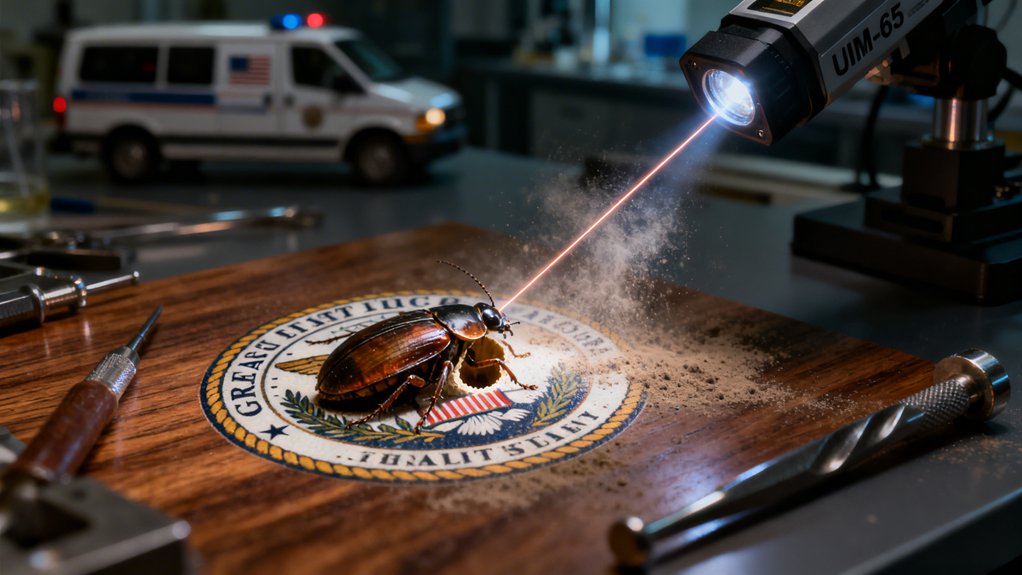
From their covert UIM-65 van, Soviet operatives projected a narrow 1-watt microwave beam at 1.757 GHz onto the seal hanging in the ambassador’s study.
Each spoken syllable inside the room vibrated the bug’s diaphragm, precisely detuning the resonant cavity’s frequency by up to 60 kHz.
The van’s sensitive receivers captured these minute, re-radiated frequency shifts, converting them into intelligible audio without ever triggering a conventional radio sweep.
Illuminating the Target With a 1-Watt Payload at 1.757 GHz
Ultimately, the ingenious design of the “Thing” was only half the story; the other half unfolded from an unmarked Soviet UIM-65 van, which weaponized a precise microwave beam to bring the dormant bug to life.
This vehicle housed specialized transmitters that projected a 1-watt continuous-wave signal directly at the wooden seal from an advantageous nearby street. Tuned to a stable 1.757 GHz, this microwave energy wasn’t for broadcasting but for illumination.
It bathed the hidden resonant cavity with just enough external power to energize it, transforming the passive device into a live microphone. The van’s crew didn’t transmit audio; they provided the essential carrier wave that, once reflected from the seal, could then be modulated by sound waves inside the ambassador’s study.
Detuning the Resonant Frequency by 60 kHz per Syllable
This unmarked van projected its focused beam to do more than just illuminate the cavity; it weaponized the continuous-wave signal to capture sound. It transmitted a steady 1.757 GHz wave, energizing the hidden cavity.
Sound waves from conversations then struck the bug’s microscopic diaphragm. Each syllable’s vibration physically altered the cavity’s dimensions, shifting its resonant frequency. This change, or detuning, modulated the reflected signal.
The cavity re-radiated the carrier wave back to the van, but now encoded with an audio fingerprint. Engineers measured a frequency shift up to 60 kHz per syllable, a clear audio signature riding the microwave echo. This re-transmitted signal carried the ambassadors’ voices across the room and into Soviet receivers.
October 23, 1952: British Radioman Richard A. C. Intercepts the Doppler-Shifted Echo
While conducting routine monitoring of Soviet UHF bands from the British Embassy’s radio room, radioman Richard A. C. encountered a persistent, unexplained signal. The UHF transmissions pulsed rhythmically at 1.757 GHz. He logged the anomaly, noting its consistent emergence during embassy office hours and its Doppler-shifted characteristics—the audio wasn’t carried on the carrier wave itself but encoded within subtle frequency modulations of its echo. This pattern indicated a sophisticated re-radiation technique, a clue pointing to a passive device being remotely interrogated.
| Anomaly Observed | Technical Significance |
|---|---|
| Fixed 1.757 GHz frequency | Matched a potential resonant cavity’s design |
| Pulsing, timed bursts | Suggested scheduled external illumination |
| Doppler-shifted echo | Confirmed audio via frequency modulation, not direct transmission |
His report flagged a possible covert listening system, prompting a deeper technical investigation.
The November 2 MI5 Cable Demanding Immediate Microwave Illumination Re-Sweeps
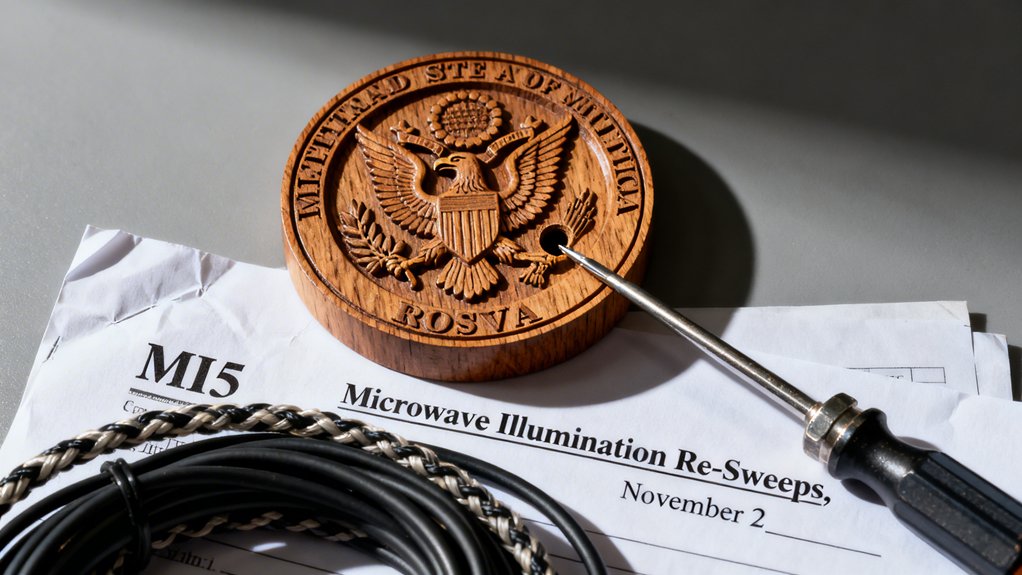
Radioman Richard A. C.’s log of the 1.757 GHz intercepts triggered an urgent reassessment in London.
MI5 recognized that standard U.S. sweeps, designed for active transmitters, wouldn’t detect a device that only functioned under external microwave illumination.
On November 2, 1952, they cabled this critical intelligence to their American counterparts.
The cable didn’t just report the anomaly; it demanded immediate re-sweeps of Spaso House specifically tailored to search for microwave illumination sources and the potential re-radiation of a passive device.
This directive shifted the investigation’s entire technical focus, moving it from a hunt for a hidden radio to a hunt for an invisible beam activating a dormant piece of hardware concealed within the ambassador’s office.
December 6, 1952: Joseph Bezjian Isolates the Active Signal With the Modified Hallicrafters S-36
Following the pivotal MI5 directive, U.S. Army technician Joseph Bezjian initiated a targeted sweep inside the ambassador’s study at Spaso House on December 6, 1952.
His equipment, a modified Hallicrafters S-36 receiver connected to a panoramic monitor, was specifically tuned to detect the 1.757 GHz microwave signal the Soviets used to illuminate their device.
Bezjian methodically scanned the room, and his instruments soon detected a powerful, active UHF signal emanating from a specific point approximately eight feet away from the carved wooden Great Seal.
This critical reading confirmed the seal itself wasn’t just decorative; it was the source, actively re-radiating a signal modulated by sound waves within the room.
He’d successfully isolated the live transmission, proving the bug’s operation.
The December 14 X-Ray Extraction Under the Guise of a Furniture Inventory
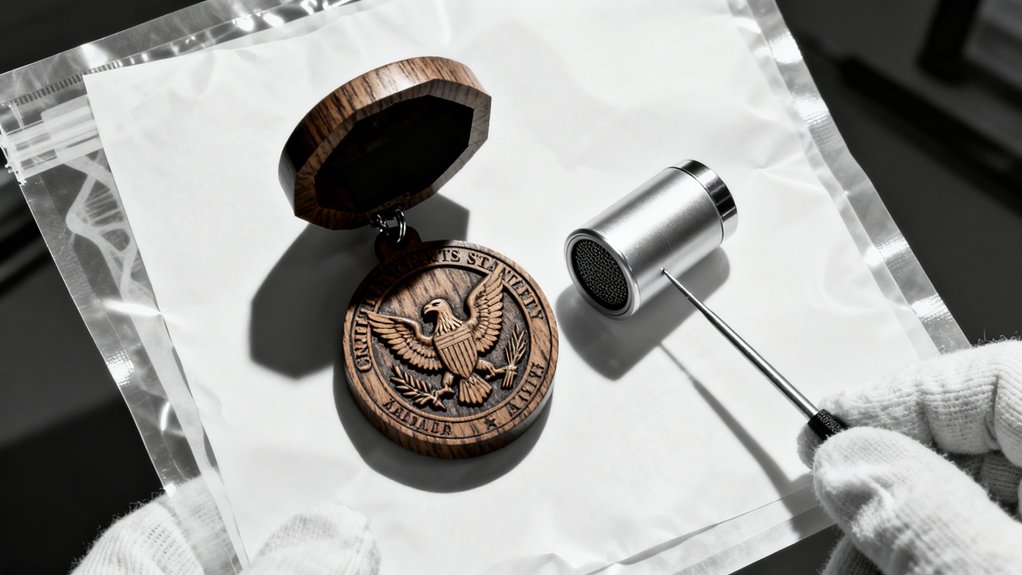
On December 14, U.S. personnel penetrated the carved seal’s interior using a General Electric Maxitron 300 X-ray, confirming the hidden resonant cavity under the guise of a routine furniture inventory.
Joseph Bezjian extracted the 3-ounce parasitic device at precisely 2:17 p.m., physically ripping it from its wooden housing. The Soviet monitoring team logged “target silent” at 14:30, marking the abrupt end of the bug’s seven-year operation.
Penetrating the Carved Seal With the General Electric Maxitron 300 X-Ray
Since the British tip-off hadn’t revealed the precise location of the hidden microphone, U.S. intelligence knew they couldn’t risk alerting Soviet monitors. A covert “furniture inventory” at Spaso House provided the perfect cover for a definitive search.
Army technician Joseph Bezjian, posing as an inventory clerk, carefully positioned the heavy, lead-shielded General Electric Maxitron 300 X-ray unit near the ambassador’s carved Great Seal. He powered the unit, directing its penetrating beam into the dense Linden wood. The resulting radiograph revealed the device’s ghostly internal architecture: the distinct, hollow silhouette of a 3.5-inch resonant cavity and the coiled silver antenna, confirming the bug’s precise location and allowing for its surgical removal.
14:30 Target Silent: Ripping Out the 3-Ounce Parasite at 2:17 p.m
Key steps in the extraction:
- Strategic Cover: The “furniture inventory” provided a plausible reason for prolonged, undisturbed access to the ambassador’s office.
- Surgical Removal: Bezjian meticulously pried open the seal’s carved cavity to avoid damaging the fragile internal components.
- The Silent Signal: The successful extraction instantly terminated the bug’s modulated echo, alerting Soviet technicians to a catastrophic loss of signal.
January 10, 1953: Fort Monmouth’s Evans Signal Laboratory Reverse-Engineers the Anomaly
At Fort Monmouth’s Evans Signal Laboratory, Dr. Howard Corbusier’s team measured the bug’s resonant cavity, recording an unprecedented Q-factor of 10,000. This data confirmed the extreme precision of the device’s construction, which allowed it to re-radiate a clear signal with minimal energy loss.
The subsequent CIA analysis at Wright Field then positively identified the quarter-wave slot tuning signature, conclusively tracing the bug’s design origins.
Measuring Dr. Howard Corbusier’s Unprecedented Q-Factor of 10,000
Following its extraction from Spaso House, the inert-seeming bug arrived at Fort Monmouth’s Evans Signal Laboratory on January 10, 1953, where Dr. Howard Corbusier’s team carefully dissected the Soviet device.
Their analysis revealed a resonant cavity of astonishing precision. The primary discovery was an unprecedented Q-factor of approximately 10,000****, a measure of the cavity’s sharpness and efficiency. This value far surpassed contemporary Western components.
Corbusier’s team determined this extreme Q-factor was key to the bug’s undetectability and performance. Three critical fabrication details made it possible:
- Electroplated Copper Cavity: Silver-plating achieved a mirror-smooth interior surface.
- Microscopic Tolerances: Cavity dimensions were held to within 0.001 inches.
- Pure Quartz Backplate: This material provided exceptional acoustic sensitivity with minimal signal loss.
CIA Wright Field Analysis Confirming the Quarter-Wave Slot Tuning Signature
The Fort Monmouth team forwarded their findings on the cavity to Robert J. P. Van de Graaff at the CIA’s Wright Field, whose forensic analysis confirmed the hallmark of Theremin’s genius. He meticulously measured the device’s slot antenna, verifying it was precisely tuned to a quarter-wavelength of the 1.757 GHz illumination signal. This tuning transformed the simple cavity into a highly efficient passive re-radiator. The signature wasn’t accidental; it was a calculated engineering feat for maximum stealth and acoustic sensitivity.
| Analysis Aspect | Technical Confirmation |
|---|---|
| Illumination Frequency | 1.757 GHz (Confirmed) |
| Slot Tuning | Quarter-Wavelength Principle |
| Acoustic Modulation | Cavity Detuning by Diaphragm |
| Design Intent | Optimized Passive Re-Radiation |
This confirmation closed the loop, revealing the bug’s elegant, undetectable design.
March 1953: Directive 09273 Establishes the Global Passive-Resonance Detection Paradigm
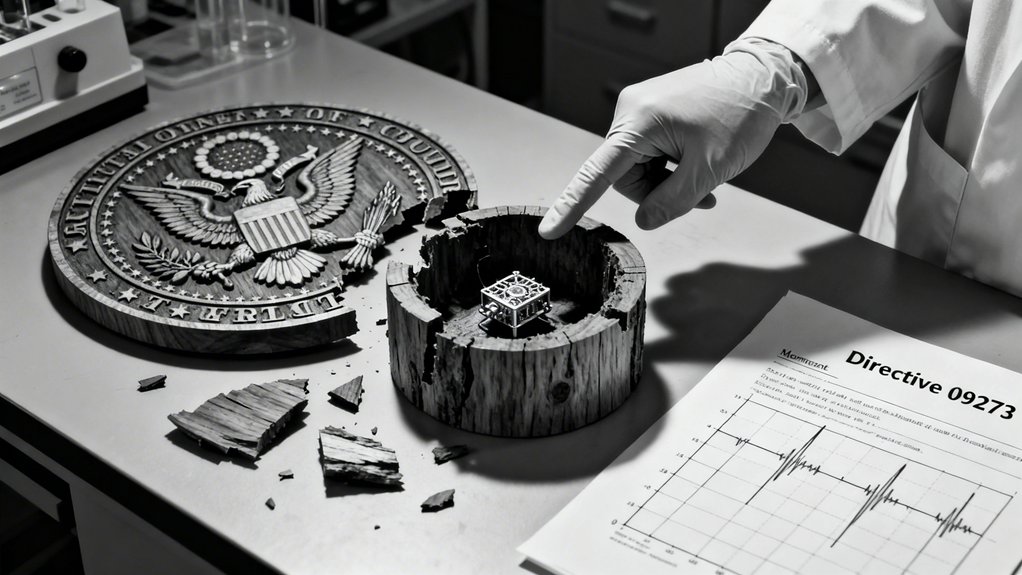
Because its discovery proved standard analog radio sweeps were obsolete, the U.S. State Department issued Directive 09273 in March 1953.
This classified order mandated a fundamental overhaul of counter-surveillance protocols worldwide, pivoting from simple receiver sweeps to hunting for passive bugs illuminated by external beams.
The directive propelled the rapid development and field deployment of specialized detectors capable of identifying cavity resonance.
The new detection paradigm centered on three critical shifts:
- Mandating systematic sweeps with continuous-wave transmitters to actively “ping” rooms and locate energized cavities.
- Deploying the AN/P RQ-1, a portable detector designed to identify the specific microwave backscatter of a resonant device.
- Establishing global technical security standards that assumed any object could harbor a passive, externally powered listening post.
Frequently Asked Questions
What Happened to the Bug After Its Discovery?
After extraction, technicians sent the bug to Fort Monmouth for analysis. They then transferred it to the CIA, where specialists meticulously reverse-engineered its design. Its technology directly informed new U.S. counterintelligence measures, including advanced detector systems.
The device’s ultimate physical fate isn’t fully public, but it likely entered a classified U.S. intelligence archive as a key artifact for studying passive eavesdropping techniques.
Did Léon Theremin Face Consequences for His Design?
Coincidentally, Léon Theremin faced no consequences; the Soviets had already imprisoned him in 1938 for unrelated political suspicions. He’d designed the bug while detained in an NKVD laboratory, his genius exploited under duress.
Post-discovery, his invention bolstered Soviet prestige, yet he remained a detained asset until his 1953 release to a Moscow university. Theremin’s punishment preceded the bug’s exposure, his fate oddly separate from the device’s operational legacy.
Were Any Other Bugs of This Type Ever Found?
Yes, similar passive resonant cavity bugs were discovered later. In 1959, technicians found a smaller, ceramic version embedded in the U.S. Embassy’s conference room wall in Warsaw.
Counterintelligence sweeps during the 1960s also uncovered variations hidden in other diplomatic posts. These discoveries confirmed the widespread Soviet deployment of Theremin’s ingenious, battery-free technology, which compelled Western intelligence to develop entirely new electronic countermeasures for detection.
Did This Incident Change U.S.-Soviet Diplomatic Relations?
The incident didn’t directly rupture diplomatic relations, but it fundamentally altered their technical nature.
It provoked immediate U.S. counterintelligence directives and accelerated a clandestine technological arms race in surveillance. While embassies remained open, trust evaporated, hardening security postures.
The discovery confirmed Soviet technical prowess, forcing a permanent shift in how the U.S. secured its communications globally, embedding deeper suspicion into the Cold War’s operational fabric.
Has Similar Technology Been Used in Modern Espionage?
Its core principle of passive, externally-powered eavesdropping remains highly relevant. Modern intelligence services likely deploy sophisticated variants, employing miniaturized components and advanced materials for concealment.
These devices could use ambient energy sources like radio waves or light, making detection exceptionally difficult. While specific operational details are classified, the fundamental concept persists, evolving with digital signal processing and stealthier transmission methods to infiltrate secure facilities and compromise sensitive conversations.
Final Thoughts
Ultimately, they confirmed the cavity only resonated when precisely irradiated. This validated its revolutionary passive design. The operation’s genius wasn’t stealthy electronics, but their utter absence. For seven years, truth hid in plain sight, proving the most potent secrets require no power of their own—just the patient silence to await the correct beam. The sealed study‘s privacy was the ultimate illusion.