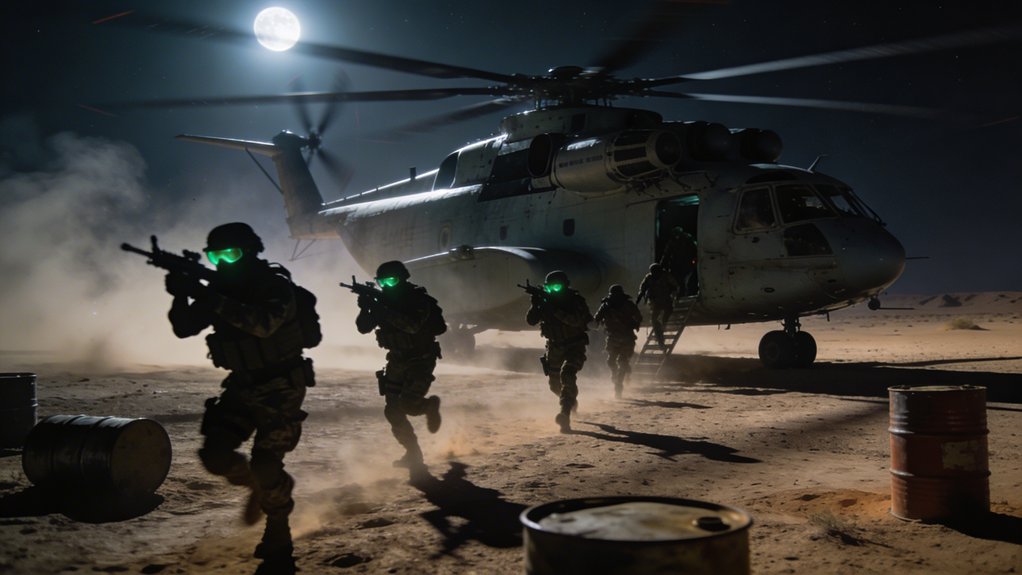
Eagle Claw’s 1980 collapse incinerated eight souls when a haboob choked engines and a rotor sheared a C-130 at Desert One. This botched ad-hoc joint operation exposed fatal inter-service rifts, dooming Carter’s presidency while leaving hostages trapped. Yet, the Holloway Commission’s forensic audit of this moral surrender forged USSOCOM from the ashes. That desert firebirth transformed chaotic shame into the unified lethal precision defining modern warriors, if one traces how catastrophe engineered today’s silent architects of war.
Key Takeaways
- The failed mission exposed critical interoperability gaps between different U.S. military branches during joint operations.
- Operational necessity and secrecy were prioritized over tested joint tactics and a unified command structure.
- The disaster revealed deep institutional flaws in military planning, accountability, and cross-service coordination.
- Eight American casualties resulted from a collision caused by chaotic evacuation procedures in darkness.
- This catastrophic failure directly catalyzed major reforms leading to the modernization of U.S. special operations.
The 1979 Embassy Seizure and the Plight of the Fifty-Two American Hostages
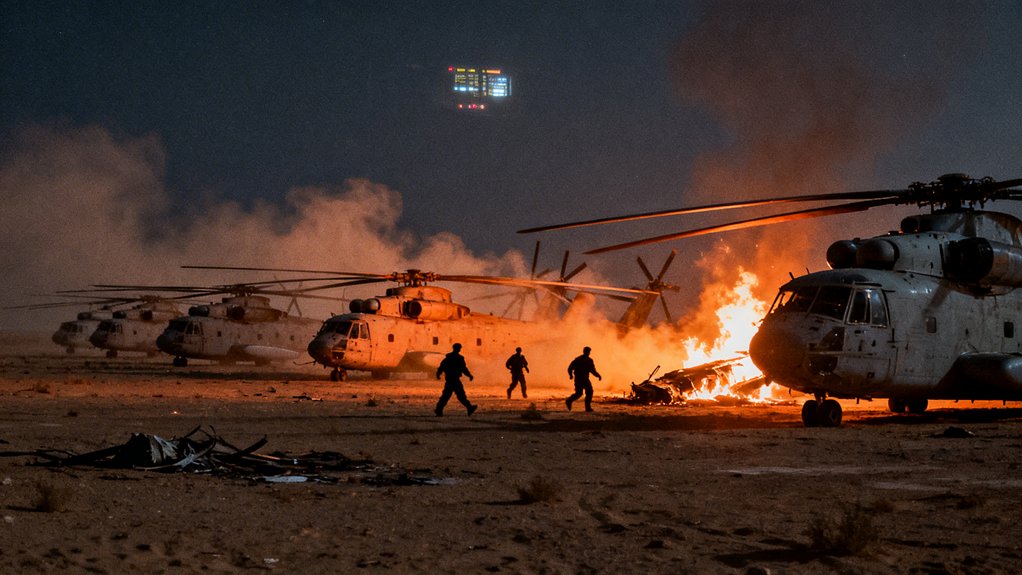
Something snapped in the diplomatic silence of November 4, 1979, when a mob of revolutionary students breached the U.S. Embassy compound in Tehran. They didn’t just enter; they dismantled sovereignty, tearing through gates while diplomats shredded classified cables in frantic, smoky rooms. The captors bound fifty-two Americans, turning them into political pawns within a chaotic revolutionary theater.
This wasn’t mere protest; it was a calculated seizure that ignited the jimmy carter iran hostage crisis, trapping a nation in helpless suspense. For 444 days, the hostages endured isolation, their fates dangling over a geopolitical abyss where moral lines blurred between revolution and terrorism.
Washington’s paralysis grew as negotiations stalled, forcing desperate measures. The looming shadow of failure demanded action, setting the stage for the ill-fated 1980 iran hostage rescue mission. Every ticking hour deepened the wound, transforming a diplomatic incident into a visceral nightmare that would soon demand blood and steel from those who dared to intervene in the dark desert night. Just as the U.S. Army later faced scrutiny for the systemic cover-up of the My Lai Massacre, the failure of Operation Eagle Claw exposed deep institutional flaws in military planning and command accountability.
Formulating Operation Eagle Claw and Selecting the Desert One Salt Flat
The interservice task force welded together disparate military branches, ignoring friction to coordinate a rescue that demanded absolute secrecy.
They deployed eight Navy RH-53D Sea Stallion helicopters toward Desert One, where the salt flat’s isolation offered a staging ground steeped in calculated risk.
This convergence of assets masked the moral weight of sending men into a dust-choked void, prioritizing operational necessity over the certainty of survival.
Such high-stakes deception echoes the legacy of Operation Northwoods, where military leaders once plotted to sacrifice American lives to manufacture a pretext for war.
Coordinating the Interservice Task Force for the 1980 Rescue Attempt
A clandestine convergence of Army Delta Force operators, Navy SEALs, and Air Force pilots coalesced into a fragile interservice task force, driven by the desperate imperative to extract fifty-two hostages from Tehran.
They forged this alliance without unified command, relying on ad-hoc cooperation that masked deep institutional rivalries.
Planners selected Desert One‘s salt flats as a precarious staging ground, ignoring the moral weight of committing untested joint tactics against a sovereign nation.
This desperate gamble, though doomed, ignited the birth of modern special forces by exposing fatal interoperability gaps.
The catastrophic failure at Desert One didn’t just cost lives; it demanded structural revolution, directly catalyzing the creation of US SOCOM.
Leaders sacrificed eight men in that fiery desert night, leaving behind burning secrets and a shattered presidency to guarantee future operators wouldn’t face such disjointed chaos again.
Just as the Church Committee later exposed unchecked intelligence abuses, this operation revealed how a lack of unified command could lead to disaster.
Eight Navy RH-53D Sea Stallion helicopters roared toward Desert One, their massive rotors kicking up the very dust that would doom the mission. planners chose this remote salt flat as a staging ground, ignoring the moral weight of committing untested joint tactics against a sovereign nation.
| Phase | Asset | Outcome |
|---|---|---|
| Departure | Eight Helicopters | Launched successfully |
| Transit | Haboob Storm | Engines choked |
| Arrival | Desert One | Only six landed |
| Abort | Mission Command | Order given |
| Retreat | Collision | Fatal fireball |
This specific moment in the operation eagle claw timeline marks where ambition met reality. One machine failed early; another succumbed to hydraulic leaks within the blinding grit. The remaining fleet hovered precariously before the fatal decision. Darkness swallowed the retreat, leading directly to the tragic desert one helicopter crash. Flames consumed men and secrets alike, leaving scorched earth as the only evidence of their audacious, flawed gamble. History judges the intent, but the desert kept the bodies. This culture of concealing operational failures mirrors how institutional secrecy later allowed agencies to destroy evidence and obstruct oversight regarding their own crimes.
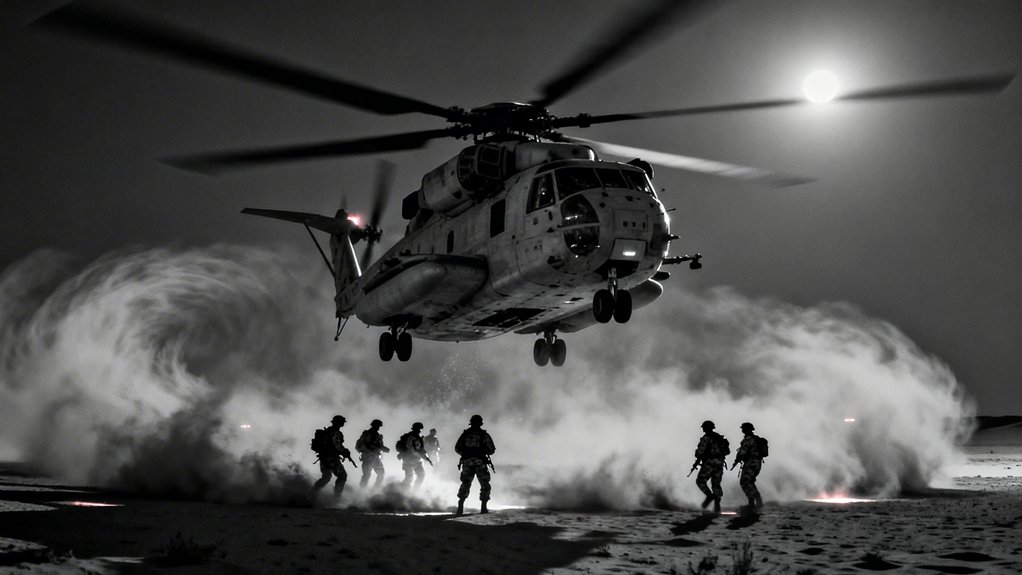
Under cover of absolute darkness, eight RH-53D Sea Stallions sliced through the hostile Iranian sky, their rotors beating a frantic rhythm against the silence of the desert night.
Pilots navigated by starlight alone, suppressing engine noise to evade radar while carrying the heavy burden of Operation Eagle Claw‘s success or failure. Below, the barren terrain offered no landmarks, only endless dunes that swallowed light and hope alike.
Every crew member understood the stakes; one mistake meant death or captivity. They pushed deeper into enemy territory, hearts pounding with a mix of duty and dread.
This clandestine insertion aimed to reach Desert One, a remote salt flat chosen for its isolation. Yet, the very darkness shielding them also hid impending doom.
As they approached the rendezvous point, the mission teetered on a knife’s edge, unaware that the coming hours would birth the tragic Desert One disaster. The air felt thick with unspoken fear, each second stretching into eternity as fate awaited them in the shadows. Just as government secrecy later fueled myths about spy planes, this classified operation relied on absolute silence to mask its presence in enemy airspace.
The Crippling Impact of the Unexpected Haboob Weather Phenomenon
A sudden wall of suspended sand blinds the pilots, stripping them of visual reference in the hostile dark.
This choking grit invades the turbine engines, forcing mechanical failures that no amount of bravery can override.
As the machines falter, the line between bad luck and fatal negligence blurs in the swirling dust.
Just as Allied leaders later justified suppressing the truth about the Katyn Massacre for military necessity, this operational failure was obscured by the chaos of the moment.
The haboob rolled in to swallow the sky, turning the moonless night into a blinding vortex of suspended grit that choked engines and erased horizons. Pilots fought invisible walls, their instruments useless against the swirling brown chaos. This wasn’t just weather; it was a tactical executioner. Every decision carried the weight of potential death, yet they pressed forward into the abyss.
The operation eagle claw summary often misses this visceral terror, focusing instead on dry statistics. But here, within the haboob dust storm military crash waiting to happen, morality blurred. Was pushing on bravery or hubris?
The sand stripped away certainty, leaving only raw survival instinct. Men navigated by faith alone, knowing one wrong turn meant oblivion. The desert demanded a price, and uncertainty became their only compass as they flew blindly toward an increasingly impossible mission.
Mechanical Failures Caused by Choked Helicopter Turbine Engines
Silence replaced the rotor’s hum as grit infiltrated the turbine hearts, starving the machines of breath. The haboob didn’t just blind; it suffocated.
Engineers later traced the collapse to three fatal mechanical betrayals:
- Sand fused within compressor blades, halting rotation instantly.
- Filters clogged beyond design limits, choking airflow completely.
- Heat spikes melted internal components before warnings flashed.
This wasn’t mere bad luck; it was a calculated gamble lost to nature’s indifference.
The resulting operation eagle claw casualties weren’t just statistics but men abandoned by technology’s fragility. Commanders knew the risks yet pushed forward, blurring lines between bravery and recklessness.
These military rescue mission failures exposed a brutal truth: preparation can’t conquer every variable. The desert claimed its due, leaving burning wrecks as monuments to hubris.
Eight souls paid the price for underestimating the storm’s vicious, grinding appetite for steel and flesh.
Converging at the Remote Desert One Staging Area in Central Iran
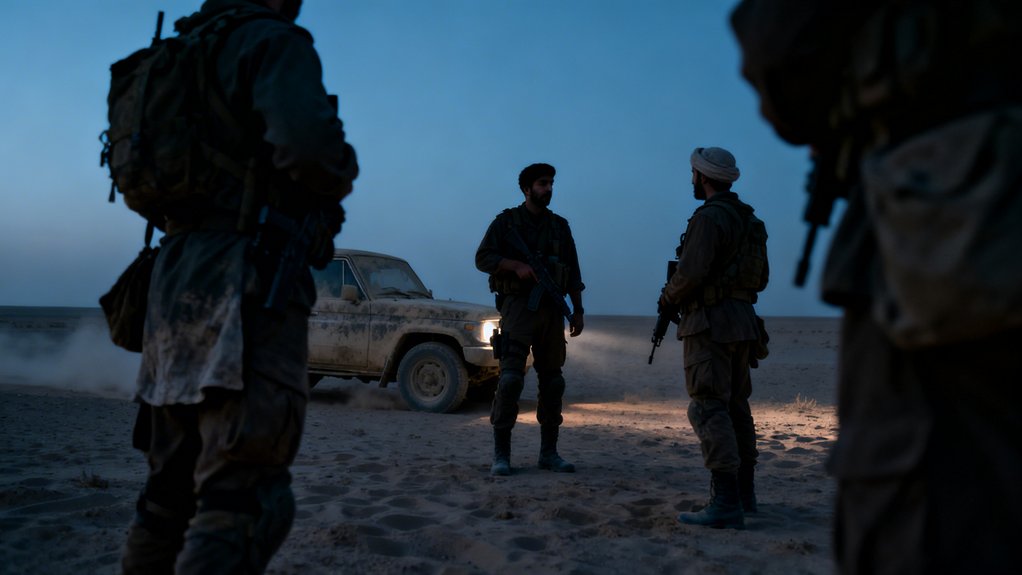
Though the moon offered no cover, eight helicopters tore through the blackness to converge on Desert One, a desolate salt flat deep within central Iran chosen as the fragile hinge for a desperate rescue. Pilots fought blinding haboobs that choked turbines, forcing emergency landings far from the planned rendezvous. As crews scrambled across the scorching crust, confusion mounted; three birds were already dead in the sand.
Commanders huddled in the dust, weighing lives against objectives, their moral certainty eroding with every passing minute. They couldn’t know yet exactly what went wrong at desert one, but the silence screamed failure. The air tasted of grit and impending doom.
With fuel critically low and visibility zero, the chain of command fractured under pressure. This gathering wasn’t a triumph; it was a funeral pyre waiting to ignite. The desert one aborted mission wasn’t just a tactical retreat; it was an admission that hubris had met an unforgiving terrain, leaving men stranded in a godforsaken void. Like the deliberately altered evidence used to justify the Vietnam War, this operation collapsed under the weight of flawed intelligence and an unforgiving reality.
Falling Below the Minimum Aircraft Requirement and the Agonizing Abort Order
Commanders counted the surviving helicopters against the salt flat’s dust, realizing five functional birds couldn’t lift the rescue force. The math was brutal; one machine broke down en route, another suffered hydraulic failure, and a third couldn’t press on through the blinding haboob.
This mechanical attrition forced an impossible choice: proceed with insufficient capacity or abort and face global humiliation. They chose survival over glory, signing a death warrant for the mission’s success.
- Mechanical breakdowns stripped the force below its critical minimum threshold.
- Leaders grappled with the moral weight of abandoning hostages to uncertainty.
- This failure sparked urgent questions about why did operation eagle claw fail.
The agonizing order crackled over radios, halting the advance just miles from Tehran. No one wanted to turn back, yet staying meant almost certain destruction.
This moment defined how did operation eagle claw change the military, exposing fatal flaws in joint operational planning. The desert swallowed their pride, leaving commanders to stare into the dark, knowing they’d failed the men waiting in captivity.
The silence that followed the abort order felt heavier than the swirling sand, marking a night where caution cost everything.
The Disastrous Evacuation Retreat and Complete Darkness Collision
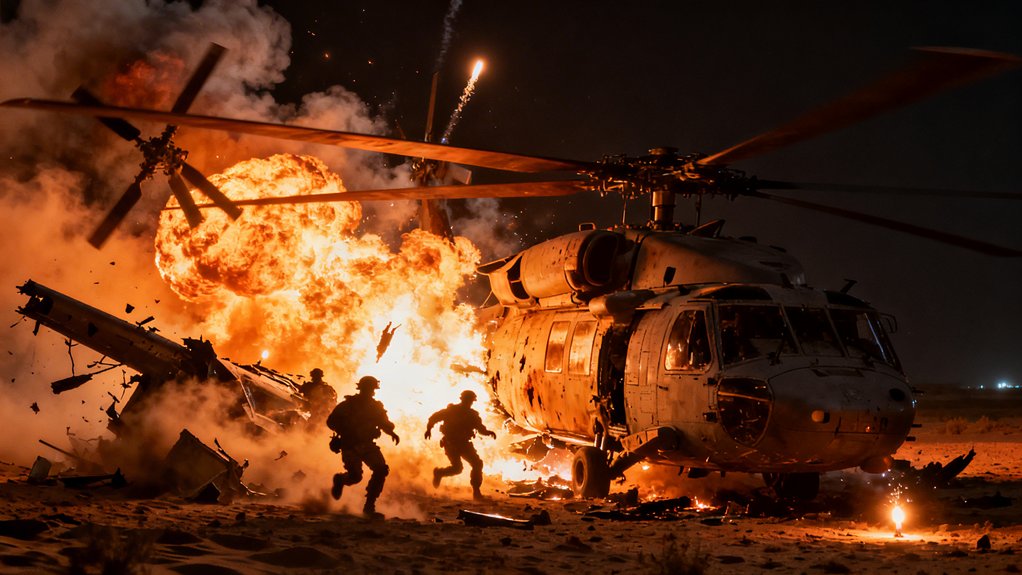
Blind pilots maneuver through the choking dust, unaware that a spinning rotor shears into the fuel-laden C-130’s fuselage.
The impact ignites a catastrophic fireball that instantly consumes eight men, leaving their burning bodies and top-secret documents abandoned in the dark.
This chaotic inferno forces a frantic retreat where survival outweighs the moral duty to recover the dead or protect classified intelligence.
The abandonment of sensitive materials in the desert mirrors the systematic government deception revealed in later decades regarding the true costs and justifications of American military interventions.
The Helicopter Rotor Strike Against the Fuel-Laden Transport Plane
As the haboob’s dust settled into a suffocating blackness, the retreat from Desert One devolved into a chaotic dance of disoriented machinery where visibility dropped to zero.
A RH-53D Sea Stallion, blinded and drifting, slammed its spinning rotor into the stationary EC-130 Hercules, shearing through the fuselage like a knife. This moment defines a tragic chapter in us military history 1980, marking exactly who died in operation eagle claw before the fire even started.
- The rotor blade severed critical fuel lines instantly.
- Pilots felt the impact but couldn’t see the source.
- Panic spread through the darkened cockpit as systems failed.
No malice drove this collision, only the cruel indifference of nature and human limitation.
The aircraft sat locked together, a silent monument to failed calculation before the inevitable ignition. Shadows hid the impending doom, leaving crews unaware that their escape route had just become their tomb.
The Catastrophic Explosion and Immediate Desert Fireball
The rupture ignited a vapor cloud that swallowed the desert floor, transforming the stalled evacuation into an incandescent trap.
Flames erupted instantly, consuming the C-130 and RH-53 in a blinding fireball that turned night into day. Eight men perished within seconds, their bodies trapped inside the melting fuselage while survivors scrambled through the choking smoke.
Commanders faced an impossible choice: recover the dead or flee before Iranian forces arrived. They chose survival, leaving burning comrades and classified documents behind on the salt flat. This wasn’t heroism; it was cold calculation born of sheer panic.
The fire illuminated their failure, casting long shadows over a mission that died not by enemy fire, but by their own chaotic retreat. Darkness returned, hiding the carnage but never the guilt. Just as later military operations would sanitize realities to mask the true cost of conflict, the immediate aftermath of Eagle Claw obscured the full horror of the self-inflicted disaster.
Leaving Behind Eight Fallen Servicemen and Top-Secret Operational Documents
Amid the roiling inferno at Desert One, the retreating force abandoned eight charred bodies and burning top-secret documents to the desert sands. Commanders faced an impossible choice: recover the dead or save the living. They chose survival, leaving their fallen comrades as grim evidence of failure.
The flames consumed sensitive materials that shouldn’t have existed, let alone burned in enemy territory. This wasn’t just a tactical retreat; it was a moral surrender to chaos.
- Incinerated remains fused with melted helicopter wreckage, forever marking the salt flat.
- Classified mission profiles crackled in the heat, exposing operational secrets to potential scavengers.
- Survivors fled into darkness, carrying guilt heavier than any equipment they’d left behind.
The desert kept its gruesome trophies while the living escaped with shattered nerves. No one could verify if Iranian forces later collected those smoldering papers or disturbed the silent, blackened forms.
The mission’s end wasn’t clean; it was messy, ambiguous, and haunting. Those eight souls became permanent fixtures of a terrain that witnessed American hubris collapse.
Their sacrifice, though unintentional, seeded future special operations doctrines born from this very failure. The fire died eventually, but its legacy burned brighter than any document ever could. Like the immunity cover-up granted to Unit 731 scientists in exchange for data, this operational failure was buried to protect strategic interests rather than honor the fallen.
The Devastating Political Fallout and Electoral Defeat for President Jimmy Carter
A single botched mission in the Iranian desert didn’t just stall a rescue; it detonated Jimmy Carter’s presidency. The burning wreckage at Desert One became a visceral symbol of American impotence, searing itself into the national psyche.
Voters didn’t see bad luck; they saw incompetence. Carter’s moral authority crumbled as images of charred bodies and abandoned secrets dominated nightly broadcasts. He couldn’t spin the narrative because the evidence smoldered under a foreign sun.
The failure exposed a fractured military machine, yet the public blamed the commander-in-chief exclusively. Hope for diplomatic resolution evaporated alongside the fuel tanks. Ronald Reagan capitalized on this collective despair, promising strength where Carter offered only caution.
The election wasn’t merely lost; it was surrendered to the ghosts of eight dead men. History judges the outcome harshly, ignoring the complex weather systems that doomed the helicopters.
In the end, political survival proved as fragile as the rotor blades that snapped in the dark, sealing Carter’s fate forever.
Investigating the Chain of Inter-Branch Failures Through the Holloway Commission
Carter’s electoral burial demanded an autopsy of the mission itself, shifting focus from the ballot box to the burned sand of Desert One.
The Holloway Commission dissected the wreckage, exposing a rotting core of inter-branch rivalry rather than simple bad luck. Investigators found no single villain, only a collective failure where pride blinded judgment and protocol choked initiative.
The report illuminated how disjointed command structures doomed brave men before engines even roared.
- Service branches hoarded assets, refusing genuine integration or shared training doctrines.
- Pilots lacked desert navigation skills, flying blindly into a known haboob wall.
- Ad hoc planning ignored basic contingency protocols for mechanical attrition mid-mission.
This forensic examination revealed a military machine fractured by institutional arrogance, not merely defeated by weather.
The commission’s findings carried a heavy moral weight; they indicted a system that sacrificed eight lives on the altar of bureaucratic silence. No court-martial followed, yet the shame burned hotter than the jet fuel that consumed the rescue team.
America stared into this abyss of incompetence, realizing their special operations capability was a hollow shell. The investigation didn’t just assign blame; it stripped away illusions of invincibility, forcing a painful reckoning with reality.
Catalyzing the Birth of Modern United States Special Forces Capabilities
The scorched remains at Desert One didn’t just bury eight men; they incinerated the old doctrine of ad-hoc cooperation, demanding a unified command that answered to no branch but necessity.
From that moral ash rose USSOCOM, a cold bureaucratic calculation designed to secure future failures wouldn’t leave secrets burning in the sand for enemies to find.
Simultaneously, the military forged the 160th Special Operations Aviation Regiment, creating a shadow fleet of pilots who’d fly through hell itself so no commander would ever again have to choose between retreat and catastrophe.
The Establishment of United States Special Operations Command
Something had to break before the machine could be rebuilt. The scorched sands of Desert One didn’t just bury eight men; they incinerated the old doctrine of fragmented command.
Congress and the Pentagon realized that ad-hoc task forces couldn’t survive modern chaos, so they forged the United States Special Operations Command. This wasn’t merely administrative; it was a moral recalibration where efficiency demanded centralized authority over scattered valor.
The blood paid for a new architecture:
- Unified command structures eliminated inter-service friction.
- Dedicated funding streams guaranteed relentless readiness.
- Joint training protocols standardized lethal precision.
Ambiguity lingered in the shadows of these decisions, as the government traded bureaucratic inertia for a streamlined, terrifying capability. They didn’t just fix the broken parts; they created a weapon that never needed to apologize for its existence again.
Forging the 160th Special Operations Aviation Regiment for Future Rescues
A ghostly silence hung over the charred wreckage at Desert One, masking the birth of a new aviation doctrine forged in eight distinct tragedies. Commanders didn’t mourn; they dissected every failed rotor blade and blinded sensor.
The military realized standard pilots couldn’t fly low enough or fast enough through hell. So, they carved out the 160th Special Operations Aviation Regiment from willing ghosts who’d fly anywhere.
These Night Stalkers embraced the dark, mastering terrain-following radar while others feared it. They accepted that survival meant becoming invisible, even if it meant bending rules of engagement. No longer would weather or darkness dictate failure.
The unit’s creation wasn’t just tactical; it was penance. They trained relentlessly, ensuring future rescues wouldn’t leave bodies burning in foreign sands. This elite force turned catastrophic shame into unmatched precision, forever changing how America projects power silently.
The Enduring Historical Legacy of the Desert One Catastrophe
Rising from the ash of eight burned bodies and abandoned top-secret blueprints, the Desert One catastrophe forced a brutal reckoning within the American military hierarchy. Commanders couldn’t ignore the glaring fractures in joint operations anymore.
The scorching sand held uncomfortable truths about arrogance and poor planning. This failure wasn’t just a tactical blunder; it was a moral wound that demanded immediate, painful surgery on the entire defense structure. Leaders realized they’d sacrificed lives for a dream built on shaky foundations.
- The disaster shattered inter-service rivalries, compelling Army, Navy, and Air Force units to finally train as one cohesive entity.
- Politicians watched Jimmy Carter’s presidency crumble, proving that military incompetence carries devastating civilian consequences beyond the battlefield.
- Modern Special Operations Command emerged directly from these charred ruins, born from the necessity to never repeat such a costly mistake.
The legacy isn’t glory; it’s a grim reminder etched in fire. We gained elite forces, yet the price remains eight souls lost to hubris. History judges the outcome harshly, but the evolution it sparked defines today’s warriors.
Frequently Asked Questions
What Specific Classified Documents Were Left Burning at Desert One?
Ironically, the exact titles of those burning papers remain lost to the very smoke that consumed them. Investigators never recovered specific manifests or codebooks from the ash at Desert One.
The fire erased the forensic trail, leaving only the moral ambiguity of eight dead men and a failed mission. History knows secrets vanished there, but the precise documents turned to carbon, hiding their contents forever within the scorched Iranian sand.
Which Eight Servicemen Died in the Helicopter and Transport Plane Collision?
Eight men died when the rotor sheared the transport plane’s fuselage at Desert One.
Major Richard Bakke, Captain Lynn McIntosh, and Staff Sergeant Joel Mayo perished in the C-130.
Marine pilots Majors James Schaefer, Robert Seibold, and Captain Charles McMillan burned in their RH-53s alongside Sergeant Dewey Johnson and Airman Corey Houston.
Their charred remains lay abandoned beside leaking secrets, a grim toll exacted by darkness and dust, leaving families with only ash and unanswered questions about the failed rescue.
How Exactly Did the Haboob Dust Storm Damage the Helicopter Engines?
Silence choked the engines where roar once lived.
The haboob didn’t just obscure vision; it injected millions of abrasive silica particles directly into the turbine intakes. These microscopic shards shredded compressor blades and clogged fuel nozzles, starving the rotors of power.
Pilots fought invisible grit that turned sophisticated machinery into dead weight, forcing them down onto the salt flats while the storm swallowed their hope whole.
What Was the Minimum Number of Helicopters Required to Continue the Mission?
Commanders demanded six operational helicopters to push forward, but only five remained airworthy after the haboob choked their engines.
This single missing machine forced the abort, sealing the fate of eight men who soon burned in the desert dark.
The rigid math of war offered no mercy; without that sixth bird, the mission died instantly, leaving secrets smoldering among the sand and blood.
Did Any Iranian Forces Discover the Abandoned American Equipment Before Withdrawal?
No Iranian forces discovered the abandoned equipment before the Americans withdrew, leaving the burning wrecks untouched in that fleeting window. The desert kept its grim secrets briefly, hiding eight charred bodies and classified documents from immediate enemy eyes.
Yet, this temporary concealment offered no moral absolution, only a hollow pause before the inevitable exposure of failure, death, and the stark reality of a mission shattered by dust and fire.
Final Thoughts
They sought silence in the dark, yet the desert screamed their failure. Eight men died not by enemy fire, but by their own spinning blades in a dust storm they couldn’t see. From that burning wreckage, a new war machine rose, forged in shame. Ironically, the mission that shattered America’s confidence birthed the very invincibility it sought to prove, turning a graveyard of errors into a temple of lethal precision.