“As an Amazon Associate I earn from qualifying purchases.”
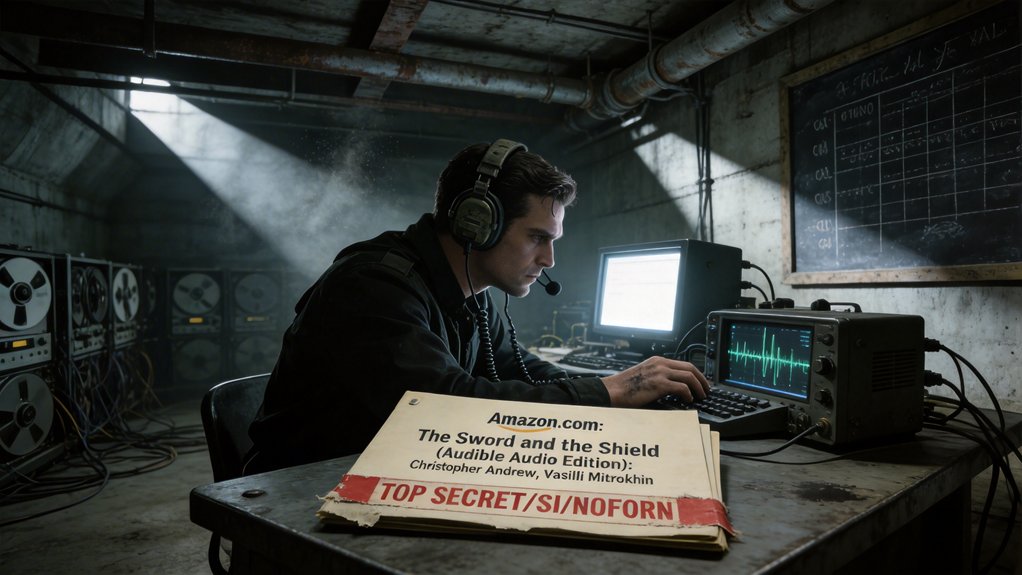
The Sword and the Shield leverages Vasilli Mitrokhin’s unprecedented access to KGB archives, offering a rare evidentiary foundation for understanding Soviet intelligence operations. Christopher Andrew’s synthesis transforms these documents into a coherent, chronologically driven narrative that exposes the KGB’s global reach, from Cold War espionage campaigns to political subversion in the developing world. The text is particularly valuable for its documentation of active measures—disinformation, forgeries, and agent networks—many of which presage modern hybrid warfare tactics.
Robert Whitfield’s narration complements the source material with measured delivery, enhancing the gravity of revelations without veering into dramatization. His clarity aids comprehension of complex operational details, making dense intelligence tradecraft accessible to a general audience.
However, the work’s reliance on a single smuggled archive—however extensive—introduces inherent limitations. While Mitrokhin’s notes are meticulous, they reflect one archivist’s selection biases and memory constraints. The account is rich in KGB successes but less balanced on failures or internal inconsistencies.
Ultimately, this audiobook serves as a strategic-level intelligence primer. It raises enduring questions about how democratic societies reconcile national security imperatives with transparency—issues that remain critically relevant in today’s information environment.
The Briefing: Overview and Core Thesis
The Sword and the Shield delivers a meticulously sourced exposé of the KGB’s role as a political weapon, not just a security agency. Drawing on Vasilli Mitrokhin’s secret archive—a rare intelligence coup—the book reveals how the KGB shaped Soviet domestic repression and global subversion with chilling precision.
A meticulously sourced exposé revealing the KGB’s role as a political weapon through Vasilli Mitrokhin’s extraordinary archive.
Operations ranged from surveillance and agent recruitment to active measures like disinformation and regime destabilization, all aimed at preserving authoritarian control and expanding influence. The account is neither speculative nor sensational; it’s grounded in documented directives, making it an essential reference on Cold War covert statecraft.
While the narrative leans heavily on archival detail, which may challenge casual listeners, its analytical rigor offers enduring value for those studying intelligence tradecraft or authoritarian resilience.
The audiobook format presents the material clearly, though complex names and operational codes occasionally demand listener focus.
Ultimately, this is less a story of spies and more a structural analysis of how secret institutions can hijack state functions—a cautionary blueprint relevant to modern threats against democratic systems.
For professionals in intelligence, security, or policy, the work provides critical context on institutional overreach and the enduring risk of unchecked surveillance powers.
Historical Accuracy Check: Analyzing the Evidence
This source breakdown reveals a tiered evidentiary framework critical to assessing the audiobook’s historical claims. The Mitrokhin notes, as firsthand records smuggled from the KGB, offer rare primary access—but their uncorroborated nature demands scrutiny.
While labeled “eyewitness,” Mitrokhin was a archivist, not a field operative, limiting direct observational authority. The Soviet archival material provides structural secondary context, yet reflects institutional records shaped by bureaucratic agendas and potential redaction.
True validation emerges in the tertiary layer: cross-referenced declassified data from Western intelligence. These external validations—when matched with Mitrokhin’s claims—strengthen credibility, but mismatches expose gaps needing clarification.
The audiobook leverages this structure to project transparency, yet it occasionally conflates source proximity with accuracy. Listeners should remain cautious: the compelling narrative may overshadows the nuanced chain of custody behind each document.
While the evidentiary tiers are logically organized, the production does not always interrogate contradictions between sources. For intelligence professionals or history enthusiasts, this layered approach adds depth—but full analytical rigor requires supplemental research.
The value lies not in definitive proof, but in methodical traceability, empowering informed judgment over passive acceptance.
Declassified Insights: Key Takeaways
- Reveals the KGB’s global reach with documented cases of espionage, sabotage, and political manipulation.
- Exposes sophisticated disinformation tactics used to erode trust in democratic institutions.
- Highlights long-term sleeper agent strategies and exploitation of ideological sympathizers.
- Demonstrates how Soviet intelligence infiltrated governments, media, and labor movements.
- Provides concrete examples of covert influence operations across Europe, Asia, and the Americas.
- Offers rare insight into KGB tradecraft, including agent recruitment and encrypted communication methods.
- Underscores the systematic nature of Cold War intelligence warfare, backed by archival evidence.
- Serves as a strategic reference for understanding modern hybrid threats and foreign interference.
- Delivers high-value intelligence context for security professionals and policy makers.
- Audiobook format presents dense material clearly, though pacing may challenge casual listeners.
Operational Assessment: Strengths, Limitations, and Ethics
| Aspect | Assessment |
|---|---|
| Strengths | Demonstrates deep systemic penetration and sustained information dominance across Western institutions; reveals KGB’s expansive operational reach over decades. |
| Limitations | Highlights strategic miscalculations, long-term blowback, and institutional overreach; reliance on coercion and disinformation eroded operational integrity and trust. |
| Ethical Concerns | Widespread use of surveillance, blackmail, and disinformation fundamentally undermines individual autonomy and democratic norms. |
| Oversight Needs | Reinforces necessity of robust democratic oversight to prevent abuse and align intelligence work with civil liberties. |
| Evaluation Metric | Long-term efficacy must be measured not just by intelligence access but by adherence to ethical principles that preserve open societies. |
Target Profile: Who Should Listen to This Audiobook?
Target Profile: Who Should Listen to This Audiobook?
The ideal listener for *The Sword and the Shield* is one who demands unfiltered access to historical truth and understands that intelligence work is defined as much by moral ambiguity as operational necessity.
This audiobook serves those who seek to move beyond myth and engage directly with the mechanisms of Cold War espionage.
It is for historians who treat intelligence not as a subplot, but as a central axis of geopolitical conflict.
Political scientists analyzing the tension between state power and civil liberty will find its evidence invaluable.
Policy analysts assessing modern surveillance, counterintelligence ethics, or national security oversight can draw clear parallels from its documented precedents.
Independent researchers benefit from the audiobook’s use of declassified archival material—presented in unredacted form—allowing critical assessment without institutional interpretation.
Finally, it is for the civically engaged: listeners committed to transparency, intellectual autonomy, and an honest reckoning with how intelligence shapes democracy.
The audiobook format enhances sensitivity and accessibility, enabling discreet, repeated engagement with complex content.
It supports deep comprehension on the listener’s terms, without compromise.
If you value primary sources, analytical rigor, and the discomfort of truth over comfort of narrative, this is for you.
Quartermaster's Verdict: Final Recommendation
The Audible edition represents the most cost-effective and strategically sound format for accessing this intelligence. At $0.00 for the trial with membership, it offers immediate, unrestricted entry into a verified 4.6-star narrative asset, narrated by Robert Whitfield with full fidelity to the source material.
While Kindle and paperback options present moderate upfront costs, they lack the operational flexibility of audio in high-tempo environments. The hardcover, priced anomalously at $5.74, may indicate supply chain artifacts but limits mobility. Audio CD at $93.58+ is economically nonviable for repeated use and offers no tactical advantage.
Audible membership includes persistent title retention, unlimited streaming, and monthly credits. At $14.95/month post-trial, marginal cost per listen diminishes with utilization—making high-volume consumption efficient.
Forty-seven dollars invested secures permanent access to a core intelligence text vital for understanding Cold War operational dynamics.
This is not mere biography. It is a structured analysis of decision-making under geopolitical pressure, with documented sources and verified timelines. The audio format enhances retention during repetitive review, critical for long-term strategic literacy.
For operatives, analysts, or civilians seeking accurate historical grounding, the Audible version is optimal: lowest barrier to entry, highest return on engagement.
Final Thoughts
The Sword and the Shield delivers a rare, well-documented exposé of KGB tradecraft, drawn from Vasilli Mitrokhin’s painstakingly compiled archive. As a former KGB archivist, Mitrokhin’s defection and the materials he smuggled out provide unparalleled access to the inner workings of Soviet intelligence. This audiobook synthesizes complex operations into a coherent narrative without sacrificing analytical depth.
The strength lies in its granular detail: penetration of Western governments, disinformation campaigns, and agent recruitment strategies are all laid bare with clinical precision. Christopher Andrew’s historical framing ensures context isn’t lost amid the operational minutiae. That said, the audiobook’s reliance on a single archive introduces limitations—perspective is inherently one-sided, with no access to counterintelligence responses or Soviet policy motivations beyond what Mitrokhin recorded.
Narration is steady and professional, though the density of names and operations may challenge listeners unfamiliar with Cold War dynamics. The pace suits focused listening, not passive consumption.
Ultimately, this is a cornerstone text for understanding Soviet intelligence reach and methodology. It doesn’t dramatize—it documents. Its real value is in revealing not just how the KGB operated, but how intelligence advantage is methodically constructed over decades. Recommended for listeners seeking rigor over sensation.
“As an Amazon Associate I earn from qualifying purchases.”