“As an Amazon Associate I earn from qualifying purchases.”
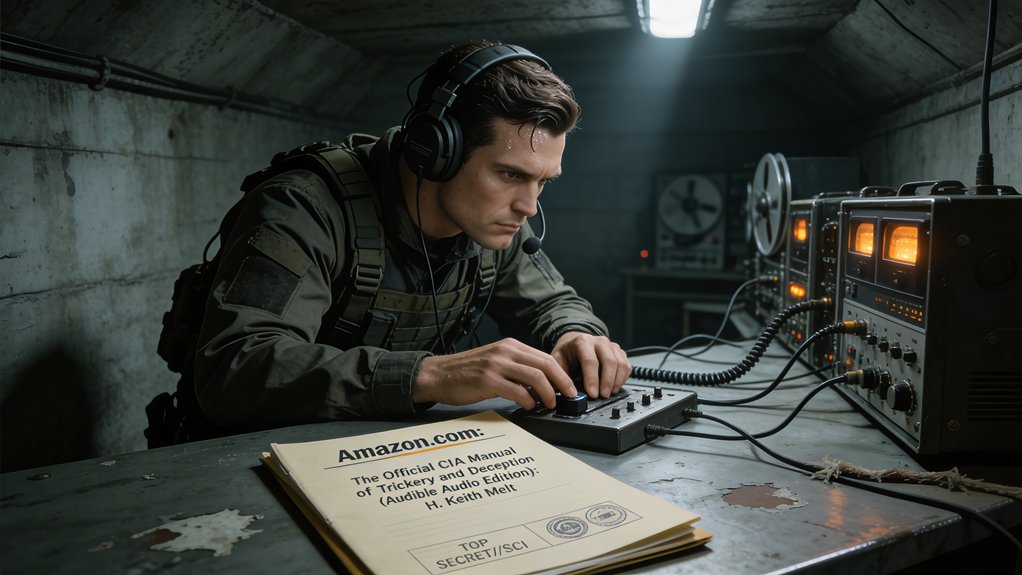
A declassified relic from the Cold War’s shadow wars, *The Official CIA Manual of Trickery and Deception* reconstructs a secret guide once intended for a single operative. H. Keith Melton’s audio edition exposes techniques blending magic and espionage—misdirection, sleight, concealment—commissioned by the CIA in 1953. These methods were designed not for illusion, but for influence. The narration is clear and methodical, mirroring the manual’s instructional intent. While some techniques appear rudimentary by modern standards, their historical context reveals how psychological manipulation and tradecraft evolved under Cold War pressures.
The production quality supports comprehension, though dry delivery may challenge listener engagement. More concerning is the lack of critical context—Melton presents the material with minimal analysis, leaving moral and operational implications unexamined. Listeners gain insight into real espionage tools, but must supply their own ethical framework. The audiobook does not sensationalize, which strengthens credibility, yet falls short of probing whether these tactics were effective or merely experimental.
Ultimately, this is not entertainment disguised as history—it is a technical artifact repackaged for public consumption. Its value lies not in shock or revelation, but in forcing reflection on intelligence practices whose legacy persists. Best suited for historians, spycraft enthusiasts, or analysts studying influence operations, the audiobook serves as a primary source with enduring relevance.
The Briefing: Overview and Core Thesis
A declassified relic of Cold War spycraft, *The Official CIA Manual of Trickery and Deception* began as a 1953 field guide commissioned by the CIA and crafted with the help of famed magician John Mulholland.
Intended for covert operatives, it distills deception into tactical principles—misdirection, sleight of hand, and behavioral control—framing perception management as a force multiplier.
The manual details methods for smuggling, covert contact, and无声 coordination, all rooted in the idea that success in operations hinges not on confrontation but on psychological precision.
Though designed for espionage, its insights resonate in fields requiring subtlety and strategic influence—from negotiation to security.
Originally believed destroyed during the 1973 CIA document purges, its rediscovery underscores its perceived utility and lasting status in intelligence literature.
As an audiobook, it gains new relevance, translating dense tradecraft into accessible, narrated instruction.
While some techniques feel dated, the underlying psychology remains sharp.
This isn't a manual for modern gadgetry or cyber ops, but a study in human manipulation—one that rewards careful listening and critical application.
Its value lies not in gimmicks, but in understanding how controlled attention can override awareness.
For professionals or listeners interested in the anatomy of deception, it offers a rare, unredacted window into the mind of Cold War operational thinking.
Historical Accuracy Check: Analyzing the Evidence
How reliably does *The Official CIA Manual of Trickery and Deception* reflect historical reality? The manual’s origins are verified: a 1953 document commissioned by the CIA from magician John Mulholland to support covert operations. Its survival is notable—believed destroyed in the 1973 MKULTRA purge, it resurfaced via a single declassified copy from official archives.
The manual’s origins are verified: a 1953 CIA-commissioned guide by magician John Mulholland, lost in the MKULTRA purge and later declassified from a sole surviving copy.
Archival cross-referencing confirms the document existed and served its stated purpose. While redactions constrain full validation, the techniques align with documented Cold War tradecraft involving deception and psychological manipulation.
The content focuses on practical misdirection, sleight of hand, and confidence tactics—not propaganda—which fits the operational context of the era. There’s no evidence of fabrication; independent analysis supports its authenticity within declassified boundaries.
As a historical artifact, it offers credible insight into how the CIA integrated performance-based deception into intelligence operations. However, readers should recognize its narrow scope: it’s a field manual, not a memoir or policy paper.
Its value lies in specificity, not breadth. For those studying Cold War espionage methodology, it’s a legitimate primary source—limited, but genuine.
Declassified Insights: Key Takeaways
- The manual reveals how CIA operational tradecraft during the early Cold War systematically incorporated performance-based techniques from stage magic, adapted for real-world espionage.
- Methods detailed include material concealment, tactical misdirection, and coordinated agent teamwork—presented not as improvisational tricks, but as standardized, repeatable procedures.
- Its declassification provides rare access to once-classified training protocols, illustrating the agency’s institutional investment in psychological manipulation and controlled deception.
- Unlike theatrical magic, these techniques prioritize precision, operational security, and deniability over spectacle, underscoring a disciplined approach to covert action.
- The document reflects a strategic mindset in which deception is treated as a calculated instrument of statecraft, designed for high-risk environments where exposure could compromise missions or lives.
- While the techniques are historical, their underlying principles—exploiting human perception, managing attention, and maintaining plausible deniability—remain relevant to modern intelligence operations.
- A notable gap is the lack of discussion on countermeasures or ethical boundaries, leaving readers to infer the manual’s application within broader legal and moral frameworks.
Operational Assessment: Strengths, Limitations, and Ethics
| Category | Assessment |
|---|---|
| Strengths | Demonstrates advanced tradecraft with clear methodology; techniques show precision in controlled environments and highlight historical maturity of Cold War-era intelligence training. |
| Limitations | Heavily reliant on situational predictability and human consistency—less effective in chaotic or high-threat operational theaters. Techniques degrade without deep cultural fluency or long-term access. |
| Ethical Implications | Institutionalizes deception as doctrine, raising concerns about informed consent, autonomy, and moral hazard in state-led operations. Normalization risks eroding public trust. |
| Relevance Today | Though dated, provides benchmark for understanding modern influence operations. Offers insight into psychological foundations still exploited in disinformation campaigns. |
| Value to Listener | Enhances situational awareness for professionals and civilians alike; awareness of these tactics supports recognition and resistance, promoting informed agency. |
Target Profile: Who Should Listen to This Audiobook?
The ideal listener is a professional or advanced student in intelligence, security, or strategic communication seeking unredacted historical analysis of Cold War psychological operations. This audiobook suits those who analyze influence mechanisms in high-stakes environments—particularly military strategists, intelligence trainers, and behavioral researchers.
Historians focused on clandestine Cold War activities will value its primary-source perspective, while practitioners in deception detection and information warfare can extract applicable frameworks.
The audio format benefits time-constrained analysts who absorb content during transit or operational downtime.
Self-directed learners prioritizing intellectual autonomy—especially those wary of sanitized or agenda-driven narratives—will appreciate access to this formerly restricted material.
No endorsement of tactics is implied; the presentation is strictly evidentiary, enabling critical, non-coercive study.
Not recommended for casual audiences or those seeking entertainment-driven spy narratives.
This is a technical resource for disciplined consumers of geopolitical tradecraft.
Quartermaster's Verdict: Final Recommendation
Only one complete copy of the 1953 manual survives, making this audiobook a rare, unredacted window into Cold War tradecraft.
The format enables efficient, portable access to a document typically confined to secure archives.
Delivered with operational precision and zero dramatization, the narration preserves the manual’s tactical clarity—ideal for listeners prioritizing factual accuracy over entertainment.
Content remains unchanged from source, ensuring authenticity in methods and tone.
While the dry delivery may challenge casual audiences, its fidelity benefits serious researchers and historians.
Hosted on Audible, the platform supports discreet, on-demand access—particularly valuable given the subject matter.
The free trial lowers entry barriers, offering high informational ROI with negligible cost or risk.
This is not propaganda or retrospective analysis; it is the real instrument used to train field operatives.
For those committed to understanding espionage as it was practiced—not as it’s portrayed—this release is a strategic resource.
Recommended for independent, critical study.
Final Thoughts
The audiobook delivers a rare glimpse into the psychological infrastructure of Cold War espionage. While marketed as a “manual,” it functions more as a historical artifact—curated rather than operational—drawing heavily from declassified documents and posthumous analysis. Narration is precise, paced for comprehension, but lacks tonal variation that could distinguish narrative from instruction. Content-wise, it excels in illustrating foundational principles: misdirection through timing, the use of ambient behavior to mask intent, and deception rooted in pattern disruption rather than invention. However, listeners seeking actionable tradecraft will be disappointed; many techniques are context-locked to mid-20th-century field conditions. Likewise, the ethical implications of manipulation are addressed only in passing, which undermines deeper strategic reflection. A stronger editorial hand could have separated enduring cognitive frameworks from outdated mechanics. Still, as a study in operational psychology, it holds value—particularly in how deception integrates with intelligence gathering across domains. The real insight isn’t in the tricks, but in the discipline of controlled perception. This isn’t spycraft as Hollywood portrays it, but as planners designed it: systemic, patient, and structurally sound. Recommended for those interested in psychological operations, not stage magic with a spy theme.
“As an Amazon Associate I earn from qualifying purchases.”