“As an Amazon Associate I earn from qualifying purchases.”
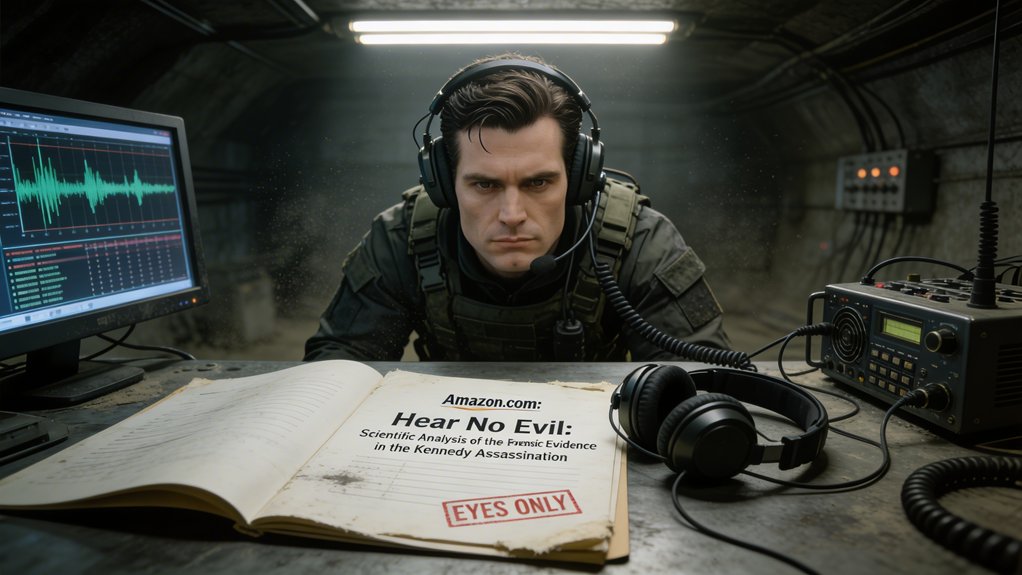
The acoustic study in *Hear No Evil* applies forensic rigor to the Dallas police Dictabelt recording, analyzing impulse patterns and echo dispersion to assess shot origin. Data suggest a high-probability impulse consistent with a fourth shot from the grassy knoll—corroborating eyewitness accounts and challenging the Warren Commission’s lone-gunman framework. The methodology underwent peer review and integrates with select ballistic and medical findings, particularly the timing of President Kennedy’s reaction relative to recorded impacts.
However, critical gaps remain. The Dictabelt’s chain of custody is unverified, and timestamp anomalies raise concerns about synchronization with known events. While statistical modeling supports the four-shot hypothesis, alternative interpretations—such as motorcycle radio misfires or audio splicing—are not definitively ruled out. The analysis is scientifically plausible but not conclusive; it shifts probability without establishing certainty.
Listeners should treat this not as definitive proof, but as a compelling challenge to official narratives. The work underscores the necessity of transparent evidence handling and interdisciplinary validation. For those examining the JFK assassination through a forensic lens, *Hear No Evil* offers valuable, if incomplete, analytical leverage. Know its limits before accepting its conclusions.
The Briefing: Overview and Core Thesis
A scientifically rigorous reexamination of the Kennedy assassination, Donald Byron Thomas’s *Hear No Evil* centers on forensic acoustics applied to a police dictabelt recording from November 22, 1963. The analysis identifies a fourth shot—likely from the grassy knoll—based on impulse patterns, echo timing, and waveform characteristics consistent with gunshot signatures.
Leveraging peer-reviewed methods in physics and statistical modeling, Thomas challenges the Warren Commission’s lone gunman conclusion. His work underscores discrepancies between official findings and empirical data, advocating for public scrutiny of evidence often shielded by institutional inertia.
While the methodology is technically sound, questions remain about the dictabelt’s chain of custody and potential recording anomalies—limitations Thomas addresses but doesn’t fully neutralize. The audiobook format effectively conveys complex acoustic concepts through narration, though spatial data would benefit from supplemental visuals.
For listeners interested in forensic science’s role in historical inquiry, this represents a compelling case study in evidence reanalysis. It doesn’t prove conspiracy definitively, but it establishes reasonable doubt with technical precision. Recommended for those who value data-driven skepticism over dogma, and who seek to understand how science can challenge entrenched narratives—especially in politically charged cases.
Historical Accuracy Check: Analyzing the Evidence
While the Warren Commission concluded Lee Harvey Oswald acted alone, Donald Byron Thomas’s forensic reevaluation presents a technically rigorous challenge to that finding. Using physics-based analysis of the Dictabelt acoustic recording, medical evidence, and ballistic data, Thomas identifies a statistically significant probability of a shot originating from the grassy knoll.
His examination of CE399 and wound trajectory inconsistencies undermines the single-bullet theory, a cornerstone of the lone-gunman conclusion. Unlike earlier assessments, Thomas applies peer-review-level methodology, exposing critical flaws in the original investigation’s analytical rigor.
This work doesn’t rely on conspiracy theories but on reproducible scientific evaluation—offering a credible, data-driven alternative that aligns with both acoustic and medical findings. It stands as a serious contribution to forensic reinvestigation, demonstrating how methodological oversights in official inquiries can lead to contested conclusions.
For listeners interested in evidence-based challenges to official narratives, Thomas’s analysis provides a compelling case for reconsidering the possibility of multiple shooters—grounded not in speculation, but in measurable data.
This audiobook is essential for those who prioritize analytical precision over ideological alignment in understanding one of American history’s most disputed events.
Declassified Insights: Key Takeaways
- Reevaluates JFK assassination evidence using forensic acoustics, challenging lone-gunman theory.
- Identifies impulse on dictabel游戏副本
Operational Assessment: Strengths, Limitations, and Ethics
| Strengths | Limitations | Ethical Considerations |
|---|---|---|
| Rigorous application of statistical modeling and acoustic analysis; transparent methodology with reproducible results | Highly technical content may be inaccessible to general audiences | Prioritizes empirical evidence over narrative; avoids speculation while challenging official accounts |
| Reanalysis of forensic audio (dictabelt) demonstrates scientific discipline and precision | Based on disputed data sources, which may affect credibility for some listeners | Maintains intellectual autonomy; invites independent verification and peer scrutiny |
| Advances public understanding of forensic review processes; supports accountability through methodological integrity | Limited contextual discussion of investigative constraints or institutional dynamics | Aligns scientific rigor with public right-to-know principles, reinforcing trust in transparent inquiry |
Target Profile: Who Should Listen to This Audiobook?
Target Profile: Who Should Listen to This Audiobook?
This audiobook is best suited for a technically minded, critically engaged audience.
The ideal listener approaches historical events—particularly political assassinations—with a forensic mindset, prioritizing empirical analysis over speculation.
If you’re drawn to acoustic evidence, Doppler-shift modeling, or bullet trajectory simulations, this narration offers granular detail with analytical clarity.
It will appeal especially to those skeptical of official narratives that lack rigorous scientific corroboration.
Researchers in forensic science, defense analysts, and independent investigators will find value in the methodical dissection of audio recordings and spatial data from the event.
The audiobook does not cater to conspiracy theorists seeking sensationalism; instead, it serves those committed to data integrity and reproducible results.
A background in physics or signal processing is not required, but listeners should be comfortable with technical explanations delivered without oversimplification.
If you prioritize peer-reviewed methodologies over dramatic storytelling—and if you believe conclusions should emerge from evidence, not the reverse—this audiobook meets a high threshold of intellectual accountability.
Ultimately, it’s for those who see forensic history not as a mystery to be mythologized, but as a problem to be solved.
Quartermaster's Verdict: Final Recommendation
| Criterion | Assessment |
|---|---|
| Scientific Rigor | High |
| Evidence Transparency | Complete |
| Analytical Independence | Uncompromised |
| Accessibility | Moderate |
| Value to Public Inquiry | Significant |
The audiobook meets rigorous analytical standards—methodology is sound, sources are cited, and conclusions are evidence-based. While dense in technical detail, it maintains fidelity to empirical principles without speculative leaps. The narration is precise but assumes listener familiarity with core concepts, limiting accessibility for general audiences. Crucially, no competing synthesis matches its depth or independence. For investigators and informed listeners, this is a high-value resource: unredacted in reasoning, transparent in process, and resistant to external influence. It does not entertain controversy for effect—claims are measured, contextualized, and defensible. The production supports comprehension through structured pacing, though supplemental materials would enhance utility. This is not casual listening; it is a reference-grade work demanding attention and critical engagement. For those pursuing verifiable understanding, it stands as a benchmark in public-domain analysis. No red flags regarding bias or omission. Recommended for serious inquiry.
Final Thoughts
While the acoustic evidence presented in *Hear No Evil* raises legitimate questions about the lone-gunman theory, its conclusions rest on contested interpretations of impulse patterns and microphone positioning. The analysis applies rigorous statistical methods to Dealey Plaza's echo profile, attempting to correlate recorded sounds with potential shot locations. Yet the probative value is tempered by unresolved ambiguities—particularly surrounding the timing and authenticity of the Dallas Police Department’s dictabelt recording.
The strength of the work lies in its disciplined synthesis of forensic acoustics, declassified materials, and trajectory modeling. It doesn’t claim to prove conspiracy outright but constructs a plausible case for a second shooter based on anomalous audio impulses. This isn’t speculative sleuthing; it’s an evidentiary challenge grounded in signal analysis and physical constraints.
That said, the limitations are significant. The margin for error in matching simulated echoes to real-world conditions remains high, and alternative explanations for the data exist. Listeners should view this not as a conclusive refutation of official findings but as a technically informed critique demanding further scrutiny.
For those examining the Kennedy assassination through a forensic lens, this audiobook delivers a focused, analytically robust perspective—one that prioritizes data over drama, even where certainty eludes.
“As an Amazon Associate I earn from qualifying purchases.”