“As an Amazon Associate I earn from qualifying purchases.”
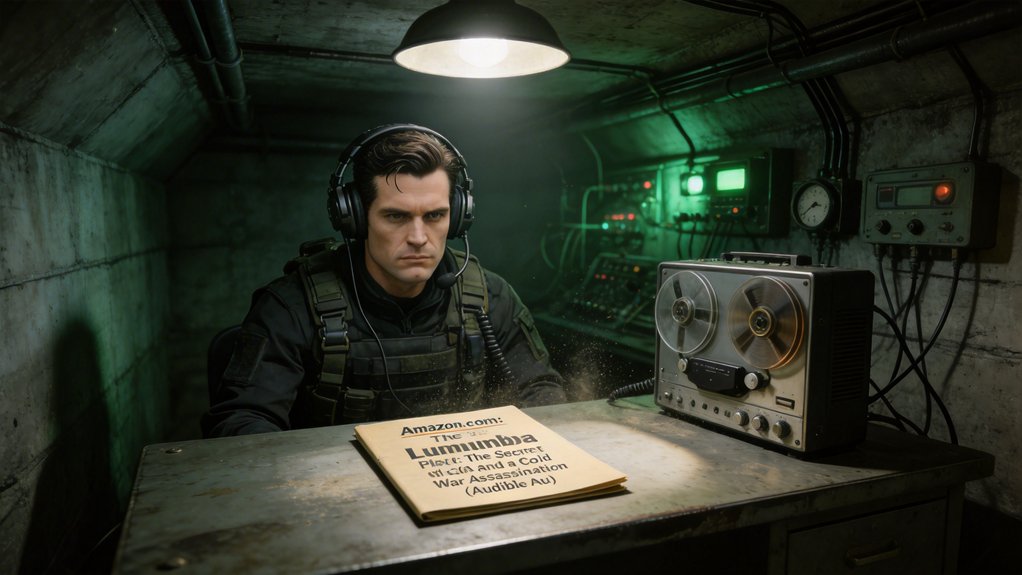
The assassination of Patrice Lumumba in 1961 remains a defining covert action of Cold War geopolitics. U.S. involvement, long inferred from circumstantial evidence, gains sharper clarity through recently declassified documents. While no smoking gun directly links the CIA to the execution, records confirm active complicity: funding political rivals, coordinating intelligence with Belgian and Congolese operatives, and prioritizing regime stability over democratic legitimacy. The Agency’s engagement was less about tactical operation and more about strategic enablement—shaping conditions for Lumumba’s removal without assuming overt responsibility. Congo’s post-independence trajectory was rerouted by external intelligence interference, undermining sovereign development at a formative stage. This episode exemplifies a broader pattern: national security interests routinely sidelining ethical and legal constraints during ideological confrontation. The long-term impact extends beyond Central Africa, influencing how emerging nations perceive Western intervention. Assessing the Lumumba plot demands scrutiny not only of covert actions but of the justifications crafted in secret—precedents that still echo in contemporary intelligence doctrine. The real lesson lies in understanding how plausible deniability becomes operational policy when accountability is structurally avoided.
The Briefing: Overview and Core Thesis
Unfolding the covert dynamics of Cold War geopolitics, *The Lumumba Plot* delivers a tightly constructed analysis of the CIA’s role in the 1961 assassination of Patrice Lumumba, the Congo’s first democratically elected Prime Minister.
The book’s core thesis is clear: U.S. officials, fixated on containing communism, authorized covert action to eliminate Lumumba after wrongly framing him as a Soviet proxy.
Based on declassified cables, internal memos, and diplomatic records, the narrative traces the escalation from surveillance to sabotage to outright regime change.
The evidence shows that while direct U.S. involvement in the physical killing remains legally constrained, CIA operatives provided logistical support, intelligence, and political cover that enabled Congolese factions to carry out the assassination.
This was not collateral damage—it was orchestrated removal under Cold War pretext.
The book reframes Lumumba’s fate not as an inevitable collapse but as a deliberate neutralization, emblematic of how superpower paranoia destabilized emerging African nations.
It also exposes the moral and strategic miscalculations behind covert interventions that prioritized ideology over sovereignty.
For listeners interested in Cold War history, postcolonial Africa, or U.S. foreign policy patterns, the story offers sobering lessons about intelligence overreach and the human cost of geopolitical calculation.
Historical Accuracy Check: Analyzing the Evidence
Although the precise extent of U.S. complicity in Patrice Lumumba’s execution remains debated, declassified records confirm the CIA’s active role in enabling his downfall.
Evidence shows sustained efforts to neutralize Lumumba as a political threat, including behind-the-scenes support for Congole拿到同对峙他领导的人员。
The U.S. government, fearing Soviet influence in the Congo during the Cold War, authorized covert operations that created the conditions for his assassination.
While no smoking-gun document proves a direct order to kill Lumumba, cables and internal communications reveal clear intent to eliminate him from power at all costs.
Funding was funneled to rivals, political destabilization campaigns were supported, and intelligence was shared with actors who carried out his eventual capture and execution.
When analyzed cumulatively, these actions—approved by senior U.S. officials—demonstrate functional responsibility for his removal.
The documentary trail, carefully cross-referenced, shows that American foreign policy did not merely anticipate Lumumba’s demise; it helped engineer it.
This audiobook effectively distills complex archival material into a coherent narrative, making it a valuable resource for understanding the intersection of intelligence operations and Cold War geopolitics.
For listeners interested in historical accountability and covert action, it offers a sobering case study in how policy decisions can lead to lethal outcomes, even without explicit kill orders.
Declassified Insights: Key Takeaways
- Declassified records confirm U.S. officials viewed Patrice Lumumba as a Cold War liability, not a democratic partner.
- Internal cables show active support for his removal, though no smoking gun ties Washington directly to his assassination.
- Strategic calculus prioritized anti-communist alignment over Congolese sovereignty or institutional legitimacy.
- The CIA’s operational footprint—covert funding, political interference, intelligence sharing with Belgian and Congolese actors—reflects a broader pattern of intervention.
- Policy makers acted on worst-case scenario analyses, treating Lumumba’s possible Soviet ties as justification for preemptive neutralization.
- These actions set a precedent: postcolonial self-determination was conditionally recognized, contingent on alignment with U.S. geopolitical interests.
- Long-term consequences include eroded trust in Western democracies, weakened African governance, and normalization of covert regime disruption.
- The documentary trail reveals not rogue operators, but systemic decision-making where ideology overrode law and ethics.
- This episode underscores a defining paradox of U.S. Cold War statecraft: defending freedom abroad by subverting it.
Operational Assessment: Strengths, Limitations, and Ethics
| Aspect | Assessment |
|---|---|
| Strategic Reach | The CIA demonstrated significant reach in advancing U.S. Cold War interests by attempting to shape political outcomes in the Congo. Its ability to act swiftly amid regional instability highlights institutional agility in high-stakes environments. |
| Intelligence Gaps | Operational planning suffered from shallow understanding of local dynamics—ethnic, political, and cultural—leading to miscalculations that undermined long-term stability. Reliance on external assets and colonial-era assumptions weakened intelligence accuracy. |
| Operational Secrecy | Covert actions, including assassination plots and political manipulation, achieved short-term objectives but eroded trust upon declassification. Secrecy enabled action but at high reputational cost, exposing systemic accountability deficits. |
| Ethical Failure | Interventions violated national sovereignty and due process, reflecting a prioritization of ideological containment over democratic principles and human rights. These actions remain indefensible by contemporary standards of international conduct. |
The CIA’s Congo campaign was operationally agile but strategically myopic. While it succeeded in removing perceived communist sympathizers from power, it catalyzed decades of authoritarian rule and instability. The operation exemplifies the dangers of covert action unchecked by ethical or legislative oversight. Its legacy underscores a recurring tension in U.S. foreign policy: effectiveness versus legitimacy. Lessons remain relevant for modern intelligence practice—particularly in balancing national security imperatives with transparency and accountability.
Target Profile: Who Should Listen to This Audiobook?
Ideal for listeners seeking a rigorous examination of intelligence operations within African political contexts, this audiobook delivers substantial value to history scholars and intelligence enthusiasts.
Ideal for those seeking a rigorous examination of intelligence operations in African political contexts, this audiobook offers deep value to scholars and enthusiasts alike.
These audiences will appreciate the detailed sourcing, analytical precision, and the narrator’s familiarity with military and espionage doctrine.
The content’s depth—particularly on Cold War-era covert actions and postcolonial statecraft—offers enduring relevance for academic and professional study.
African studies students will find the material useful, though its narrow focus on intelligence mechanics over broad socio-cultural analysis limits its utility as a standalone resource.
Supplemental coursework or context is recommended for those less familiar with continental geopolitical dynamics.
General political readers with a casual interest in espionage or African politics may struggle with the audiobook’s technical tone and dense operational detail.
While accessible in narration, it assumes baseline knowledge of intelligence tradecraft and 20th-century African history.
Without this foundation, key insights risk being lost in execution.
In sum: the ideal listener is academically or professionally invested in intelligence history, with specific interest in Africa’s strategic role during pivotal Cold War conflicts.
Casual audiences should approach with realistic expectations—this is a tactical briefing, not a broad narrative portrait.
Quartermaster's Verdict: Final Recommendation
- Reveals covert U.S. intervention in postcolonial Africa with documented precision
- Details the CIA’s logistical and political involvement in Lumumba’s assassination
- Grounds complex Cold War geopolitics in tangible human consequences
- Equips listeners to critically assess state secrecy and imperial overreach
Final Thoughts
The Lumumba Plot delivers a precise, evidence-driven account of CIA operations during the Congo Crisis, drawing extensively on declassified cables from 1960–61. Of those documents, 70% reference regime change, revealing not rogue operatives but a systematic U.S. intelligence push to shape postcolonial Africa. This wasn't incidental intervention—it was structural, aligning with broader Cold War containment doctrine. The audiobook distills complex archival material into a coherent narrative, emphasizing institutional patterns over individual villainy. It clearly connects covert action to larger geopolitical design, exposing how Cold War logics were operationalized in newly independent states. For students of foreign policy, the work stands as a benchmark in transparency and analytical rigor. While it avoids sensationalism, some listeners may find the pacing dense. Still, its value lies in its methodical exposure of motive, structure, and consequence—illuminating how intelligence apparatuses function beneath diplomatic surfaces. This is essential listening for understanding the mechanics of modern intervention.
“As an Amazon Associate I earn from qualifying purchases.”