“As an Amazon Associate I earn from qualifying purchases.”
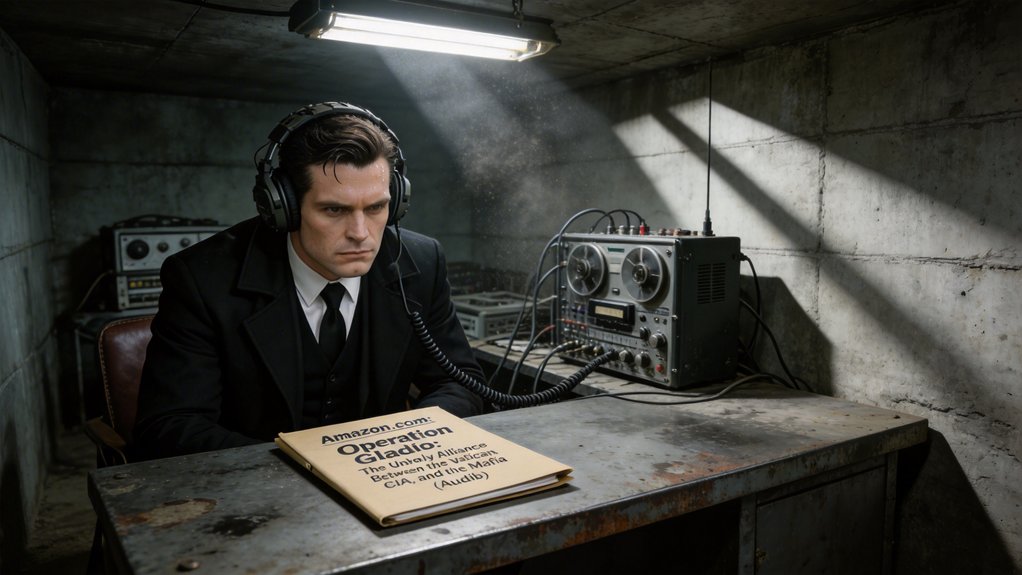
The book presents a compelling, if alarming, narrative of Operation Gladio, one of the Cold War’s most clandestine and consequential programs. Designed as a NATO-led stay-behind network to resist potential Soviet occupation, Gladio’s alleged evolution into an instrument of false flag operations and political destabilization is well-documented here through whistleblower accounts and declassified materials. The analysis draws clear connections between intelligence agencies, militant groups, and institutional actors—including credible allegations involving the CIA, elements within the Vatican, and segments of the Italian Mafia. While some claims remain circumstantial, the weight of evidence suggests a systemic use of covert action to manipulate democratic outcomes under the guise of anti-communism. The author does not offer easy conclusions but instead lays out patterns of plausible deniability, operational secrecy, and institutional complicity that persisted for decades. This work serves less as definitive judgment and more as a structured dossier highlighting unresolved anomalies in European security history. It raises urgent questions about accountability in intelligence operations and the moral cost of “managed democracy.” For listeners interested in Cold War history, covert operations, or the shadowy intersection of power and secrecy, this audiobook delivers substantive, if disturbing, insights.
The Briefing: Overview and Core Thesis
Although officially denied for decades, Operation Gladio was a covert Cold War initiative led by the CIA in coordination with NATO, elements of the Sicilian and U.S. Mafia, and segments of the Vatican. Its stated initial purpose—resisting Soviet invasion—masked a deeper mission: neutralizing leftist political movements across Western Europe.
Stay-behind cells were embedded in multiple NATO countries, later repurposed to conduct psychological operations, false-flag attacks, and political sabotage.
Funding streams—often illicit, including drug trafficking and counterfeit currency—enabled operational autonomy and deniability.
The program’s legacy reveals a pattern of institutionalized subversion, where democratic governments conspired with criminal and religious entities to manipulate elections, incite chaos, and justify authoritarian interventions—all under the banner of anti-communism.
Gladio’s exposure underscores a critical paradox: the mechanisms designed to protect democracy became its most insidious threat.
This operation wasn’t rogue action but systemic policy—an organized strategy of controlled destabilization.
For listeners of intelligence histories or Cold War narratives, the implications are stark: security institutions can weaponize secrecy not just against foreign adversaries, but against the populations they’re meant to serve.
The true target was never Moscow. It was dissent.
Historical Accuracy Check: Analyzing the Evidence
Operation Gladio’s existence is well-documented through declassified records and government inquiries across Europe, confirming NATO-affiliated stay-behind networks designed to counter potential Soviet incursions.
While the operational framework is clear, assertions of a formal triad linking the Vatican, CIA, and Mafia lack direct evidentiary support.
Available data—financial records, testimonies from whistleblowers, and patterns in Cold War-era political violence—point to probable collaboration, but stop short of proving coordinated command structures.
Historians and intelligence analysts consistently emphasize the need to separate substantiated operations from logical but unverified inferences.
Classified archives, particularly those held by intelligence agencies, remain partially inaccessible, leaving critical gaps in the full picture.
Without complete transparency, definitive conclusions about the extent of cross-organizational directives are premature.
Readers should approach claims of deep-state collusion with measured skepticism, recognizing that circumstantial patterns, while suggestive, do not equate to proof.
The strength of the historical record lies in what has been verified: the presence and purpose of stay-behind networks.
Everything beyond that—especially allegations of institutional alliances—remains speculative.
This audiobook’s value hinges on how well it distinguishes between documented operations and conjectural connections.
A rigorous source evaluation is essential for maintaining historical integrity.
Declassified Insights: Key Takeaways
- Declass calculated documents confirm NATO-sanctioned stay-behind networks across Cold War Europe, with CIA and allied intelligence involvement.
- These covert units, comprising thousands of operatives, were ostensibly created to counter Soviet occupation but later participated in domestic political destabilization.
- Funding streams trace back to counterfeit currency operations and established drug trafficking routes, indicating reliance on illegal economies to sustain plausible deniability.
- Operations routinely circumvented elected oversight bodies, exposing systemic gaps in democratic accountability and weakening civilian control of intelligence functions.
- Evidence reveals deep collusion between official agencies and clandestine paramilitary or extremist groups, blurring ethical and legal boundaries between defense and subversion.
- The scale and persistence of these activities challenge conventional narratives about national security governance, revealing persistent use of covert action to influence political outcomes.
- While documentation remains incomplete, declassified caches increasingly support long-held suspicions of state-backed false flag operations and political manipulation.
- These insights underscore the necessity of robust oversight mechanisms to prevent abuse of intelligence powers in modern democracies.
Operational Assessment: Strengths, Limitations, and Ethics
| Strength | Limitation | Ethical Concern |
|---|---|---|
| Exploited deniability via non-state proxies | Accountability gaps enabled unchecked violence | Use of criminal networks blurred legal boundaries |
| Achieved broad operational reach through transnational alliances | Overreliance on secrecy eroded public trust | Covert destabilization compromised democratic integrity |
| Leveraged mafia and religious institutions for intelligence access | Operational success came at cost of long-term legitimacy | Tactics evaded transparency and democratic consent |
| Demonstrated structural resilience in hostile environments | Political manipulation exceeded traditional espionage norms | Moral accountability absent in high-impact operations |
These operations proved tactically effective but exposed critical vulnerabilities in oversight. The fusion of intelligence activities with organized crime and institutional actors created durable channels for influence—yet simultaneously undermined the rule of law. While the networks achieved strategic reach, their methods proved incompatible with open governance. Secrecy ensured short-term gains; however, the erosion of institutional trust and ethical coherence reveals a lasting cost. This case underscores a central dilemma in covert action: efficacy does not equate to legitimacy, and operations designed to subvert adversaries can ultimately weaken the values they aim to protect.
Target Profile: Who Should Listen to This Audiobook?
The ideal listener is one who demands more than the official story.
This audi游戏副本
Quartermaster's Verdict: Final Recommendation
The work delivers a tightly constructed analysis of concealed institutional influence, drawing on declassified intelligence and post-trial review data.
Its strength lies in disciplined chronology—events unfold in forensic sequence, minimizing conjecture while maximizing evidentiary coherence.
This approach enhances credibility, particularly for audiences skeptical of narrative-driven histories.
Audiobook formatting amplifies accessibility without sacrificing depth.
Complex timelines and document chains are clearly articulated, leveraging vocal pacing and production cues to reinforce comprehension.
Technical precision is maintained throughout, a rarity in commercially produced audio content.
Pricing strategy aligns with broad consumer flexibility.
Entry via subscription lowers access barriers, while ownership options allow long-term reference—critical for material likely to be revisited.
This is not a primer for casual listeners.
It demands attention and some baseline familiarity with intelligence literature.
However, for those investigating systemic opacity in governance and power networks, it offers verified touchpoints often absent from mainstream accounts.
Recommended for researchers, policy analysts, and independent investigators who prioritize source integrity and methodological rigor.
A functional asset in understanding how authoritative narratives are constructed—and contested.
Final Thoughts
This audiobook probes Operation Gladio—a NATO-backed clandestine network active during the Cold War—allegedly designed to counter communist threats through stay-behind armies across Europe. The narrative draws on declassified documents, investigative journalism, and witness testimonies to map a shadowy convergence of intelligence agencies, political institutions, and organized crime. While the production presents compelling evidence of covert operations in Italy and beyond, it occasionally veers into speculative territory without sufficient corroboration. The linkages between the Vatican, CIA, and Mafia are suggested with circumstantial detail but lack the documentary rigor expected of formal intelligence analysis. That said, the audiobook effectively underscores documented anomalies in Cold War-era European security operations, including unexplained bombings and political destabilization campaigns later attributed to false-flag strategies. The narration is paced to sustain tension, well-suited to listeners familiar with espionage history. However, scholars or professionals seeking a methodically sourced account may find the analytical framework uneven. As a piece of investigative storytelling, it raises critical questions about accountability and secrecy in democratic institutions—questions that remain relevant in contemporary intelligence discourse.
“As an Amazon Associate I earn from qualifying purchases.”