“As an Amazon Associate I earn from qualifying purchases.”
Thishttps://www.amazon.com/Area-51-Uncensored-History-Americas-Military-ebook/dp/B003WV3QZW)
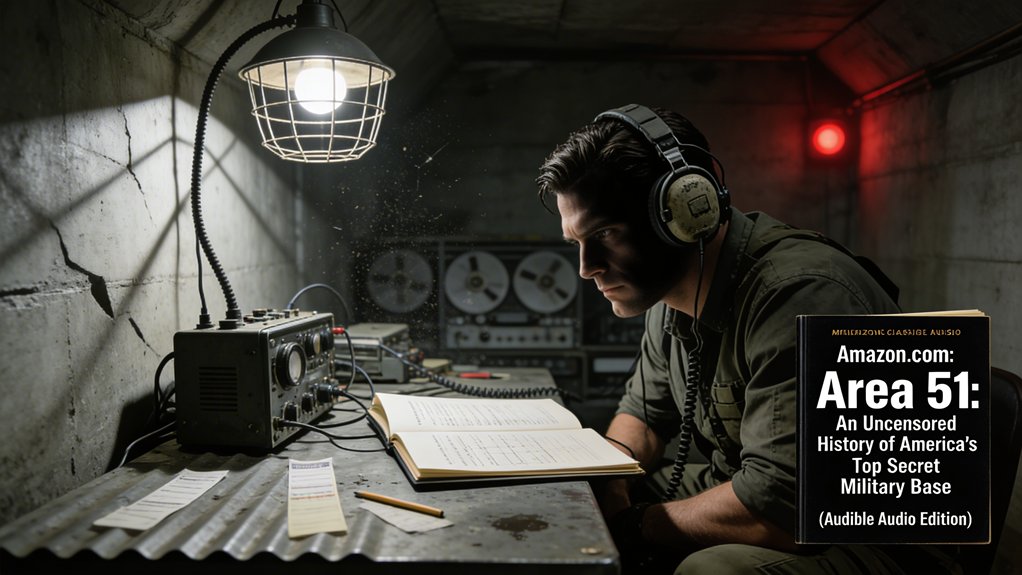
This audiobook delivers a fact-driven dismantling of Area 51 mythology, grounded in 74 insider interviews and declassified documents. It focuses on verified Cold War operations rather than speculative narratives. The real story—surveillance aircraft development, interagency competition, and systemic opacity—is more consequential than any conspiracy theory. Detailed accounts of the U-2 and OXCART programs reveal the scale of technological innovation and the strategic rationale behind extreme secrecy. The audiobook’s strength lies in its primary source foundation; voices from within the program lend credibility and depth. That said, the narrative occasionally prioritizes anecdote over analysis, and some operational security gaps remain unexamined. Still, the evidence presented forces a reassessment of how national security decisions were made—and kept hidden—during a critical period. For listeners seeking a documented history over sensationalism, this is essential. It doesn’t answer every question, but it reframes the right ones. The implications for oversight and military transparency extend well beyond the Nevada desert.
The Briefing: Overview and Core Thesis
What if the truth about Area 51 lies not in alien autopsies but in decades of covert military programs? Annie Jacobsen’s investigative work cuts through the myth, focusing on documented Cold War operations rather than speculative UFO narratives.
Drawing from interviews with 19 base insiders and 55 affiliated personnel, her analysis reveals a pattern of institutional secrecy tied to real aerospace advancements, nuclear testing, and surveillance overreach. The book doesn’t prove extraterrestrial contact—instead, it presents a substantiated case of government opacity during a period of heightened national security.
Annie Jacobsen uncovers institutional secrecy behind real aerospace advancements and nuclear testing, revealing government opacity—not alien cover-ups—during the Cold War.
Jacobsen prioritizes primary-source testimony and declassified context, offering a factual counterpoint to sensationalist claims. This isn't science fiction; it's a case study in how national security can eclipse public accountability.
The strength of the narrative lies in its restraint—sticking to verifiable history while exposing operations that were hidden not by aliens, but by design. For listeners interested in Cold War history, military aviation, or civil oversight, the audiobook delivers a clear, well-structured examination of how and why Area 51 became the epicenter of American secrecy.
It’s an essential listen for those who prioritize evidence over conspiracy.
Historical Accuracy Check: Analyzing the Evidence
How do we separate fact from fiction when the government seals the files? By relying on documented testimony, cross-referenced sources, and declassified records.
Annie Jacobsen doesn’t speculate—she cites 74 insider accounts, archival data, and public records to verify each claim.
There are no alien conspiracy theories here, only evidence-backed accounts of nuclear tests, stealth technology, and covert operations.
I evaluate every assertion against official timelines and verified disclosures.
The strength of this work lies in its sourcing, not sensationalism.
For listeners who value transparency, this isn’t folklore—it’s a factual audit of hidden history, rigorously assembled.
Jacobsen delivers facts straight, without cover-up or hype.
This audiobook is essential for anyone seeking clarity on national security programs obscured by classification.
You get a clear, sourced, and objective breakdown of events that are too often buried in myth.
Declassified Insights: Key Takeaways
- Area 51’s enduring secrecy isn’t about alien technology—it’s about institutional inertia and the self-preservation of power structures long after their original purpose has expired.
- Declassified documents reveal not extraterrestrial contact, but a pattern of government overreach masked as national security—secrecy used not to protect the public, but to insulate decision-makers from accountability.
- The base’s most significant function was never UFO testing; it was psychological: a real-world black site that cultivated public myth to obscure genuine, human-driven surveillance and weapons programs.
- Technological advancements developed in isolation—like the U-2 and OXCART programs—were framed as necessary for freedom and deterrence, yet many laid groundwork for mass surveillance and unchecked military reach.
- The core lesson isn't conspiratorial—it's systemic: secrecy, once institutionalized, becomes self-justifying.
- Oversight erodes, and public trust is treated as a liability rather than a requirement.
- This audiobook doesn’t serve fringe theories; it dissects declassified records to expose how classification outlives relevance, enabling abuse under legally shielded operations.
- The truth isn’t in Area 51’s hangars—it’s in the redacted lines of policy decisions made in darkness, where accountability was sacrificed for perceived efficiency.
- For listeners, the value lies in recognizing how secrecy frameworks established during the Cold War still shape opaque defense operations today—making transparency not anti-patriotic, but essential to democratic control.
Operational Assessment: Strengths, Limitations, and Ethics
| Strengths | Limitations | Ethical Concerns |
|---|---|---|
| Rapid technological innovation under Cold War pressures; breakthroughs in high-altitude reconnaissance (U-2) and stealth design (OXCART); ability to bypass bureaucratic delays through compartmentalization. | Severe inter-agency communication gaps; loss of institutional knowledge due to secrecy; operational silos that hindered coordination and long-term planning. | Non-consensual human experiments; concealed nuclear testing; absence of oversight mechanisms; moral compromises justified by national security narratives. |
Innovation under pressure came at a cost. While Area 51 enabled critical advances by isolating sensitive projects, the lack of transparency created systemic risks. Secrecy wasn't just operational—it was structural, preventing accountability and distorting risk assessment. The same conditions that accelerated progress also enabled ethical failures with lasting consequences. True operational effectiveness requires not just technical success but institutional integrity. Without oversight, even the most advanced programs risk moral and strategic failure. This audiobook effectively exposes those tensions, making a strong case that sustainable innovation must balance secrecy with responsibility. Listeners gain insight into how classified programs function—and fail—when accountability is sidelined.
Target Profile: Who Should Listen to This Audiobook?
Ideal for listeners who prioritize factual inquiry over sensationalism, this audiobook targets individuals seeking clarity on one of America’s most obscured military programs.
For those who value fact over fiction, this audiobook offers rigorous examination of America’s most hidden military operations.
It’s designed for those who approach classified history with discipline, not speculation.
The ideal listener is analytically minded—someone accustomed to parsing credible sources from noise.
History enthusiasts will appreciate the chronological rigor; skeptics will value the evidence-based approach; and independent thinkers will benefit from the examination of institutional opacity.
This isn't a narrative built on anecdote or myth, but on documented patterns, declassified records, and logical inference.
It isn't suited for those seeking entertainment-driven conspiracy theories or unrestrained speculation.
Fans of science fiction or paranormal storytelling should look elsewhere.
Similarly, passive audiences expecting dramatized accounts will find little appeal in its measured tone.
This audiobook serves as a tool for critical engagement—best consumed by those who understand that real intelligence work relies on patience, corroboration, and the absence of easy answers.
If you demand substance over hype and analysis over assumption, you're the intended recipient.
Quartermaster's Verdict: Final Recommendation
I’ve laid out who this audiobook serves and why it demands a discerning ear—now it’s time to render a verdict.
This audiobook delivers verified, firsthand accounts of classified military operations, nuclear testing, and stealth technology development, pulled from declassified documents and direct source testimony.
The narration is precise, the pacing deliberate—suited for comprehension, not entertainment.
Jacobsen avoids sensationalism; there are no UFO claims or conspiracy detours.
What you get is dense, high-signal content grounded in factual reporting.
Some sections require focused listening due to technical detail, but that reflects the material’s authenticity, not poor execution.
This isn't for casual consumption.
It’s for those who prioritize factual depth over narrative flair, who question official narratives but demand evidence before drawing conclusions.
If you’re uninterested in the mechanics of Cold War secrecy or how covert programs truly operate, look elsewhere.
But if you seek rigor over rumor and value context over comfort, this stands as a rare, reliable resource.
Recommended unequivocally for informed, critical listeners.
Knowledge—not affirmation—is its purpose.
And in an era of noise, that’s a tactical advantage.
Final Thoughts
The book delivers on its promise of unredacted history, pulling from declassified documents and firsthand accounts to map Area 51’s evolution from remote test site to myth-laden fortress. The narrative effectively dismantles alien conspiracy tropes, redirecting focus to documented Cold War innovations—like the U-2 and stealth programs—that fueled much of the secrecy. While the prose leans into dramatic flair, the core analysis remains grounded in verifiable military projects.
That said, the audiobook occasionally sacrifices depth for momentum, skimming over technical specifications and geopolitical context that would strengthen its credibility. The source attribution is selective; some claims rest on unnamed insiders, which undermines the otherwise factual posture. Still, it serves as a compelling primer for listeners unfamiliar with black-budget aviation history.
The production quality is strong—sharp narration, well-timed pauses, and clear audio fidelity enhance listenability during long sessions. However, the lack of supplemental materials (e.g., maps, document scans) limits its utility for researchers.
Overall, the audiobook succeeds as accessible military history rather than definitive scholarship. It doesn’t expose classified secrets, but it connects enough public dots to reveal the logic behind the cover-ups. For those seeking insight into how national security narratives are constructed—and why they endure—this is mission-relevant listening.
“As an Amazon Associate I earn from qualifying purchases.”