
“As an Amazon Associate I earn from qualifying purchases.”
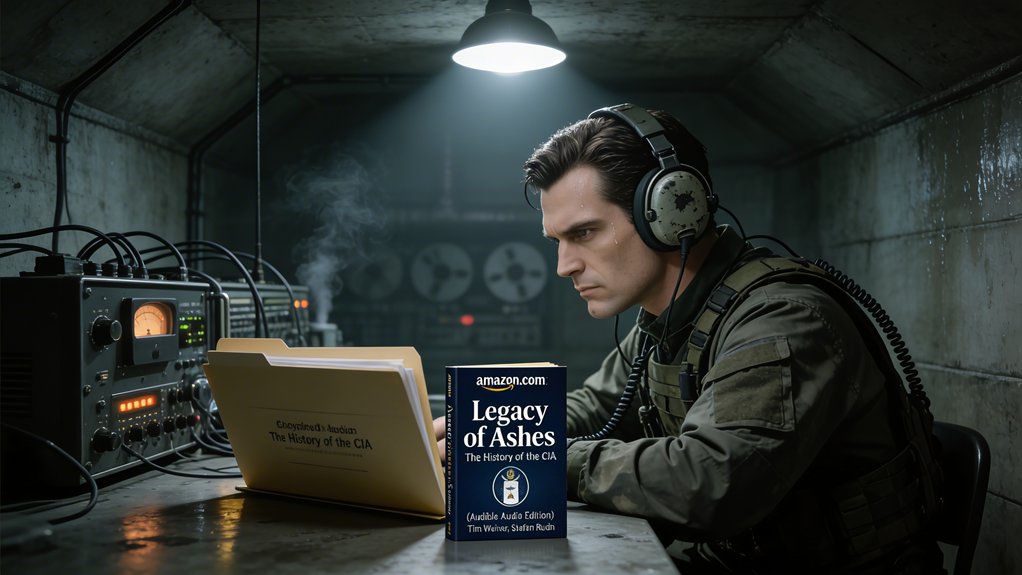
A meticulously researched exposé, *Legacy of Ashes* leverages declassified documents to reconstruct the CIA’s institutional trajectory from World War II to the War on Terror. Weiner, a Pulitzer Prize–winning journalist, avoids sensationalism, instead offering a methodically structured chronicle of operational failures, strategic miscalculations, and systemic overreach. The narrative reveals a pattern: repeated interventions based on flawed intelligence, weak oversight, and bureaucratic inertia—often with far-reaching geopolitical consequences. What emerges is not an agency of omniscient spycraft, but one hamstrung by internal dysfunction and political pressure. The audiobook’s narration by Stefan Rudnicki complements the tone—measured, authoritative, and unflinching—enhancing the gravity of the material without dramatization. For listeners seeking an evidence-based critique rather than cloak-and-dagger mythmaking, this is essential. The work’s greatest value lies in its documentation of systemic vulnerabilities: blown operations, compromised assets, and failed coups that underscore the costs of intelligence failure. While the book's scope spans decades, its insights remain acutely relevant in an era of opaque surveillance and persistent covert action. Not a dissection of tactics, but a forensic review of institutional accountability. Recommended for policymakers, students of foreign policy, and any listener committed to understanding the real-world consequences of intelligence mismanagement.
The Briefing: Overview and Core Thesis
A sweeping indictment of institutional failure, *Legacy of Ashes* delivers a rigorously documented chronicle of the CIA from 1947 to the early 2000s. The central thesis is clear: the agency systematically failed at its primary mission—collecting accurate intelligence and providing objective analysis.
Instead, it became fixated on covert operations often rooted in ideological bias, political convenience, and operational hubris. Weiner demonstrates how a culture of secrecy, chronic mismanagement, and absence of accountability eroded effectiveness.
The CIA’s obsession with covert action—fueled by ideology, secrecy, and arrogance—systematically undermined its intelligence mission and accountability.
Time and again, the CIA produced flawed intelligence, suppressed dissenting analysis, and prioritized pleasing policymakers over truth-telling—leading to disastrous outcomes from Iran in 1953 to Iraq in 2003.
Drawing on declassified records and insider accounts, the book exposes how the agency’s actions routinely undermined both national security and democratic principles. This isn't a story of shadowy triumphs, but of self-inflicted failures with lasting consequences.
For listeners seeking an unvarnished audit of U.S. intelligence, the audiobook offers essential, sobering insights.
Historical Accuracy Check: Analyzing the Evidence
How solid is the ground beneath *Legacy of Ashes*? Weiner builds his case on declassified CIA documents, official archives, and firsthand accounts, providing a well-sourced examination of the Agency’s institutional failures. His footnotes meticulously trace claims to primary records, including internal audits and congressional reports, lending strong evidentiary support.
While interpretations of motive or leadership judgment may be contested, the core findings—chronic operational blunders, systemic intelligence failures, and recurring bureaucratic dysfunction—are substantiated by the record.
Some critics note omissions, particularly regarding Cold War context or technical collection successes, but these don't invalidate the book’s central thesis.
Weiner avoids sensationalism, instead presenting a methodical critique grounded in documentary proof. For listeners prioritizing factual rigor over narrative flair, the audiobook delivers a compelling, evidence-based account.
The foundation is factual, transparent, and analytically sound—valuable for anyone assessing the CIA’s historical performance on its documented merits.
Declassified Insights: Key Takeaways
- Institutional failures stem from arrogance, lack of oversight, and persistent misjudgment—patterns clearly documented in declassified records.
- The CIA consistently overestimates operational capabilities while underestimating adversaries, resulting in high-profile operational failures.
- Planning frequently dismisses contradictory intelligence, reinforcing flawed assumptions and generating self-fulfilling outcomes.
- Covert actions destabilize democratic governments, inflame anti-American sentiment, and rarely deliver measurable strategic value.
- Documented successes are isolated, short-lived, and often the result of luck rather than design.
- A culture resistant to reform, protective of inefficiency, and devoid of accountability perpetuates systemic flaws.
- These issues aren't exceptions—they are embedded in the institution’s structure and operational doctrine.
- Unchecked secrecy distorts mission integrity, impairs judgment, and threatens both national security and democratic oversight.
- Effective, independent oversight isn't bureaucratic overhead; it's a necessary safeguard against institutional failure.
Operational Assessment: Strengths, Limitations, and Ethics
| Strengths | Limitations | Ethical Risks |
|---|---|---|
| Global reach, vast resources, and capacity for precise intelligence collection | Chronic lack of oversight, cultural myopia, and operational overreach | Coups, assassinations, and covert actions that undercut democratic principles |
| Successes tied to disciplined tradecraft and accurate analysis | Failures often rooted in hubris, political pressure, and flawed assumptions | Repeated ethical breaches erode institutional legitimacy and public trust |
| Demonstrated capability to penetrate hostile networks | Long-term effectiveness undermined by reactive, rather than strategic, operations | Actions frequently contradict the freedoms the agency is mandated to defend |
Weiner’s account reveals a consistent pattern: when the CIA operates without accountability, mission integrity and moral standing both deteriorate. Operational success is not sustainable when divorced from oversight or ethical boundaries. A more restrained, transparent intelligence model—one focused on intelligence rather than intervention—aligns better with democratic values and long-term security. For students of intelligence, this is a critical lesson: capability without constraint often leads to strategic failure.
Target Profile: Who Should Listen to This Audiobook?
Who should listen? Informed citizens, policymakers, and students of history committed to transparency and accountability. This audiobook targets those who reject sanitized narratives and demand unfiltered analysis of the CIA’s institutional record.
It’s for listeners focused on civil liberties, governmental oversight, and the mechanics of covert power.
Academics and independent researchers will value its methodical dissection of systemic failures, while skeptics of national security orthodoxy will find its evidence-based approach essential.
The narration, deliberate and neutral, serves the material without dramatization—facts, not persuasion, drive the narrative.
This isn't for casual audiences seeking intrigue or espionage thriller tropes. It’s for those who understand that real intelligence work lies in pattern recognition, structural critique, and historical honesty.
If you believe democratic integrity depends on examining hard truths—even flawed or incomplete ones—this audiobook is a necessary listen.
Freedom isn’t sustained by myth, but by vigilance. This is intelligence work made audible.
Quartermaster's Verdict: Final Recommendation
The evidence presented in *Legacy of Ashes* forms a damning dossier on the CIA’s historical performance, substantiated by extensive documentation and investigative rigor. This audiobook doesn't traffic in polemics—it delivers a forensic examination of institutional dysfunction, marked by operational blunders, strategic miscalculations, and a persistent culture of concealment.
Stefan Rudnicki’s narration functions as a neutral intelligence briefing: controlled, precise, and devoid of embellishment, which enhances the material’s credibility. At 21 hours and 37 minutes, the runtime is substantial, but the density of insight justifies the investment.
The free Audible trial allows risk-free evaluation, a tactical advantage for discerning listeners. While the work offers no absolution for the agency, its value lies not in condemnation alone, but in its utility as a cautionary record.
For those prioritizing transparency, accountability, and historical clarity, this audiobook serves as both evidence file and civic resource. The conclusion is unambiguous: *Legacy of Ashes* is essential listening for any serious student of intelligence, foreign policy, or democratic oversight.
It informs with precision, warns by example, and ultimately empowers through knowledge.
Final Thoughts
The CIA was engineered for secrecy, but Tim Weiner reveals how that same secrecy became its operational flaw. *Legacy of Ashes* dismantles the myth of omniscience, exposing institutional failures rooted in politicized intelligence, flawed assumptions, and repeated overreach. Based on declassified documents and insider accounts, the book demonstrates that the agency often failed not from lack of data, but from a failure to interpret it objectively. Strategic blunders—from Iran in 1953 to the Bay of Pigs and beyond—were not anomalies but patterns, enabled by a culture resistant to accountability. While the narrative covers decades of covert action, its central critique remains timely: an intelligence agency insulated from oversight becomes a liability, not an asset. The audiobook, narrated with clinical precision by Stefan Rudnicki, enhances the gravitas of Weiner’s reporting. For listeners seeking an unvarnished look at the cost of clandestine power, this is essential listening. It doesn’t just recount failures—it traces the systemic roots of dysfunction, offering a cautionary blueprint for how intelligence should not be conducted. Most valuable for those interested in U.S. foreign policy, Cold War history, or national security governance, the work underscores a persistent dilemma: when truth is subordinate to agenda, the intelligence mission is compromised.
“As an Amazon Associate I earn from qualifying purchases.”